
10-Minute Delivery Model: Balancing Quick Commerce and Gig Worker Safety
In December 2025, over a lakh gig workers protested against 10-20 minute delivery models, highlighting severe safety and livelihood concerns. This article examines the government's intervention, state-level welfare laws, and the debate surrounding the rapid growth of quick commerce in India's employment landscape.
Introduction
Context & Background
Key Points
- •The Strike and Intervention: In December 2025, a nationwide strike by over one lakh gig workers led to direct intervention by the Union Labour Ministry. Quick commerce platforms subsequently agreed to remove advertisements promising 10-minute deliveries.
- •Psychological and Physical Safety: Removing time-bound ads aims to reset customer expectations and reduce the intense psychological strain on riders. The Labour Ministry warned that rigid 10-minute timelines create unsafe pressure, spiking accident risks.
- •Legislative Protection: The pushback aligns with the Code on Social Security (2020), which formally includes gig workers in welfare coverage. The e-SHRAM Portal (2021) further mainstreams them into national databases for insurance.
- •State Leadership: States are pioneering gig worker rights. Rajasthan introduced a landmark Act in 2023 mandating a welfare cess, while Karnataka proposed a Gig Workers’ Welfare Board in 2024.
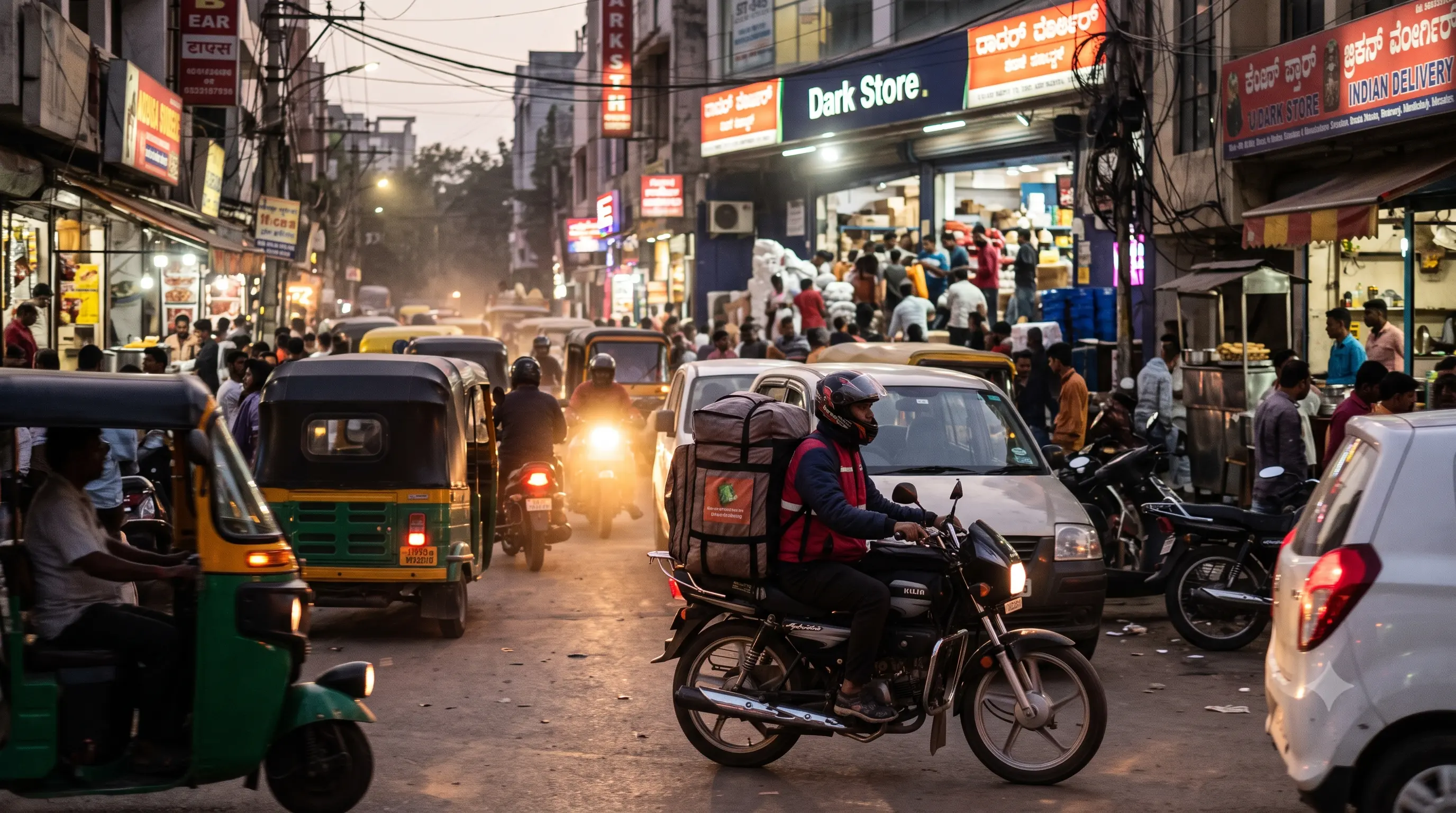
- •Operational Reality of Quick Commerce: Despite removing the 10-minute ads, actual delivery times may remain extremely fast due to the hyperlocal network of 'dark stores' placed in high-density areas.
- •The Employment Paradox: India adds 20 million workers annually but creates only ~2 million formal jobs. Quick commerce, projected to hit ₹1–1.5 lakh crore by 2027, fills this void but at the cost of labor exploitation.
Key Legal Frameworks and Initiatives for Gig Workers
| Initiative/Law | Level | Key Provisions | Bookmark |
|---|---|---|---|
| Code on Social Security (2020) | Central | Defines gig/platform workers; enables life, disability, accident, and maternity benefits. | |
| e-SHRAM Portal (2021) | Central | National database enabling portable social security and accident insurance. | |
| Draft National Framework on Gig Workers | Central (MoLE) | Proposes platform accountability, data sharing, and welfare financing. | |
| Rajasthan Gig Workers Act (2023) | State | Mandates aggregator registration and a welfare cess to fund social security. | |
| Karnataka Gig Workers Bill (2024) | State | Proposes a Welfare Board for insurance, pensions, and grievance redressal. |
Quick Commerce: Arguments For vs. Against
| Theme | Arguments Supporting the Model | Arguments Against the Model | Bookmark |
|---|---|---|---|
| Employment | Absorbs massive low-skilled labor; crucial fallback in a job-deficit market. | Treats labor as a 'shock absorber'; shifts competition costs onto vulnerable workers. | |
| Consumer Need | Demand-driven; 40-50% growth projected in online grocery. | False necessity; marginal difference between 10 vs 30 minutes, but huge stress increase. | |
| Safety | High density of 'dark stores' technically allows fast delivery without speeding. | Rigid algorithmic pressure increases severe accident risks (1.7 lakh+ annual road deaths). |
Related Entities
Impact & Significance
- •Employment Absorption: The rapid expansion of quick commerce provides an immediate income source for millions of low-skilled and semi-skilled youths entering the workforce.
- •Consumer Behavior Shift: The 10-minute model has fundamentally altered urban consumption patterns, accelerating the shift from traditional retail to digital platforms.
- •Policy Precedent: The direct intervention by the Union Labour Ministry against marketing 10-minute deliveries sets a massive precedent for regulating algorithmic management in tech platforms.
Challenges & Criticism
- •Worker Safety: The severe speed pressure is entirely borne by the delivery partners. In a country where road accident fatalities exceed 1.7 lakh annually (MoRTH), incentivizing rushing is highly dangerous.
- •False Necessity: Critics argue there is practically no consumer welfare difference between receiving groceries in 10 minutes versus 30 minutes, making the added risk to workers entirely unjustified.
- •Labor as a Shock Absorber: Tech platforms protect their fixed costs (marketing, technology) while using human labor as an adjustable variable, shifting the financial and physical costs of intense market competition onto the most vulnerable link.
Future Outlook
- •Operationalizing the Social Security Code: The immediate future requires moving the 2020 Code from paper to practice, ensuring platforms contribute to the proposed welfare funds.
- •Algorithmic Transparency: Regulators may need to step in to monitor how delivery algorithms penalize riders for delays, ensuring that speed is not incentivized at the cost of traffic safety.
- •National Adoption of Welfare Cess: The 'Rajasthan Model' of levying a cess on every platform transaction to fund gig worker welfare could become a national standard.
- •Sustainable Livelihoods: Quick commerce platforms must evolve from treating labor as expendable infrastructure to providing guaranteed minimum earnings and better grievance redressal mechanisms.
UPSC Relevance
- • GS-3 (Economy): Employment, growth of the digital/gig economy, and challenges of the unorganized sector.
- • GS-2 (Social Justice & Governance): Government policies and interventions for vulnerable sections; functioning of the Code on Social Security.
- • Essay Topics: 'The human cost of convenience in the digital age' or 'Demographic dividend or distress: The reality of India's gig economy'.
- • Mains Focus: Analyzing the conflict between rapid startup growth (Quick Commerce) and labor rights/safety.
Sample Questions
Prelims
With reference to the legislative framework for gig workers in India, consider the following statements: 1. The Code on Social Security (2020) provides a formal legal definition for gig and platform workers. 2. The e-SHRAM portal is exclusively designed for the registration of gig workers employed by quick commerce platforms. 3. Rajasthan is the first state in India to mandate a welfare cess on aggregator platforms to fund gig worker social security. Which of the statements given above is/are correct?
A) 1 and 2 only
B) 2 and 3 only
C) 1 and 3 only
D) 1, 2, and 3
Answer: Option C) 1 and 3 only
Explanation: Statement 1 is correct; the 2020 Code officially defines them. Statement 2 is incorrect; the e-SHRAM portal is a national database for *all* unorganised workers, not exclusively gig workers. Statement 3 is correct; the Rajasthan Platform-Based Gig Workers Act (2023) pioneered the welfare cess model.
Mains
“The gig economy addresses India’s acute job shortage but fundamentally treats labor as an expendable shock absorber.” Critically analyze this statement in the context of the recent protests against the 10-minute delivery model and outline the legislative measures taken to protect gig workers.
Introduction: Define the gig economy and introduce the December 2025 nationwide strikes against the 10-minute delivery model as a flashpoint for labor rights.
Body:
• The Dual Nature of Quick Commerce: Highlight the job creation aspect (fallback for millions in a job-deficit economy, growth from ₹50,000 crore to ₹1.5 lakh crore). Contrast this with the 'shock absorber' reality: intense speed pressure, accident risks, and shifting operational costs onto riders.
• The 10-Minute Debate: Discuss the concept of 'False Necessity'—the marginal consumer benefit versus the severe psychological/physical toll on riders, leading to the Labour Ministry's intervention to remove such ads.
• Legislative Measures: Detail the Code on Social Security (2020), e-SHRAM portal, and progressive state laws (Rajasthan's Welfare Cess Act of 2023 and Karnataka's 2024 Bill).
Conclusion: Conclude that while quick commerce is a vital employment engine, it must be balanced with algorithmic transparency and strict enforcement of social security codes to ensure dignified, sustainable work.