
ACC PLI Scheme Performance: Bottlenecks in India's Battery Manufacturing Push
The Advanced Chemistry Cell (ACC) Production Linked Incentive Scheme, launched to localise battery manufacturing in India, has fallen significantly short of its targets. With only 1.4 GWh commissioned against a 50 GWh goal by late 2025, the scheme faces challenges such as unrealistic timelines, raw material bottlenecks, and a massive skills deficit. This article outlines the current status, reasons for underperformance, implications, and the necessary reforms.
Introduction
Context & Background
Key Points
- •Unrealistic Timelines: A mandated two-year gestation period sharply contrasts with the global gigafactory setup norm of 4–6 years, creating major delays in capacity rollout.
- •Raw Material Bottlenecks: India processes less than 1% of the world's lithium and lacks necessary cobalt and nickel refining infrastructure, severely impeding the mandated Domestic Value Addition (DVA) targets.
- •Experience Gap: Since 100% of awarded capacity went to new entrants, established players like Exide and Amara Raja were excluded from the scheme, leading to steep learning curves.
- •Skill and Visa Issues: The battery cell manufacturing workforce remains nascent across 80% of planned projects. This is compounded by visa delays for crucial international technical specialists, stalling plant timelines.
- •Strategic Vulnerability: China controls over 75% of global battery manufacturing capacity, leaving India heavily reliant on imports and exposed to geopolitical and supply chain disruptions.
Current Performance Snapshot of ACC PLI Scheme
| Metric | Status | Bookmark |
|---|---|---|
| Targeted Capacity | 50 GWh by October 2025 | |
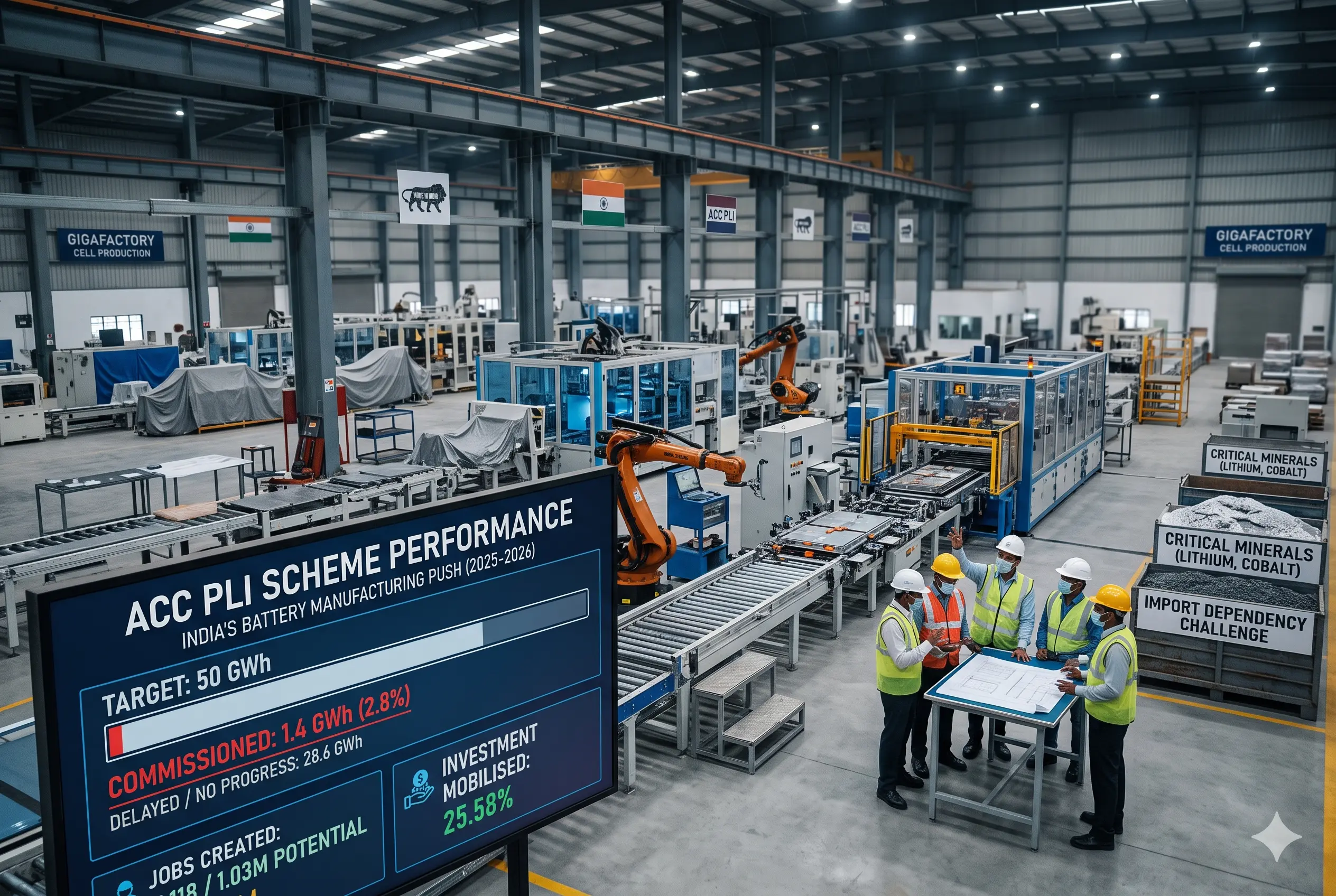
| Installed Capacity | 1.4 GWh (2.8% of target) | |
| Delayed Projects | 8.6 GWh under development; 20 GWh with no progress | |
| Jobs Created | 1,118 (against 1.03 million potential jobs) | |
| Investment Mobilised | 25.58% of target | |
| Incentives Released | ₹0 disbursed so far |
Key Features of the ACC PLI Scheme
| Feature | Description | Bookmark |
|---|---|---|
| Objective | Build domestic advanced battery ecosystem to cut imports and support EVs/renewable energy. | |
| Financial Outlay | ₹18,100 crore | |
| Incentive Design | Up to ₹2,000 per kWh for gigafactory investments. | |
| Technology-Agnostic | Open to lithium-ion, lithium iron phosphate, sodium-ion, etc. | |
| DVA Mandate | 25% domestic value addition within two years; 60% by fifth year. |
Related Entities
Impact & Significance
- •EV Affordability: With batteries constituting 35–45% of an EV's cost, the failure to localize production keeps electric vehicles expensive, hindering mass adoption.
- •Import Dependence: The stall in domestic manufacturing means India continues to import nearly 100% of its advanced battery cells.
- •Clean Energy Slowdown: A lack of adequate grid-scale storage capacity directly impedes the integration of renewable energy, risking India's 2030 green energy targets.
- •Geopolitical Vulnerability: Heavy reliance on imported cells exposes India to supply chain shocks, especially given China's dominance over 75% of global battery manufacturing.
Challenges & Criticism
- •Flawed Design Timelines: A mandated 2-year timeline ignores the realities of setting up gigafactories, which typically take 4-6 years globally.
- •Exclusion of Veterans: Awarding 100% of the capacity to new entrants while excluding established players created a severe experience gap.
- •Supply Chain Naivety: Setting high Domestic Value Addition (DVA) targets without first securing domestic refining capacity for critical minerals made compliance practically impossible.
- •Bureaucratic Hurdles: Delays in issuing visas for foreign technical experts have severely stalled the setup of complex manufacturing equipment.
Future Outlook
- •Timeline Realism: Commissioning periods must be extended to match global build cycles of 4-6 years, similar to the phased rollouts under the India Semiconductor Mission.
- •Mineral Security: Scaling domestic refining via the Critical Minerals Mission and forging overseas asset acquisition partnerships (e.g., KABIL's acquisition of lithium blocks in Argentina).
- •Experience Weightage: Revise the PLI bidding mechanism to factor in and reward proven manufacturing track records, utilizing hybrid eligibility models used in the electronics PLI.
- •Technology Transfer: Facilitate fast-track visas for technical experts and encourage joint ventures and licensing agreements with global battery leaders.
- •Demand Linkage: Integrate the ACC PLI with EV subsidies like PM E-Drive and renewable energy storage tenders to guarantee market offtake.
UPSC Relevance
- • GS-3 (Indian Economy): Industrial policy, manufacturing sector, and the effectiveness of PLI schemes.
- • GS-3 (Environment/Infrastructure): Energy transition, renewable energy storage (500 GW non-fossil target by 2030), and electric vehicle ecosystem.
- • GS-2 (International Relations): Supply chain resilience, strategic vulnerabilities, and geopolitical reliance on China for critical minerals.
- • Mains Focus: Analyzing bottlenecks in domestic manufacturing and suggesting policy corrections for green technology initiatives.
Sample Questions
Prelims
Consider the following statements regarding the Advanced Chemistry Cell (ACC) PLI Scheme:
1. The ACC PLI Scheme strictly mandates the use of only lithium-ion chemistry for battery manufacturing.
2. Beneficiary firms are required to achieve 100% Domestic Value Addition (DVA) within the first two years.
3. The scheme provides performance-linked subsidies to incentivize the setup of gigafactories for advanced battery ecosystems.
Answer: Option 3
Explanation: Statement 1 is incorrect; the scheme is technology-agnostic and supports various chemistries including lithium iron phosphate and sodium-ion. Statement 2 is incorrect; the DVA mandate requires 25% within two years and 60% by the fifth year. Statement 3 is correct.
Mains
Despite a massive financial outlay, the Advanced Chemistry Cell (ACC) PLI Scheme has significantly underperformed its initial targets. Analyze the key bottlenecks hindering the localization of battery manufacturing in India and suggest a strategic way forward.
Introduction: Briefly introduce the ACC PLI Scheme (₹18,100 crore outlay, 50 GWh target) and state its current underperformance (only 1.4 GWh commissioned by late 2025).
Body:
• Bottlenecks: Highlight unrealistic gestation periods (2 years vs. global 4-6 years), raw material scarcity (India refines <1% lithium), exclusion of experienced players, and skill/visa deficits.
• Implications: Discuss high EV costs (batteries are 35-45% of vehicle cost), nearly 100% import dependence, slower clean energy integration, and strategic vulnerability to Chinese supply chains.
• Strategic Way Forward: Suggest timeline extensions (like the Semiconductor Mission), enhancing mineral security via KABIL, modifying bidding to include experienced players, fast-tracking tech transfer, and integrating demand (PM E-Drive).
Conclusion: Conclude that an adaptive policy approach, aligning manufacturing timelines with global realities and securing raw material supply chains, is essential for India's self-reliance and green transition.