
Aerospace Manufacturing in India
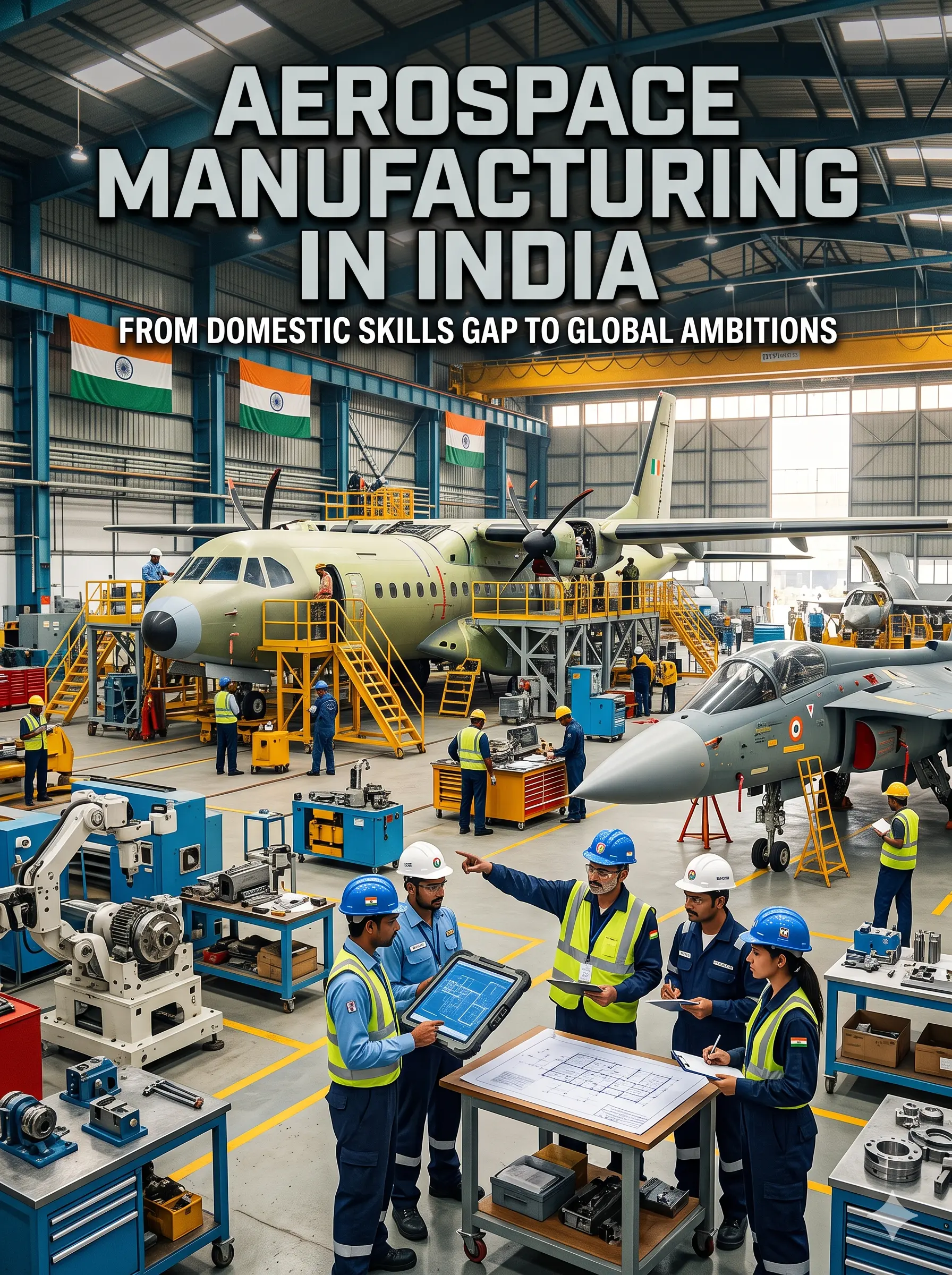
Despite record growth and strategic opportunities, a significant engineering skills gap could hinder India’s aerospace manufacturing ambitions. This article explores India's market landscape, government initiatives, and the multifaceted challenges in building a robust aerospace manufacturing ecosystem.
Introduction
Context & Background
Key Points
- •Market Potential: India is the world’s third-largest aviation market, requiring ~3,300 new aircraft by 2044, with component manufacturing expected to reach $21.5 billion by 2030.
- •MRO Growth: The Maintenance, Repair, and Overhaul (MRO) sector is projected to hit $4 billion by 2031, supported by a GST reduction from 18% to 5%.
- •Private Sector Milestone: The Tata-Airbus consortium in Vadodara marks India’s first private Final Assembly Line (FAL) for C-295 aircraft.
- •Indigenisation Push: The Ministry of Defence's five Positive Indigenisation Lists embargo imports on over 5,000 items to secure a domestic market.
- •FDI & Digital Support: 74% FDI is allowed under the automatic route, and the SRIJAN portal aids private industries in reverse-engineering imported parts.
India's Aerospace Manufacturing Landscape
| Segment / Indicator | Current Status & Projections | Bookmark |
|---|---|---|
| Market Position | World's third-largest aviation market; ~3,300 new aircraft needed by 2044. | |
| Component Manufacturing | Expected to reach $21.5 billion by 2030. | |
| MRO Sector | Projected to be a $4 billion industry by 2031, transitioning to a domestic hub. | |
| Private Assembly | Tata-Airbus consortium established India's first private FAL in Vadodara (40 C-295 aircraft). |
Key Government Initiatives
| Initiative / Policy | Objective / Description | Bookmark |
|---|---|---|
| Indigenisation Lists | Five Positive Indigenisation Lists by MoD embargoing >5,000 imported items. | |
| Infrastructure Support | Defence Industrial Corridors in UP and TN offering subsidised land and plug-and-play infra. | |
| Fiscal Incentives | GST rate on MRO services reduced from 18% to 5% to boost global competitiveness. | |
| Investment Policy | Up to 74% FDI permitted in defence manufacturing under the automatic route. | |
| SRIJAN Portal | Digital interface listing previously imported aviation items for reverse engineering. |
Related Entities
Impact & Significance
- •Strategic Autonomy: Reducing reliance on foreign OEMs for critical defence and commercial aerospace components.
- •Economic Growth: Capturing a larger share of the $21.5 billion component manufacturing market and the $4 billion MRO industry.
- •Technological Upgradation: Fostering 'know-why' technologies and transitioning MSMEs up the value chain through advanced manufacturing.
- •Employment Generation: Creating high-skilled, high-paying jobs in specialized fields like avionics, composite materials, and precision machining.
Challenges & Criticism
- •Material Dependency: India imports more than 70% of its aerospace-grade raw materials, creating a critical supply chain vulnerability.
- •Regulatory Hurdles: The slow, multi-year process of obtaining airworthiness certification severely strains the cash flow of smaller startups.
- •Skills Deficit: There is a severe shortage of niche skills (avionics, composite materials, precision machining) required to meet zero-error aerospace standards.
- •Infrastructure Gaps: Private players lack access to affordable testing facilities, such as wind tunnels, often forcing them to send components abroad for validation.
- •Ecosystem Maturity: The domestic ecosystem lacks a dense network of specialized Tier-2/3 MSMEs capable of the high-precision machining required for aviation parts.
Future Outlook
- •Curriculum Reform: Co-creating engineering curricula with industry bodies like SIATI to mandate shop-floor internships and AS9100 quality standard certification.
- •Production Clusters: Establishing integrated manufacturing hubs that consolidate design, testing, and production at a single location to reduce logistics costs.
- •Technology Upgrade: Expanding the Credit-Linked Capital Subsidy Scheme (CLCSS) to enable aerospace MSMEs to acquire advanced, complex machines.
- •Leverage Offsets: Strictly enforcing foreign OEM offset obligations to secure the transfer of critical 'know-why' technologies, such as single-crystal blade casting.
- •Coordinate Innovation: Creating a National Defence Technology and Innovation Framework linking DRDO, academia, and private industry to prevent R&D duplication.
UPSC Relevance
- • GS-3 (Indian Economy): Changes in industrial policy, manufacturing sector growth, and their effects on industrial growth.
- • GS-3 (Science & Tech / Security): Indigenization of technology and developing new technology in defence.
- • Essay Topics: 'Self-reliance in Defence: A Strategic Imperative', 'The Future of Manufacturing in India'.
- • Mains Focus: Analyzing bottlenecks in the MSME ecosystem, skill deficits, and evaluating the success of Defence Industrial Corridors.
Sample Questions
Prelims
Consider the following statements regarding India's Aerospace and Defence Manufacturing sector:
1. The GST rate on Maintenance, Repair, and Overhaul (MRO) services was recently increased to 18% to boost tax revenues.
2. Under the automatic route, up to 74% Foreign Direct Investment (FDI) is currently permitted in defence manufacturing.
3. The SRIJAN portal is exclusively designed for foreign OEMs to bid on Indian defence contracts.
Answer: Option 2
Explanation: Statement 1 is incorrect; GST on MRO was reduced from 18% to 5%. Statement 2 is correct. Statement 3 is incorrect; the SRIJAN portal lists imported items to help domestic private industries with reverse engineering.
Mains
Analyze the potential and challenges of India's aerospace manufacturing sector. What policy measures are required to make India a global aerospace hub?
Introduction: Highlight India's rising aviation demand and recent indigenization efforts (Positive Indigenisation Lists, Defence Corridors).
Body:
• Potential: 3rd largest aviation market; $21.5B component market by 2030; $4B MRO sector; establishment of private FALs (Tata-Airbus).
• Challenges: Heavy import dependency for raw materials (70%); regulatory bottlenecks in certification; severe shortage of niche engineering skills; lack of testing infrastructure (wind tunnels).
• Policy Measures: Creating integrated production clusters; curriculum reform for AS9100 certification; expanding CLCSS for MSMEs; enforcing OEM offset obligations for tech transfer.
Conclusion: Conclude that building a domestic aerospace ecosystem is vital for strategic autonomy and economic growth, echoing the ethos that 'building wings at home ensures India soars globally.'