
African Union Summit 2026: An Opportunity for Renewal Amidst Crises
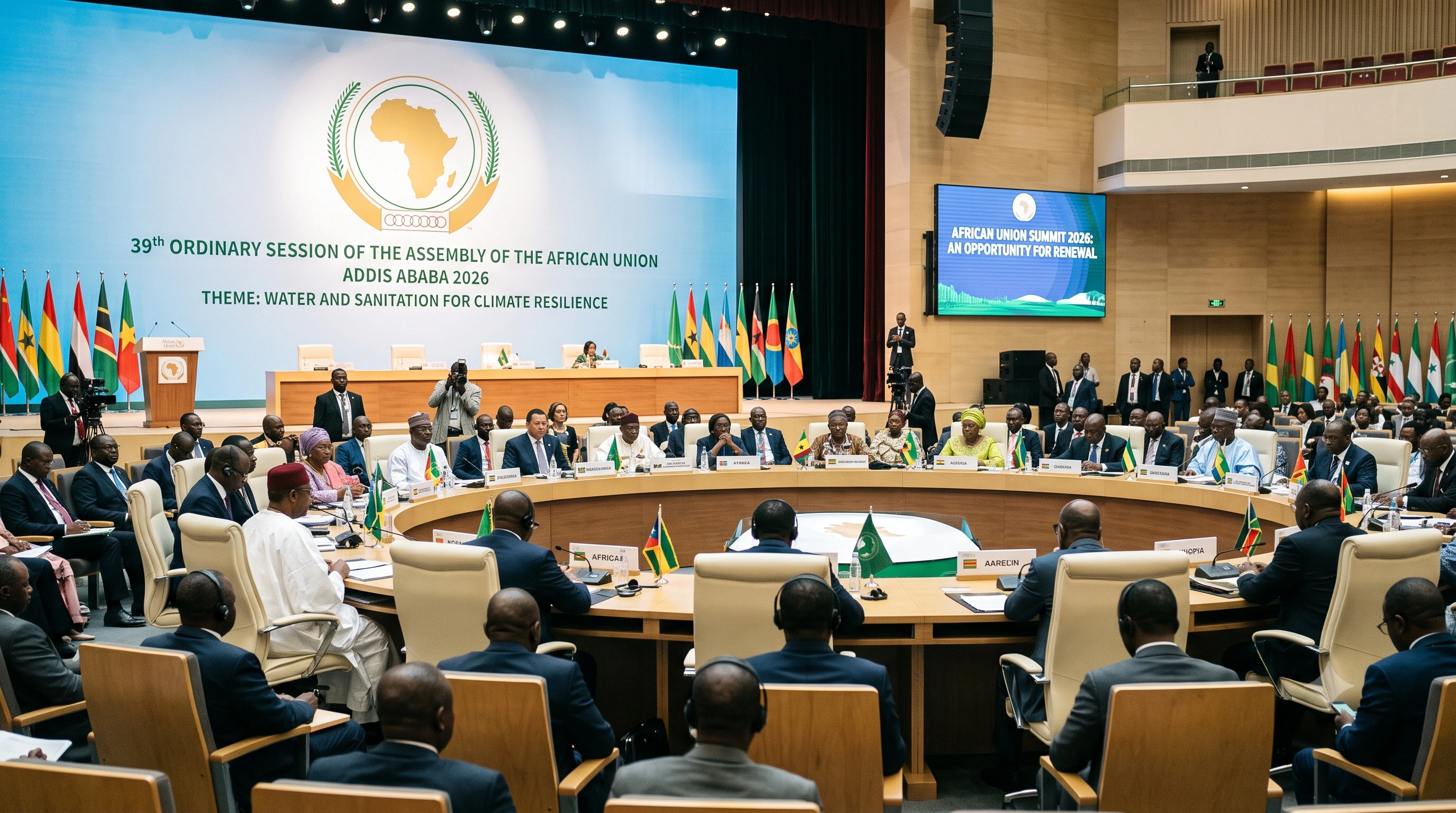
The 39th Summit of the African Union (AU) in Addis Ababa brings together 55 African nations. Centered on water, sanitation, and climate resilience, the summit highlights the AU's struggle with democratic backsliding, economic strain, and the pressing need for institutional reforms to reclaim its legitimacy.
Introduction
Context & Background
Key Points
- •Core Objectives: The AU aims to promote unity and solidarity among African states, defend sovereignty, and accelerate political and socio-economic integration across the continent.
- •The 2026 Theme: The 39th AU Summit focuses heavily on water and sanitation, alongside critical discussions on climate resilience, humanitarian crises, and global geopolitical shifts.
- •Democratic & Political Instability: Recent years have seen a surge in coups (Mali, Burkina Faso, Niger, Gabon) and democratic backsliding marked by opposition repression and contested elections.
- •Legitimacy Crisis: With over 400 million youth, there is widespread disillusionment. The AU is increasingly viewed by young citizens as a 'bloc of old leaders' focused more on protecting governments than representing the people.
- •Weak Enforcement: While the AU frequently passes resolutions and suspends coup-hit nations, member state compliance is low, and funding constraints severely weaken its enforcement capabilities.
- •Climate Justice Dilemma: Africa contributes minimally to global emissions but disproportionately suffers from climate impacts, including droughts and floods, necessitating stronger global climate finance advocacy.
About the African Union (AU)
| Attribute | Detail | Significance | Bookmark |
|---|---|---|---|
| Establishment | Founded in 2002 | Replaced the Organization of African Unity (OAU). | |
| Headquarters | Addis Ababa, Ethiopia | Central hub for AU administrative and political operations. | |
| Membership | 55 Member States | Encompasses all African countries. |
Key Initiatives & India-AU Relations
| Initiative/Partnership | Description | Bookmark |
|---|---|---|
| Agenda 2063 | Long-term development blueprint for Africa's socio-economic transformation. | |
| AfCFTA | African Continental Free Trade Area, the world’s largest free trade area by member count. | |
| G20 Membership | AU became a permanent member of the G20 in 2023 under India’s presidency. | |
| India-Africa Forum | Summit platform that continuously strengthens India–AU cooperation. |
Related Entities
Impact & Significance
- •Geopolitical Competition: As global powers vie for influence and resources in Africa, a unified AU is critical to negotiating fair trade and development partnerships.
- •Institutional Credibility: The 2026 Summit is a litmus test for the AU's ability to pivot from a reactive body to a proactive enforcer of democratic and constitutional norms.
- •Humanitarian & Climate Urgency: With intensifying droughts and floods, the AU's focus on water, sanitation, and climate resilience is existential for millions of displaced citizens.
- •Youth Dynamics: The rising tide of youth-led democratic movements indicates that failure to reform could lead to unprecedented civil unrest and further political fragmentation.
Challenges & Criticism
- •Democratic Backsliding: Elections across the continent are frequently marred by internet shutdowns, opposition repression, and disputed results, which the AU often fails to adequately penalize.
- •Political Instability: The AU's response to military coups is typically limited to suspending the affected nations, which has proven insufficient in deterring future unconstitutional power grabs.
- •Economic Hardship: High youth unemployment, mounting sovereign debt, and aid cuts from traditional Western partners threaten to derail the developmental goals of Agenda 2063.
- •Implementation Gap: While the AU excels at passing ambitious resolutions, member states routinely ignore them, and the organization lacks the financial autonomy to enforce compliance.
Future Outlook
- •Advancing Economic Integration: Accelerating the African Continental Free Trade Area (AfCFTA) is essential to boost intra-African trade, create jobs, and tackle soaring youth unemployment.
- •Reclaiming People-Centred Governance: The AU must shift from being leader-centric to citizen-driven, actively engaging with civil society and youth forums to restore institutional legitimacy.
- •Strengthening Electoral & Democratic Norms: Reforming election observation to be more transparent and instituting strict penalties for unconstitutional regime changes are needed to rebuild trust.
- •Reducing Aid Dependency: Amidst global aid cuts, the AU needs to emphasize domestic resource mobilization and regional financing mechanisms to ensure political and economic autonomy.
- •Climate and Water Security Leadership: Capitalizing on the 2026 summit's theme, the AU must push aggressively for climate adaptation funding and sustainable resource management frameworks.
UPSC Relevance
- • GS-2 (International Relations): Regional groupings and agreements involving India and/or affecting India's interests (India-AU cooperation, G20).
- • GS-2 (Governance): Important International institutions, agencies, and fora- their structure, mandate.
- • Mains Focus: Analyzing the effectiveness of the AU in maintaining democratic stability and tackling economic and climate challenges in the Global South.
Sample Questions
Prelims
Consider the following statements regarding the African Union (AU): 1. It was established in 2002, replacing the Organization of African Unity (OAU). 2. The African Continental Free Trade Area (AfCFTA) operates under the aegis of the AU. 3. The AU was granted permanent membership in the G20 during South Africa's presidency. Which of the statements given above is/are correct?
1 and 2 only
2 and 3 only
1 and 3 only
1, 2, and 3
Answer: Option 1 and 2 only
Explanation: Statement 1 is correct; the AU replaced the OAU in 2002. Statement 2 is correct; AfCFTA is a flagship project of the AU's Agenda 2063. Statement 3 is incorrect; the AU became a permanent member of the G20 in 2023 under India's presidency, not South Africa's.
Mains
Despite possessing ambitious frameworks like Agenda 2063, the African Union (AU) struggles with a 'legitimacy crisis' and weak enforcement. Critically analyze the contemporary challenges facing the AU and suggest how the 2026 Summit can act as a catalyst for institutional renewal.
Introduction: Define the African Union (AU), its mandate, and briefly mention the context of the 39th AU Summit in Addis Ababa focusing on water, sanitation, and climate resilience.
Body:
• Contemporary Challenges: Discuss political instability (coups in the Sahel), democratic backsliding, youth disillusionment, economic hardships, and the overarching problem of weak enforcement mechanisms.
• The Legitimacy Crisis: Explain the gap between the AU's leadership ('bloc of old leaders') and Africa's massive youth demographic.
• Opportunities for Renewal (2026 Summit): Highlight the need for AfCFTA acceleration, enforcing democratic norms/penalties, reducing aid dependency, and projecting a unified voice on climate justice.
Conclusion: Conclude that the AU must transition from a 'forum of leaders' to a 'platform for the people' to remain relevant in a fractured geopolitical world order.