
Strengthening AI Governance through a Techno-Legal Framework
The White Paper issued by the Office of the Principal Scientific Adviser (OPSA) in January 2026 advocates a shift from rigid, command-and-control regulation to a techno-legal approach for AI governance. This model integrates legal and ethical safeguards directly into the technical architecture of AI systems, aiming to balance rapid innovation with citizen protection across the AI lifecycle.
Introduction
Context & Background
Key Points
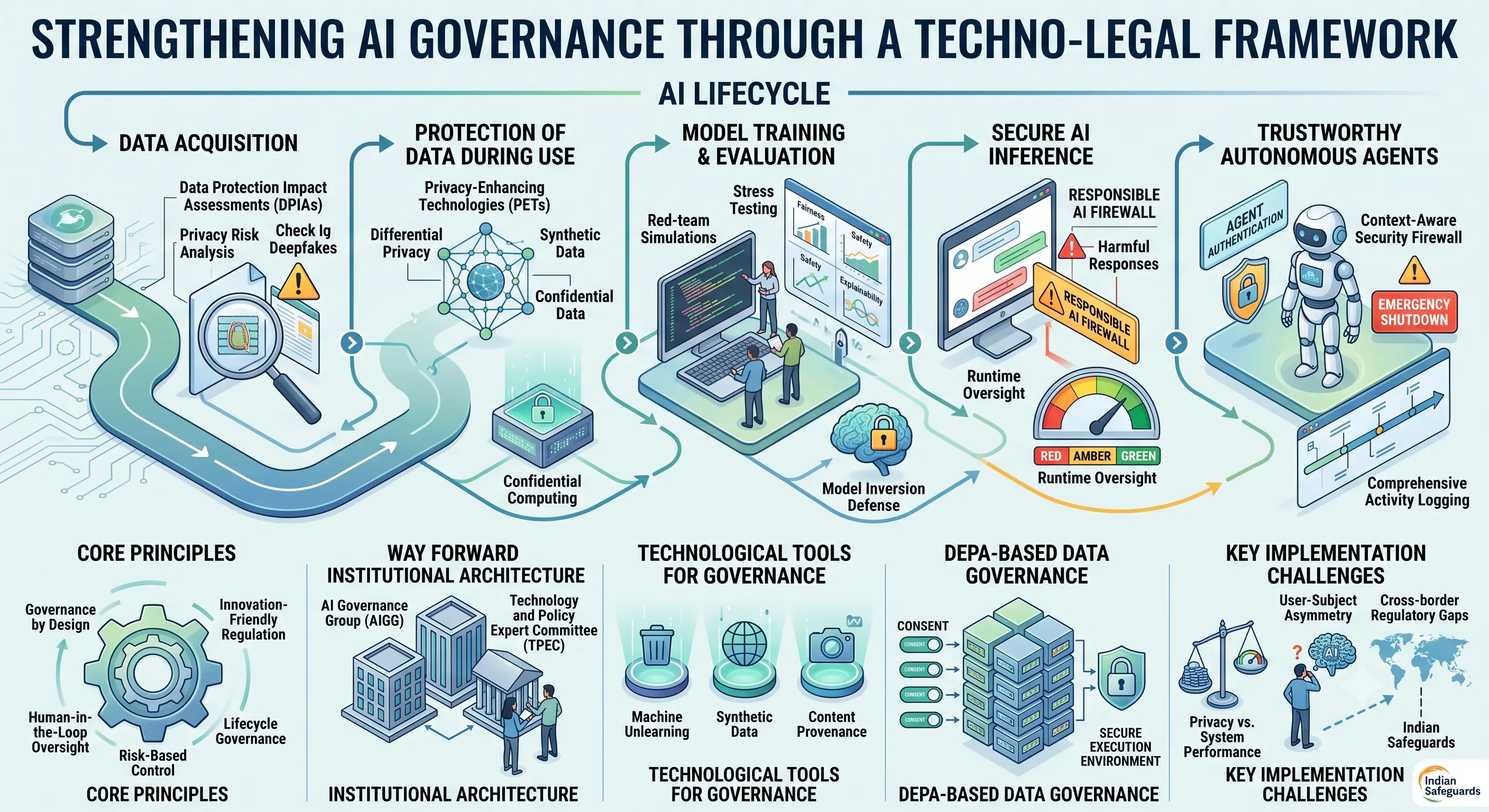
- •Governance by Design: Legal, ethical, and accountability requirements are integrated into AI systems at the development and design stage itself, rather than bolted on post-deployment.
- •Innovation-Friendly & Adaptive Regulation: Regulatory safeguards are deliberately structured to manage and mitigate risks without stifling technological advancement or economic competitiveness.
- •Risk-Based and Proportionate Control: Oversight mechanisms are strictly calibrated to the level of risk and potential harm associated with specific AI applications (e.g., high-risk vs. low-risk systems).
- •Human-in-the-Loop Oversight: Critical and high-stakes decisions remain subject to human review to reduce the risk of unchecked automated outcomes.
- •Lifecycle-Oriented Governance: Regulatory safeguards are applied comprehensively throughout the AI lifecycle, from initial data sourcing and model training to deployment and real-world inference.
- •DEPA-Based Data Governance: Leveraging the Data Empowerment and Protection Architecture (DEPA) to ensure consent-based data sharing and establish secure, trusted execution environments.
AI Lifecycle Phases and Techno-Legal Safeguards
| AI Lifecycle Phase | Major Risks Involved | Suggested Techno-Legal Safeguards | Bookmark |
|---|---|---|---|
| Data Acquisition | Breach of privacy, ingestion of harmful or deepfake material, infringement of IP rights, and biased data sampling | Conducting Data Protection Impact Assessments (DPIAs), verifying informed consent, and privacy risk analysis | |
| Protection of Data During Use | Illegal access, data poisoning attacks, and leakage of sensitive information to external entities | Deployment of Privacy-Enhancing Technologies (PETs), Differential Privacy, Synthetic Data, and Confidential Computing | |
| Model Training and Evaluation | Model inversion threats, unintended retention of personal data, and limited transparency or explainability | Red-team simulations, rigorous stress testing, and evaluation frameworks for privacy, safety, fairness, and explainability | |
| Secure AI Inference | Hallucinated outputs, prompt-based manipulation, and harmful responses during real-time deployment | Continuous runtime oversight, 'Responsible AI' firewalls, and risk-graded prompt classification (Red/Amber/Green) | |
| Trustworthy Autonomous Agents | Agents exceeding authorised boundaries, escalation of privileges, and weak audit trails | Strong agent authentication, context-aware security firewalls, emergency shutdown mechanisms, and activity logging |
Related Entities
Impact & Significance
- •Balancing Act: It provides a credible alternative to purely prescriptive global models (like the EU AI Act), offering a flexible, sector-aware structure that supports population-scale deployments.
- •Continuous Compliance: By transforming legal requirements into technical parameters (like privacy-enhancing technologies and automated logging), regulation becomes a continuous, auditable process.
- •Protection of Vulnerable Demographics: It mitigates risks like deepfakes and algorithmic bias, which disproportionately affect linguistically and culturally diverse populations.
- •Economic Competitiveness: A predictable, risk-calibrated governance environment boosts investor confidence and ensures Indian AI systems can be globally trusted and adopted.
Challenges & Criticism
- •Accuracy vs. Compliance Trade-offs: Implementing stringent privacy measures, such as large-scale data deletion or machine unlearning, can significantly degrade the predictive accuracy and efficiency of AI models.
- •User-Subject Asymmetry: In critical public sectors (welfare delivery, policing), citizens are often passive 'subjects' of AI decisions rather than active users, limiting their ability to appeal algorithmic outcomes.
- •Resource Burden on Startups: Smaller enterprises and startups may lack the financial and technical resources to operationalize complex 'compliance-by-design' controls.
- •Cross-Border Enforcement: Foreign-developed foundational models may not inherently comply with Indian ethical safeguards, creating a regulatory blind spot for imported technology.
Future Outlook
- •Institutional Architecture: Developing a coordinated, whole-of-government framework supported by dedicated bodies like the AI Governance Group (AIGG) for inter-ministerial coordination and the Technology and Policy Expert Committee (TPEC).
- •Technological Tools for Governance: Rapid deployment of emerging solutions such as Machine Unlearning to operationalize the right to erasure, Synthetic Data for privacy, and Content Provenance tools (watermarking/metadata) to detect deepfakes.
- •Integration with Digital Public Infrastructure (DPI): Anchoring AI governance to existing DPI systems, such as Aadhaar and UPI, to enable scalable, low-cost compliance.
- •Closing the Global Gap: Addressing the complexities of imported foundation models and cross-border regulatory gaps through international alignment.
UPSC Relevance
- • GS-2 (Governance): E-governance applications, models, successes, limitations, and potential; Government policies and interventions for development in various sectors.
- • GS-3 (Science and Technology): Developments and their applications and effects in everyday life; Awareness in the fields of IT, Space, Computers, and Robotics.
- • Essay Topics: 'Regulating the Unknown: The Future of AI Governance', 'Techno-Legal Frameworks: Bridging the Gap between Law and Innovation'.
- • Mains Focus: Analyzing the shift from rule-based to risk-based AI governance and evaluating the implementation challenges of the techno-legal framework.
Sample Questions
Prelims
With reference to the 'Techno-Legal Framework' for AI governance proposed by the Office of the Principal Scientific Adviser, consider the following statements: 1. It advocates for a strict 'command-and-control' regulatory regime to stifle unverified technological advancement. 2. It recommends 'Governance by design', integrating ethical requirements at the AI development stage itself. 3. It suggests integrating AI systems with Digital Public Infrastructure (DPI) like Aadhaar and UPI for better compliance. Which of the statements given above is/are correct?
1 and 2 only
2 and 3 only
1 and 3 only
1, 2, and 3
Answer: Option 1
Explanation: Statement 1 is incorrect; the framework explicitly moves away from rigid 'command-and-control' regulation in favor of innovation-friendly, adaptive, and risk-based control. Statements 2 and 3 are correct as it emphasizes 'Governance by design' and leverages DPI systems like Aadhaar and UPI for compliance.
Mains
“The rapid evolution of Artificial Intelligence necessitates a shift from traditional regulatory models to a techno-legal governance framework.” Discuss the core principles of the techno-legal approach proposed by the OPSA and highlight the challenges in its implementation.
Introduction: Define the techno-legal framework as the integration of legal, ethical, and accountability requirements directly into the design and technical architecture of AI systems. Mention the recent White Paper issued by the Office of the Principal Scientific Adviser (OPSA).
Body:
• Core Principles: Governance by design; Risk-based and proportionate control (avoiding one-size-fits-all rules); Human-in-the-loop oversight; Lifecycle-oriented governance covering data acquisition to real-world inference.
• Implementation Challenges: Tension between privacy mandates (like data deletion) and model accuracy; User-subject asymmetry in sectors like healthcare or policing; Cross-border regulatory gaps for foreign-trained models; The compliance burden on smaller enterprises.
Conclusion: Conclude by stating that while challenges exist, a robust institutional architecture (like AIGG and TPEC) combined with India's Digital Public Infrastructure (DPI) can successfully anchor this framework, making India a leader in responsible AI.