
AI in Robotics: Revolutionising Healthcare, Agriculture, and Industry in India
AI-driven robotics integrates machine learning, computer vision and natural language processing into machines, enabling adaptive, context-aware robots that are transforming healthcare, agriculture, logistics and manufacturing across India. The shift supports precision, efficiency, sustainability and inclusive growth when paired with skills training and ethical safeguards.
Introduction
Context & Background
Key Points
- •What is AI in Robotics? It is the integration of machine learning, computer vision, sensor fusion and natural language processing into robots so they can perceive, learn from data, plan actions and interact safely with humans.
- •Robots → from tools to partners: Traditional robots followed fixed programs. AI-powered robots adapt in real time — learning from examples, improving over time, and handling uncertainty (e.g., irregular crops, diverse patient anatomies).
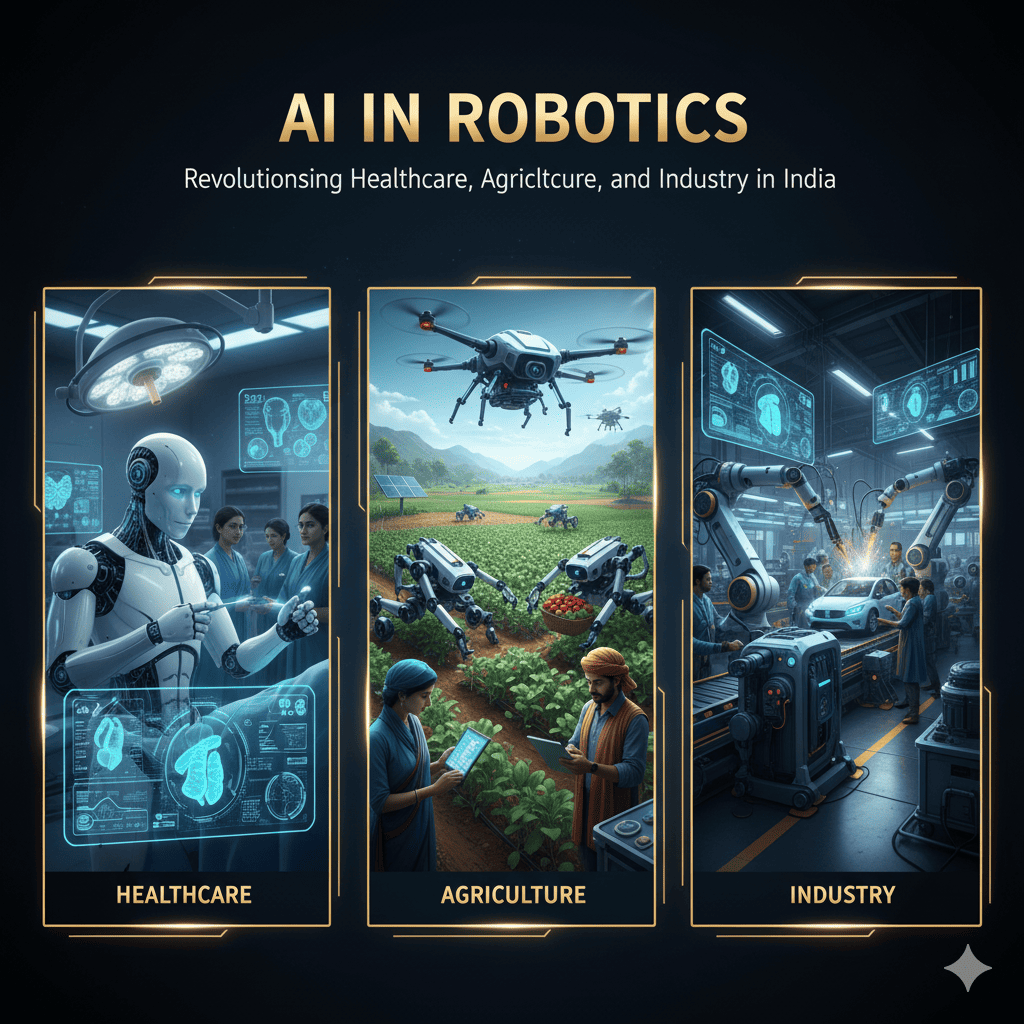
- •Healthcare — high-impact uses: Robotic-assisted surgery (microsurgery, orthopaedics), rehabilitation robots (adaptive exoskeletons), service robots (disinfection, medicine delivery), and tele-robotics for remote diagnostics. These improve precision, reduce infections, and expand specialist care to remote areas.
- •Agriculture — precision & productivity: AI drones and field robots monitor crop health, map soil nutrients, detect diseases early, and perform targeted spraying/harvesting — reducing chemical use and labour drudgery. Programs like Telangana’s Saagu Baagu show how agritech adoption increases yields and incomes.
- •Manufacturing — cobots & predictive maintenance: Cobots (collaborative robots) work alongside humans, handling repetitive, hazardous tasks while learning from human operators. Predictive maintenance uses sensor data and AI to foresee equipment failure, drastically cutting downtime and maintenance costs.
- •Logistics & e-commerce: Autonomous warehouse robots streamline picking, packing and sorting. AI routing optimises last-mile delivery, lowering costs and emissions. Indian firms like GreyOrange and Addverb show domestic capability.
- •Emerging AI trends in robotics: Conversational GenAI & voice interfaces (robots that talk naturally); Domain-specific LLMs (healthcare LLMs, agri-LLMs); AI agents for decision support; composite AI (multiple models cooperating); and sovereign AI stacks (BharatGPT, IndiCASA) ensuring data privacy and context relevance.
- •Sovereign AI & data security: India is pushing for localised AI datasets and models (e.g., IndiCASA) to reduce bias and protect citizen data — critical when healthcare or farm data is involved.
- •Affordable & accessible robotics: Open-source frameworks, no-code AI platforms, and shared testbeds are lowering barriers so MSMEs and rural entrepreneurs can adopt robotics solutions.
- •Human–robot collaboration: Robots are increasingly built for cooperation — safe sensors, force feedback and explainable AI let robots work with humans without replacing them.
- •Ethical & regulatory issues: Decisions by autonomous systems in healthcare or agro-chemical application raise questions about liability, consent, and transparency — requiring ethical frameworks and regulation.
- •Skill transformation: AI-robotics creates demand for new jobs — robot-maintenance technicians, data labelers, AI trainers — making reskilling critical to inclusive adoption.
- •Environmental footprint: While AI-robotics boosts efficiency, compute-hungry AI and battery-powered robots have an energy footprint; pairing them with renewables is essential.
- •Startups & indigenous innovation: India’s robotics startup ecosystem is vibrant — focusing on frugal engineering, local language interfaces, and solutions tuned to Indian contexts (uneven farms, crowded hospitals).
- •Cost vs value: Initial capital costs can be high, but ROI appears quickly in sectors like automated warehousing, precision spraying, and surgical efficiency. Financing and leasing models help smaller enterprises adopt tech.
- •Telepresence & remote operations: Robots with remote control and AI assistance enable specialists (surgeons, agronomists) to operate or advise remotely, bridging urban–rural divides.
- •AI agents & decision support: Robots increasingly serve as assistants — flagging anomalies, suggesting interventions, and automating routine tasks while humans make final decisions.
- •Composite AI lifecycle: Multiple AI modules (perception, planning, language) are stitched into lifecycle-based systems that update, learn and improve from field data.
- •Regulatory push & Make in India: Government incentives (R&D funding, testbeds, procurement preferences) encourage domestic manufacturing of robots and sensors.
- •Beginner analogy: If traditional industrial robots are like calculators (fast at fixed tasks), AI-robots are like smartphones — they can learn apps (tasks), connect to the internet (data), and get smarter with updates.
AI–Robotics Use Cases Across Key Sectors
| Sector | Applications | Beginner-Friendly Explanation | Bookmark |
|---|---|---|---|
| Healthcare | Robotic surgery, rehab robots, hospital service robots, telepresence robots | Robots help doctors perform precise surgeries, assist recovery, deliver medicines, and enable remote consultations. | |
| Agriculture | AI drones, soil robots, smart sprayers, automated harvesters | Robots monitor crop health, detect pests, and harvest crops — saving labour and reducing chemical use. | |
| Manufacturing | Cobots, automated assembly, predictive maintenance, quality control | Robots work with humans on factory floors, inspect products, and prevent machine breakdowns. | |
| Logistics & E-commerce | Warehouse automation, autonomous sorting, delivery bots | Robots help pick, pack, sort and deliver goods — making online shopping faster and cheaper. | |
| Public Services | Surveillance drones, disaster response robots | Robots assist in search-and-rescue, surveillance, and delivering supplies during emergencies. |
Emerging Trends in AI Robotics
| Trend | Description | Why It Matters | Bookmark |
|---|---|---|---|
| Conversational GenAI | Robots that understand speech and respond naturally | Makes robots easier to use for non-technical people, including farmers and elderly patients. | |
| Domain-Specific LLMs | AI trained for healthcare, agriculture, defence | Improves accuracy because the AI understands context-specific terminology and rules. | |
| AI Agents | Robots capable of decision-making and planning | Allows robots to handle complex, changing environments independently. | |
| Composite AI | Combines multiple AI systems (vision, speech, reasoning) | Improves reliability and real-world performance. | |
| Sovereign AI | Locally trained models like BharatGPT, IndiCASA | Protects data privacy and reduces dependence on foreign AI companies. |
Related Entities
Impact & Significance
- •Economic Growth: AI-driven robotics could add $500 billion to India’s GDP by 2030 through automation, precision operations, and reduced wastage.
- •Labour Productivity Boost: In agriculture, robots reduce manual drudgery; in manufacturing, they work 24×7 with consistent quality.
- •Healthcare Accessibility: Tele-robotic surgery and hospital automation can bring quality care to rural and remote regions.
- •Industrial Modernisation: Cobots and predictive AI improve efficiency, quality control, and reduce equipment failures.
- •Environmental Sustainability: Precision agriculture reduces chemical usage; factory automation cuts energy waste; smart logistics lowers emissions.
- •National Security: AI-enabled drones and autonomous systems improve border surveillance, disaster response, and strategic capabilities.
- •Inclusive Development: MSMEs gain access to affordable AI-powered tools, levelling the playing field with large industries.
Challenges & Criticism
- •Job Displacement Anxiety: Fear of robots replacing workers can slow adoption, even when tech is designed to augment human labour.
- •Data Security & Privacy: Healthcare robotics and farm analytics involve sensitive data. Weak cybersecurity can expose personal or business information.
- •Ethical & Legal Accountability: If an autonomous robot makes an error in surgery or chemical application, determining responsibility becomes complex.
- •High Initial Costs: Robotics hardware and high-compute AI systems require significant investment, challenging for MSMEs and small farms.
- •Skill Gaps: India lacks trained technicians, AI engineers, and robotics specialists — slowing deployment.
- •Infrastructure Requirements: Reliable electricity, fast connectivity, and sensor calibration ecosystems are still evolving.
- •AI Bias & Safety: Biased datasets can lead to unsafe decisions in healthcare or agriculture if not properly trained and tested.
Future Outlook
- •Promote human-centric robotics where robots assist, not replace, human workers — ensuring inclusive productivity gains.
- •Integrate AI–robotics education into schools, ITIs, engineering colleges, and workforce training programs.
- •Develop Robotics Parks and testbeds across states to accelerate R&D, prototyping, and industrial pilots.
- •Incentivise domestic manufacturing of sensors, actuators, chips, and robot platforms.
- •Set up a national Robotics Standards & Certification framework ensuring safety, reliability, and ethical use.
- •Promote affordable robotics for MSMEs through soft loans, leasing models, and public procurement.
- •Strengthen India’s sovereign AI ecosystem by developing India-centric datasets (agriculture, healthcare, languages).
UPSC Relevance
- • GS-3: Robotics, AI, Industry 4.0, Precision agriculture, Healthcare technology.
- • GS-2: Data governance, privacy, national AI policy.
- • GS-1: Impact on society, labour, employment patterns.
- • Essay: Technology & society, future of work, automation ethics.
Sample Questions
Prelims
With reference to AI-driven robotics in India, consider the following statements:
- (a)Collaborative robots (cobots) are designed to safely work alongside human workers.
- (b)Domain-specific LLMs help robots perform better by understanding sector-specific terminology.
- (c)Predictive maintenance in robotics refers to repairing machines only after they break down.
- (d)Saagu Baagu is an Indian initiative using AI tools in agriculture.
Mains
AI-driven robotics is transforming India’s healthcare, agriculture, and manufacturing sectors. Discuss how India can leverage this transformation for inclusive and sustainable development.
Introduction: AI and robotics together enable autonomous perception, decision-making, and precision actions. This is reshaping India’s economic and social landscape.
Body:
• Healthcare: Robotic surgeries, telepresence, rehab robots — improving precision and access.
• Agriculture: AI drones, soil robots, precision spraying — reducing chemical use and boosting productivity.
• Industry: Cobots, predictive maintenance, automated quality control — enhancing competitiveness.
• Inclusivity: Affordable robotics, MSME support, rural automation, skilling programmes.
• Sustainability: Energy-efficient robotics, reduced wastage, precision inputs in farming.
• Policy Pathways: R&D incentives, sovereign AI, standards, robotics parks, skill mission.
Conclusion: With the right policies, India can turn AI-robotics into a driver of inclusive, sustainable and globally competitive growth.