
Bank Frauds in India: Navigating the Surge in High-Value Cases Despite Falling Volumes
According to the RBI’s Report on Trend and Progress of Banking in India 2024-25, the banking sector is witnessing a paradoxical trend: while the overall number of fraud cases has declined, the monetary value involved has surged significantly. This article analyzes the drivers behind this shift, the impact of legacy loan reclassifications, and the strategic road ahead for Indian banking.
Introduction
Context & Background
Key Points
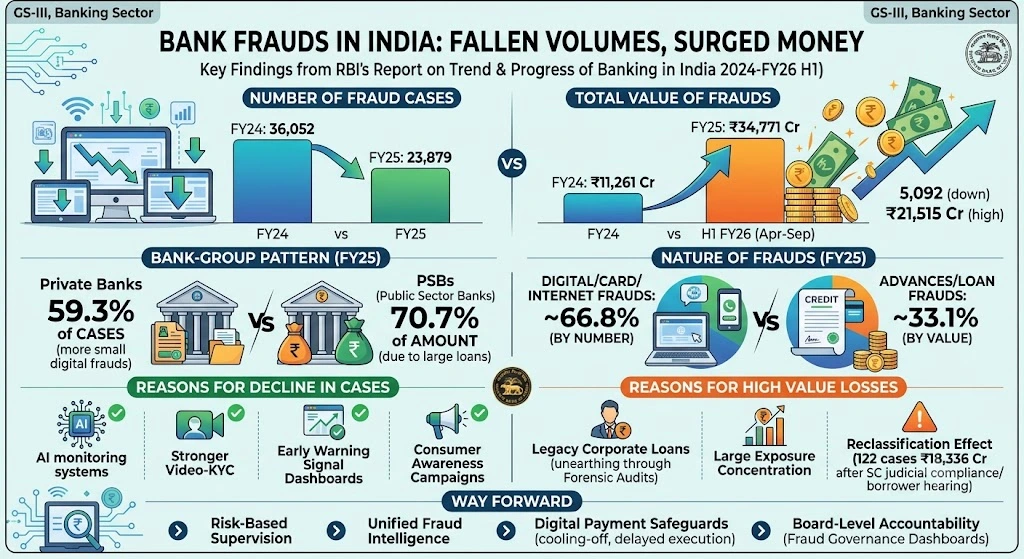
- •The Volume vs. Value Paradox: The RBI's Report on Trend and Progress of Banking in India 2024-25 reveals a sharp contrast. Fraud volumes have dropped (23,879 from 36,052), but the financial magnitude has nearly tripled to ₹34,771 crore.
- •The Supreme Court Reclassification Effect: A major driver for this value spike is the court-linked reclassification. 122 legacy cases worth ₹18,336 crore were re-reported in FY25 after complying with Supreme Court guidelines regarding borrower hearings and the principles of natural justice.
- •The H1 FY26 Trajectory: The trend continues into the first half of FY26 (April–September), where the number of cases dropped sharply to 5,092 (from 18,386), but the total amount involved stood high at ₹21,515 crore.
- •Sectoral Burden (Private vs. PSBs): There is a clear dichotomy in how bank groups experience fraud. Private Banks report the most cases (59.3%), largely driven by retail digital frauds, whereas Public Sector Banks (PSBs) bear the heaviest financial losses, accounting for 70.7% of the total fraud value due to large credit exposures.
- •Nature of the Frauds: Digital frauds (cards and internet) dominate the sheer volume of cases (66.8%), but loan/advances-related frauds are responsible for a third of the total financial loss (33.1%).
Key Findings: RBI Report on Bank Frauds (2024-25)
| Parameter | Data Metric | Insight | Bookmark |
|---|---|---|---|
| Total Fraud Cases (FY25) | 23,879 | Fell from 36,052 in the previous year. | |
| Total Value of Frauds (FY25) | ₹34,771 crore | Jumped significantly from ₹11,261 crore. | |
| H1 FY26 (Apr-Sep) Trend | 5,092 cases (₹21,515 crore) | Cases fell from 18,386, but value remains high. | |
| Digital/Card/Internet Frauds | 66.8% (by number) | High volume, lower ticket size. | |
| Advances (Loan) Frauds | 33.1% (by value) | Lower volume, massive ticket size. | |
| Private Sector Banks | 59.3% (by number of cases) | Higher susceptibility to high-volume digital/retail frauds. | |
| Public Sector Banks (PSBs) | 70.7% (by value of frauds) | Higher exposure to large corporate and legacy loan frauds. |
Reasons for Decline in the Number of Fraud Cases
| Intervention Area | Impact | Bookmark |
|---|---|---|
| Digital Transaction Controls | AI-based monitoring, velocity checks, and risk-based authentication have successfully thwarted small-value fraud attempts. | |
| Stronger KYC Framework | Mandatory re-KYC, Video KYC, and centralized records have drastically reduced impersonation and mule accounts. | |
| Early Warning Systems | Automated alerts and dashboards help freeze suspicious transactions faster. | |
| Consumer Awareness | Aggressive SMS alerts, fraud advisories, and cyber awareness campaigns have improved customer response times. |
Related Entities
Impact & Significance
- •Erosion of Asset Quality: High-value loan frauds directly degrade the asset quality of banks, forcing them to set aside higher provisions, which eats into their profitability.
- •Systemic Vulnerability: The concentration of high-value frauds in Public Sector Banks (PSBs) poses a systemic risk, as these institutions are the backbone of domestic credit flow and government socio-economic schemes.
- •Capital Misallocation: When thousands of crores are siphoned off through corporate fraud, it deprives legitimate businesses and vital infrastructure projects of much-needed credit.
- •Judicial & Regulatory Strain: The phenomenon of reclassifying older cases emphasizes the delayed discovery of frauds, highlighting a lag in the forensic and regulatory auditing processes that burdens both the banking regulators and the judiciary.
Challenges & Criticism
- •Legacy Loan Frauds: Large corporate and consortium loan frauds often surface only after extensive forensic audits, inflating the total financial loss decades after the initial loan was disbursed.
- •The Reclassification Effect: A major statistical challenge is that earlier under-reported or legally disputed frauds are frequently re-examined and reported afresh. This adds massive high-ticket amounts into a single financial year's data, skewing short-term trend analysis.
- •Advances Concentration: Credit-related frauds might be fewer in number compared to retail digital scams, but they involve massive, concentrated exposure sizes, meaning a single failure causes disproportionate damage.
Future Outlook
- •Risk-Based Supervision: Regulatory bodies and banks must intensify the scrutiny of large-value advances using dynamic risk scoring models, such as borrower risk heat-maps, to enable early supervisory intervention.
- •Unified Fraud Intelligence: There is a critical need to integrate fraud registries across banks and non-banking financial companies (NBFCs) for real-time red-flag sharing, akin to interoperable payment switch networks.
- •Digital Payment Safeguards: Implementing targeted safeguards for high-risk transactions, such as mandatory cooling-off periods and enhanced beneficiary verification for first-time high-value transfers.
- •Board-Level Accountability: Bank boards must take a proactive role by mandating periodic fraud-risk reviews with fixed response timelines, utilizing quarterly fraud governance dashboards.
UPSC Relevance
- • GS-3 (Indian Economy): Banking sector reforms, Non-Performing Assets (NPAs), financial stability, and mobilization of resources.
- • GS-2 (Governance): Role of regulatory bodies (RBI), transparency, and accountability in financial institutions.
- • Essay Topics: 'The digitalization of India's economy: Boon or Bane?', 'Corporate Governance in Indian Banking'.
- • Mains Focus: Analyzing the shift from retail digital frauds to high-ticket corporate loan frauds and suggesting regulatory reforms.
Sample Questions
Prelims
With reference to the trends in Bank Frauds in India (2024-25), consider the following statements: 1. Digital and internet-based frauds account for the highest share of the total monetary value lost to frauds. 2. Public Sector Banks (PSBs) account for a larger share of the total fraud amount compared to Private Sector Banks. 3. The recent surge in fraud value is partially attributed to the re-reporting of older cases following judicial interventions. Which of the statements given above is/are correct?
A) 1 and 2 only
B) 2 and 3 only
C) 1 and 3 only
D) 1, 2, and 3
Answer: Option B) 2 and 3 only
Explanation: Statement 1 is incorrect: Digital/internet frauds account for the highest volume (number of cases - 66.8%), but advances/loans account for a massive share of the value. Statement 2 is correct: PSBs account for 70.7% of the fraud amount. Statement 3 is correct: The surge is largely due to 122 cases re-reported after complying with Supreme Court guidelines.
Mains
“While the digital transformation of Indian banking has reduced the volume of retail frauds, high-value corporate loan frauds continue to threaten financial stability.” In the context of the recent RBI report, analyze the reasons behind the surge in the value of bank frauds and suggest a comprehensive framework to address this challenge.
Introduction: Introduce the context using the RBI’s Report on Trend and Progress of Banking in India 2024-25, highlighting the paradox: fraud volume dropped to 23,879, but value surged to ₹34,771 crore.
Body:
• Reasons for Volume Drop: Mention the success of digital transaction controls (AI/velocity checks), strong KYC frameworks (Video KYC), and early warning systems.
• Reasons for Value Surge: Discuss legacy loan frauds unearthed by forensic audits, the concentration of advances (high exposure), and the Supreme Court-mandated reclassification effect (122 cases worth ₹18,336 crore).
• Way Forward: Propose solutions like Unified Fraud Intelligence, Risk-Based Supervision via heat-maps, strict digital safeguards, and enhanced Board-Level Accountability.
Conclusion: Conclude by stating that while retail consumer protection has improved, safeguarding systemic macro-economic stability requires stringent corporate governance and proactive forensic auditing in consortium lending.