
India Pledges $500 Million for new BIMSTEC 'Blue Bond' Initiative for Marine Conservation
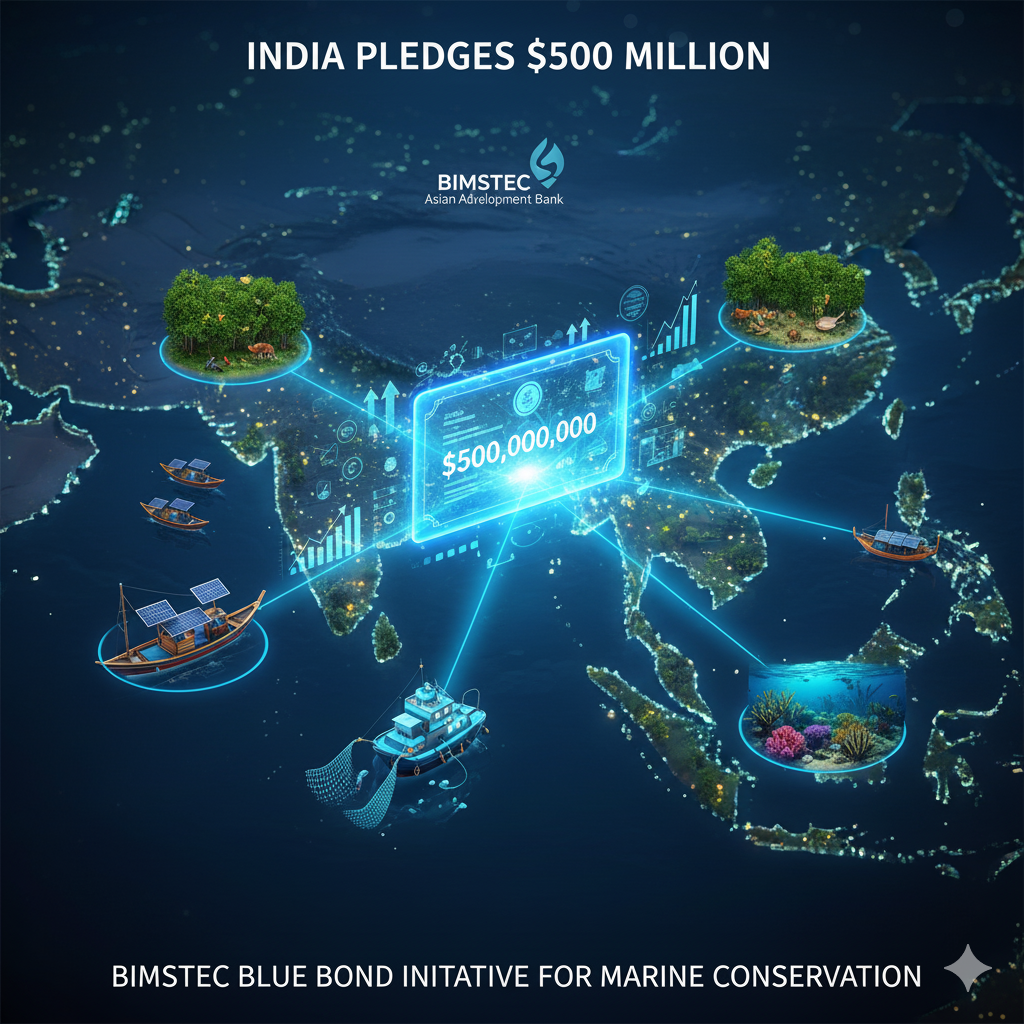
At the 6th BIMSTEC Summit, India announced a $500 million contribution to a new 'BIMSTEC Blue Bond Initiative' aimed at financing sustainable marine resource management and coastal protection across the Bay of Bengal region.
Introduction
Context & Background
Key Points
- •What is a 'Blue Bond'?: It is a type of debt instrument (like an IOU or a loan from investors). The money raised from this bond is specifically promised to be used only for projects that help the ocean, like cleaning up pollution or protecting coral reefs.
- •India's Contribution: India has pledged $500 million as an anchor investor (the first major investor who provides a large sum, giving confidence to others). Contributions are also expected from Japan (as an observer) and the Asian Development Bank (ADB).
- •Fund Allocation: The fund will be managed by the BIMSTEC Secretariat and will finance projects like: 1) Mangrove restoration, 2) Combating IUU fishing (Illegal, Unreported, and Unregulated fishing), 3) Marine pollution control systems, 4) Sustainable aquaculture.
- •Regional Focus: This marks a shift from bilateral aid (one country giving to another) to a multilateral, regionally-owned fund for the Bay of Bengal.
Related Entities
Impact & Significance
- •Strengthens 'Neighbourhood First': Reaffirms India's role as a leader and 'net security provider' (meaning India contributes more to regional security and stability than it consumes) in the Bay of Bengal.
- •Counters Chinese Influence: Provides a credible, sustainable, and transparent alternative to other infrastructure and investment programs in the region.
- •Boosts Blue Economy: Will help member states (like Bangladesh, Sri Lanka, Myanmar) sustainably develop their marine resources.
- •Climate Action: Directly addresses SDG 14 (Life Below Water), which is one of the 17 UN Sustainable Development Goals aimed at protecting the oceans, and enhances coastal resilience for millions.
Challenges & Criticism
- •Political Instability: Ongoing political instability in member states (e.g., Myanmar) could hinder project implementation and fund disbursement.
- •Utilization Capacity: Smaller member states may lack the technical expertise and institutional capacity to effectively utilize the funds for complex projects.
- •Accountability: Ensuring the funds are used for genuine 'blue' projects and preventing 'blue-washing' (pretending a project is good for the ocean when it's not, just to get the money) will require a robust monitoring framework.
- •Attracting Capital: Attracting sufficient private capital (beyond government pledges) to make the bond self-sustaining might be difficult.
Future Outlook
- •The BIMSTEC Secretariat is tasked with finalizing the bond's framework (the rules for how it will work) by March 2026.
- •The first tranche (or portion) of the bond is expected to be issued on international markets by late 2026.
- •This initiative is likely to be a key discussion point at the next India-ASEAN summit, promoting a wider Indo-Pacific maritime cooperation.
UPSC Relevance
- • GS Paper 2: International Relations (Bilateral, regional & global groupings, India's neighborhood)
- • GS Paper 3: Environment (Conservation), Economy (Resource mobilization, Infrastructure, Blue Economy)
Sample Questions
Prelims
The 'BIMSTEC Blue Bond Initiative', recently in the news, is related to:
- (a)A naval defence pact for the Bay of Bengal.
- (b)A financial instrument to fund sustainable marine conservation.
- (c)A satellite network for monitoring maritime traffic.
- (d)A trade agreement to reduce tariffs on fish products.
Mains
By championing the 'Blue Bond Initiative', India is reinforcing its leadership in the BIMSTEC region. Elaborate on the strategic and environmental significance of this move for the Bay of Bengal littoral states.
Introduction: The BIMSTEC Blue Bond Initiative, with India as its anchor investor, is a novel financial instrument to fund sustainable marine projects. This move underscores India's 'Neighbourhood First' policy and its role as a regional leader in the Bay of Bengal.
Body:
• Strategic Significance: It strengthens India's role as a reliable partner and 'net security provider'. It offers a transparent, multilateral financing alternative to other predatory or non-transparent models of investment in the region, thereby enhancing India's diplomatic influence.
• Environmental Significance: It directly tackles shared threats like climate change, marine pollution, and sea-level rise. By funding mangrove restoration and pollution control, it helps protect the coastlines of vulnerable states like Bangladesh and Sri Lanka, addressing SDG 14.
• Economic Significance: It promotes the 'Blue Economy' as a sustainable growth engine for all member states, moving beyond just extraction (like fishing) to sustainable value addition (like aquaculture, ecotourism).
• Challenges: Success hinges on overcoming regional political instability, building technical capacity in all member states to actually use the funds, and ensuring strict accountability to prevent 'blue-washing' (fake green projects).
Conclusion: The Blue Bond is a powerful tool for geopolitical and environmental diplomacy. It cleverly aligns India's strategic interests (regional leadership, security) with the urgent sustainable development goals of the entire Bay of Bengal region.