
Why Bioremediation Matters for India’s Pollution Challenge
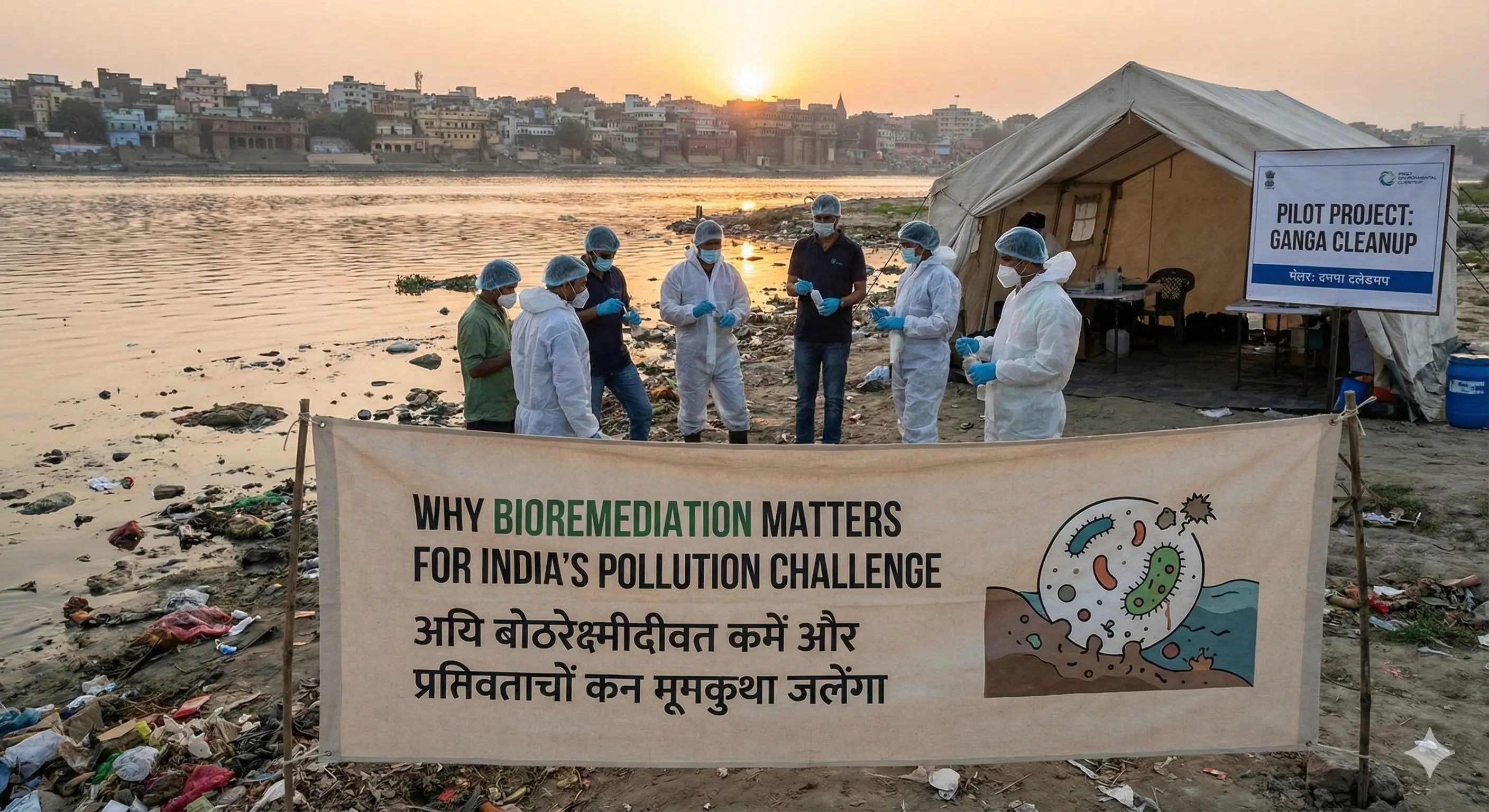
As India struggles with toxic rivers, landfills, and oil spills, the country is turning to 'Bioremediation'—a method that uses nature's own bacteria and plants to eat up pollution. This article explains how this green technology works, its specific uses in India (like cleaning the Ganga or mining sites), and the hurdles in making it a nationwide solution.
Introduction
Context & Background
Key Points
- •Who are the 'Bioremediates'? These are the workers in this process. They are mostly microorganisms (tiny bacteria and fungi) or specific plants. They look at pollutants—such as oil spills or heavy metals—as food. They metabolize (digest) these toxins and excrete harmless byproducts. It is similar to how our bodies digest food to produce energy.
- •New Technologies (Simplified): Science has advanced beyond just finding natural bugs. We now have:
1. Genetically Engineered Microbes: Scientists can 'edit' the DNA of bacteria to make them hungrier for specific pollutants. For example, the bacterium Ideonella sakaiensis has been modified to eat PET plastic bottles.
2. Enzyme-based Remediation: Instead of using the whole live bacteria, scientists just extract the 'enzyme' (the chemical tool the bacteria uses to digest) and spray that on sewage. It's safer because you aren't releasing live germs.
3. Metagenomics: This is a high-tech way of testing dirty water (like in the Ganga) to find out exactly which local bacteria are already trying to eat the pollution, so we can breed more of them. - •Phytoremediation (Plant Power): This uses plants instead of bacteria. In mining states like Odisha and Jharkhand, certain plants act like 'sponges.' They suck up dangerous heavy metals from the soil through their roots and store them in their leaves. When the plants are harvested and disposed of safely, the soil is left clean.
- •The Indigenous Advantage: Just as a local person is better adapted to India's summer heat than a tourist, India's native microbes are better suited to our climate (high heat, salinity) than imported bacteria. Using local strains is safer and more effective.
- •International Success Stories:
- China: Uses super-bacteria to restore land ruined by factories.
- Japan: Uses these methods to manage city waste.
- European Union: Uses bioremediation to clean up oil spills in the ocean. - •Why it makes Economic Sense: For a developing nation like India, this is attractive because it is low-cost. You don't need to build massive factories to clean the water; you just need to manage the ecosystem, which saves huge amounts of electricity and money.
Comparison: Bioremediation vs. Old Methods
| Feature | Bioremediation (The Green Way) | Conventional (Chemical/Mechanical) | Bookmark |
|---|---|---|---|
| Cost | Cheaper: Uses natural processes. | Expensive: Needs heavy machinery & fuel. | |
| Waste | Zero Harmful Waste: Turns toxins into CO2/water. | Secondary Waste: Often leaves toxic sludge behind. | |
| Impact | Sustainable: Heals the soil/water permanently. | Disruptive: Digging/dredging destroys habitats. | |
| Speed | Slow: Nature takes time to work. | Fast: Immediate removal, but surface-level. |
Types of Bioremediation Techniques
| Technique Name | Simple Explanation | Where is it used? | Bookmark |
|---|---|---|---|
| Phytoremediation | 'Phyto' = Plant. Using plants to absorb poisons via roots. | Mining sites with heavy metals in soil. | |
| Bioaugmentation | 'Augment' = To Add. Adding super-bacteria to a dirty site to speed up cleaning. | Oil spills in the ocean (using oil-eating bacteria). | |
| Biostimulation | 'Stimulate' = To Feed. Adding nutrients (fertilizer) to help existing good bacteria grow faster. | Groundwater that has been polluted by chemicals. | |
| Mycoremediation | 'Myco' = Fungi. Using mushrooms/fungi to break down tough waste. | Industrial waste or pesticide-filled soil. |
Related Entities
Impact & Significance
- •Reviving Dead Water Bodies: Many Indian lakes are 'dead' because they have no oxygen left. Bioremediation can eat up the organic waste, bringing oxygen—and fish—back to the water.
- •Creating Usable Land: Large areas of land near factories are currently unusable because the soil is toxic. By cleaning this soil, we can reclaim land for farming or building homes.
- •Supporting National Missions: It aligns perfectly with the Swachh Bharat Mission (Clean India) and Namami Gange (Clean Ganga) by providing a scientific way to treat waste rather than just hiding it.
- •Green Jobs: Scaling this up will create new jobs for biologists, field workers, and waste management technicians.
Challenges & Criticism
- •The 'Frankenstein' Fear (Biosafety): There is a fear of releasing Genetically Modified Organisms (GMOs) into the wild. If we release a super-bacteria to eat plastic, what if it mutates and starts eating something else? Containing them is a major safety concern.
- •Nature is Slow & Fussy: Unlike a machine that works the same way everywhere, microbes are sensitive. If it's too cold or the soil is too acidic, they might stop working. A solution that works in a lab might fail in a real river.
- •Lack of Standards: India doesn't yet have a strong system to certify these products. This risks the market being flooded with fake or ineffective 'bio-solutions' that don't actually work.
- •The 'Quick Fix' Trap: Industries might get lazy. If they think "bacteria will clean this up later," they might stop trying to reduce their pollution in the first place.
Future Outlook
- •Setting Rules: The government (CPCB and DBT) must create national protocols to certify which microbes are safe to use.
- •Regional Hubs: We need research centers in every state because the bacteria that work in the cold Himalayas won't work in the hot deserts of Rajasthan.
- •High-Tech Monitoring: We need to use biosensors (digital sniffers) to track if the bacteria are actually cleaning the pollution in real-time.
- •Public Trust: We need to educate people that these microbes are 'good germs', not disease-causing ones, so communities accept these projects.
UPSC Relevance
- • GS-3 (Science & Tech): Understanding how biotechnology solves real-world problems.
- • GS-3 (Environment): Topics like Pollution, Conservation, and Environmental Impact Assessment.
- • Prelims Focus: Know definitions: Bioremediation (microbes), Phytoremediation (plants), Mycoremediation (fungi). Know specific Indian innovations like 'Oilzapper'.
- • Mains Focus: Be able to argue why bioremediation is good for India (cheap, sustainable) but also list the risks (biosafety, slow speed).
Sample Questions
Prelims
Which of the following statements best describes 'Bioremediation'?
1. Using microorganisms to break down environmental pollutants into less toxic forms.
2. Using chemical fertilizers to boost crop growth in bad soil.
3. Burning medical waste in high-temperature chambers.
4. Filtering factory water using carbon filters.
Answer: Option 1
Explanation: Bioremediation is specifically about using biological agents (life) to neutralize pollution.
Mains
Bioremediation offers a sustainable solution to India’s pollution crisis, but it is not widely used yet. Discuss the opportunities and challenges in scaling up this technology.
Introduction: Define bioremediation (using microbes to clean pollution) and why India needs it (dirty rivers, oil spills).
Body:
• Why is it good? (Opportunities): It is cheaper than chemical cleaning; it heals the soil instead of just moving the waste; India has great local bacteria to use.
• Why is it hard? (Challenges): Safety fears about releasing modified germs; it is slower than machines; we lack clear government rules for it.
• What should we do? Create strict safety rules (protocols); encourage startups to invent new solutions; test it in more cities.
Conclusion: Bioremediation isn't a magic wand, but it is a powerful tool. With the right rules, it can clean India's environment sustainably.