
BNP’s victory: Challenges and Strategic Openings for India
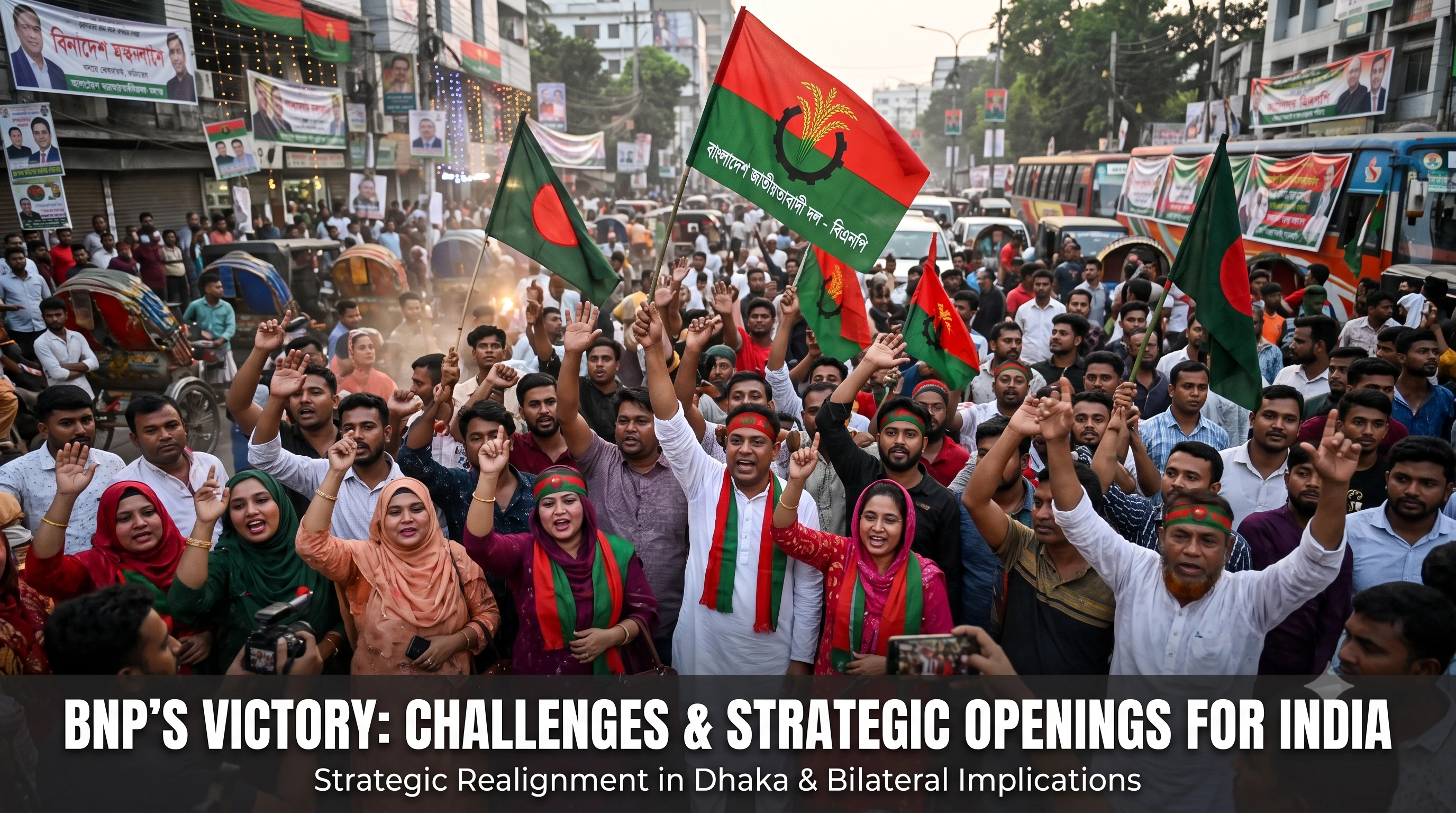
The decisive victory of the Bangladesh Nationalist Party (BNP) under Tarique Rahman in the 2026 parliamentary elections marks a major political shift in Dhaka. This article examines India's historical engagement with BNP, key bilateral issues like the Ganga Water Treaty, strategic regional contestations, and the way forward for India-Bangladesh relations.
Introduction
Context & Background
Key Points
- •India’s History with the BNP: The BNP was founded in 1978 by Gen. Ziaur Rahman. Unlike the pro-India Awami League, the BNP cultivated a nationalist identity emphasizing sovereignty and strategic autonomy vis-à-vis India.
- •Khaleda Zia Period (2001–2006): During the BNP-Jamaat coalition, ties deteriorated. India accused Dhaka of allowing Northeastern insurgent groups and terror outfits to operate from Bangladeshi soil.
- •Contrast with Hasina Era: Under Sheikh Hasina (2009–2024), Bangladesh cracked down on anti-India insurgent networks, a period PM Modi described as a 'Shonali adhyay' (golden chapter).
- •Recent BNP Manifesto (2026 Elections): Avoided direct reference to India but emphasized 'Friend Yes, Master No', non-interference in internal affairs, and a strategic partnership with the 'Muslim world'.
- •Strategic Relief in Majority: The BNP now governs without Jamaat-e-Islami, reducing the risk of hardline, anti-India policymaking. It offers a clearer decision-making structure and pragmatic, business-oriented leadership.
- •Key Focus Areas of the New Government: Renewal of the Ganga Waters Treaty before December 2026, addressing 'border killings' by demanding apprehension instead of firearms, managing Sheikh Hasina's presence in India, and expansion of medical visas.
Key Facts: Ganga Water Treaty (1996)
| Feature | Description | Bookmark |
|---|---|---|
| Parties involved | India (upper riparian) and Bangladesh (lower riparian). | |
| Purpose | To regulate the sharing of Ganga river waters at the Farakka Barrage, particularly during the lean (dry) season. | |
| Duration | Valid for 30 years (up to 2026), with a provision for review and renewal by mutual consent. | |
| Sharing mechanism | Water allocation is decided on the basis of 10-day periods using an agreed formula for minimum assured flows. | |
| Significance | Considered a successful example of bilateral river-water cooperation in South Asia. |
Related Entities
Impact & Significance
- •Northeast Security: Peace and stability in Bangladesh directly impact India’s eastern states (Assam, Meghalaya, Tripura, West Bengal). A cooperative Dhaka is essential to prevent insurgency.
- •Strategic Equilibrium: Bangladesh must balance its sovereignty against global influences. Its alignments directly affect the regional equilibrium in the geopolitically vital Bay of Bengal.
- •Economic Interdependence: A stable trade and investment environment is critical. Medical tourism and connectivity projects tie the economic prospects of both nations closely together.
Challenges & Criticism
- •Sheikh Hasina’s Presence: The former PM's continued stay in India could become a political flashpoint if Dhaka presses for extradition or objects to her public comments.
- •Security & Extremism: Past experiences of terror outfits operating from Bangladeshi soil during previous BNP tenures keep Indian security agencies highly cautious.
- •Minority Rights: Attacks on Hindus and other minorities in Bangladesh create severe domestic political pressure in India, complicating bilateral trust.
- •External Influence: Deepening strategic engagement of Bangladesh with China (infrastructure/ports) or Pakistan (intelligence links) remains a core concern for New Delhi.
Future Outlook
- •Constructive Engagement: India should engage the BNP government with respect. Quiet diplomacy works better than public pressure to build bilateral trust.
- •Strengthen Economic Ties: Expanding trade, investment, and energy cooperation will build stability and mutual dependence.
- •Security & Connectivity: Maintain intelligence sharing to prevent insurgent activities and accelerate road, rail, and river connectivity between India’s Northeast and Bangladesh.
- •Balance External Influence: India must offer credible alternatives in infrastructure and development to prevent Dhaka's excessive reliance on external powers like China.
UPSC Relevance
- • GS-2 (International Relations): India and its neighbourhood- relations; Bilateral, regional and global groupings and agreements involving India.
- • GS-3 (Internal Security): Security challenges and their management in border areas.
Sample Questions
Prelims
Consider the following statements regarding the Ganga Water Treaty between India and Bangladesh: 1. It was signed in 1996 and regulates the sharing of water at the Farakka Barrage. 2. It ensures minimum assured flows to Bangladesh throughout the entire year. 3. The treaty is valid up to the year 2026. Which of the statements given above is/are correct?
1 only
1 and 3 only
2 and 3 only
1, 2 and 3
Answer: Option 1
Explanation: Statement 1 is correct. Statement 2 is incorrect; the treaty applies specifically to the lean season (January 1 to May 31), not the entire year. Statement 3 is correct; it was signed for a 30-year duration, valid up to 2026.
Mains
The political transition in Bangladesh in 2026 presents both historical challenges and new strategic openings for India. Analyze the implications of the BNP’s victory on India-Bangladesh relations and suggest a way forward.
Introduction: Introduce the context of the 2026 parliamentary elections in Bangladesh resulting in a BNP majority, marking a shift from the Awami League era.
Body:
• Historical Challenges: Recall the 2001-2006 BNP-Jamaat era (insurgent safe havens); current challenges including Hasina's presence in India, border killings, and minority protection.
• Strategic Openings: A single-party BNP majority without Jamaat reduces hardline influence; pragmatic, business-focused leadership provides predictable governance.
• Geopolitical Dynamics: China's expanding footprint, Pakistan's tactical interests, and the strategic importance of the Bay of Bengal.
Conclusion: Conclude by emphasizing the need for strategic realism, quiet diplomacy, and robust economic/connectivity engagement to ensure regional stability.