
Visit of Brazil's President Lula to India: Deepening the Strategic Partnership
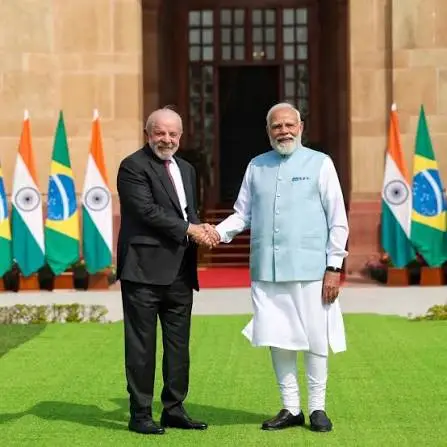
Brazilian President Luiz Inácio Lula da Silva’s February 2026 State visit to India marked a significant deepening of the India–Brazil Strategic Partnership. Amidst heightened global tariffs and geopolitical competition, the visit focused on expanding trade, establishing cooperation in critical minerals and digital infrastructure, and reinforcing South-South solidarity.
Introduction
Context & Background
Key Points
- •Ten Landmark Agreements: Signed across high-growth sectors including critical minerals, digital cooperation, traditional knowledge, health, and MSMEs, shifting the focus from mere commodity trade to institutionalised strategic cooperation.
- •Ambitious Trade Targets: A commitment to raise bilateral trade beyond $20 billion within five years, aiming to diversify from current commodity dominance (oil, sugar, iron ore) into industrial and technology trade.
- •Digital Public Infrastructure (DPI): India and Brazil agreed to establish a Centre of Excellence for DPI in Brazil, highlighting digital sovereignty as a core geopolitical issue.
- •Critical Minerals Resiliency: Joint efforts to exploit and process reserves of lithium, niobium, and rare earth elements to reduce dependence on concentrated global suppliers and support energy transition ambitions.
- •Defence Cooperation: Expanding military synergies, including defence industry collaboration and joint maritime cooperation spanning both the Indian and South Atlantic Oceans.
Key Agreements from the 2026 Visit
| Agreement Field | Format | Focus Area | Bookmark |
|---|---|---|---|
| Digital Partnership for the Future | Joint Declaration | Cooperation in AI, Digital Public Infrastructure (DPI), and emerging technologies. | |
| Rare Earths and Critical Minerals | MoU | Exploration, mining, processing, and recycling of strategic minerals. | |
| Mining for the Steel Supply Chain | MoU | Strengthening cooperation in iron ore, steel production, and sustainable mining. | |
| Electronic Certificates of Origin (e-CoO) | MoU | Mutual recognition of digital certificates for traded goods. |
Strategic Goals and Initiatives
| Initiative | Objective/Significance | Bookmark |
|---|---|---|
| $20 Billion Trade Target | Expand beyond current commodity-driven trade into value-added exports and technology. | |
| DPI Centre of Excellence | Establishment of an Indian-backed Digital Public Infrastructure Centre in Brazil. | |
| Defence & Strategic Synergy | Military training exchanges and maritime cooperation in the Indian and South Atlantic Oceans. |
Related Entities
Impact & Significance
- •Strategic Autonomy: By strengthening bilateral ties and South-South trade resilience, both nations reduce their vulnerability to unilateral economic pressures and bloc politics.
- •Supply Chain Security: Collaborating on critical minerals and rare earths helps secure the raw materials necessary for EV batteries, semiconductors, and the broader clean energy transition.
- •Cross-Regional Solidarity: The partnership bridges Asia and Latin America, creating a unified voice that can more effectively advocate for the interests of the Global South on the world stage.
- •Technological Diplomacy: Exporting India's success with Digital Public Infrastructure to Brazil sets a precedent for technological cooperation among developing nations.
Challenges & Criticism
- •Trade Composition: Despite the ambitious $20 billion target, bilateral trade currently remains heavily dependent on primary commodities like oil, sugar, and iron ore.
- •External Economic Pressures: Navigating and mitigating the impact of protectionist policies and tariffs imposed by developed nations like the United States.
- •Implementation Hurdles: While MoUs have been signed in complex sectors like critical minerals and DPI, executing these projects across vast geographic distances requires sustained bureaucratic and diplomatic commitment.
- •Global Geopolitical Friction: Maintaining a multipolar, non-aligned stance while engaging with competing global superpowers.
Future Outlook
- •Value-Added Trade Expansion: Efforts will intensify to improve market access, regulatory alignment, and the export of manufactured and technological goods between the two nations.
- •Collective Economic Bargaining: Leveraging blocs like BRICS and G20 to collectively negotiate against unilateral economic pressures, such as U.S. tariffs.
- •Shared Development Models: Continuous knowledge exchange, with Brazil adapting India’s macroeconomic and forex strategies, while India integrates Brazil's agro-industrial efficiency and biofuel innovations.
- •Multilateral Reform Push: Sustained joint advocacy for UN Security Council reform and expansion under the G4 framework to reflect contemporary multipolar realities.
UPSC Relevance
- • GS-2 (International Relations): Bilateral, regional, and global groupings and agreements involving India and/or affecting India's interests.
- • GS-2 (Global South Diplomacy): Effect of policies and politics of developed and developing countries on India's interests.
- • GS-3 (Economy & Technology): Issues relating to supply chains, critical minerals, and digital public infrastructure (DPI).
- • Mains Focus: Analyzing the strategic convergence of India and Brazil in multipolar world-building and UN Security Council reforms.
Sample Questions
Prelims
With reference to the India-Brazil Strategic Partnership, which of the following statements is correct?
1. Both countries are members of the G4 framework advocating for UN Security Council reforms.
2. India and Brazil recently agreed to establish an Indian Centre of Excellence for Digital Public Infrastructure (DPI) in New Delhi.
3. The primary focus of the 2026 trade agreements was solely to maximize the export of raw agricultural commodities.
4. Brazil assumes the BRICS Chairship in 2026.
Answer: Option 1
Explanation: Statement 1 is correct. Statement 2 is incorrect; the DPI Centre of Excellence is to be established in Brazil. Statement 3 is incorrect; the new agreements aim to move beyond commodity trade into high-growth, technology, and strategic sectors. Statement 4 is incorrect; India assumes the BRICS Chairship in 2026.
Mains
“The deepening of the India-Brazil Strategic Partnership is a cornerstone for South-South cooperation and the assertion of a multipolar world order.” Analyze this statement in the context of the recent bilateral agreements on critical minerals, digital infrastructure, and global governance.
Introduction: Introduce the context of the February 2026 State visit of the Brazilian President. Define the historical context of the strategic partnership and its current relevance.
Body:
• Economic & Technological Synergy: The shift from commodity-based trade to a $20 billion target involving digital public infrastructure (DPI) and critical minerals (lithium, rare earths) builds supply chain resilience.
• Geopolitical Coordination: Collective bargaining against unilateral tariffs; expanding coordination within BRICS (India's 2026 Chairship) and G20 to champion the Global South.
• Global Governance Reforms: Joint advocacy through the G4 framework for UN Security Council democratization; pushing for a multipolar, rule-based order devoid of Cold War-style bloc politics.
Conclusion: Conclude by highlighting how the cross-continental axis between Asia and Latin America's largest democracies acts as a stabilizing force and an alternative development model for the global architecture.