
Britain’s House of Lords Vs. Rajya Sabha
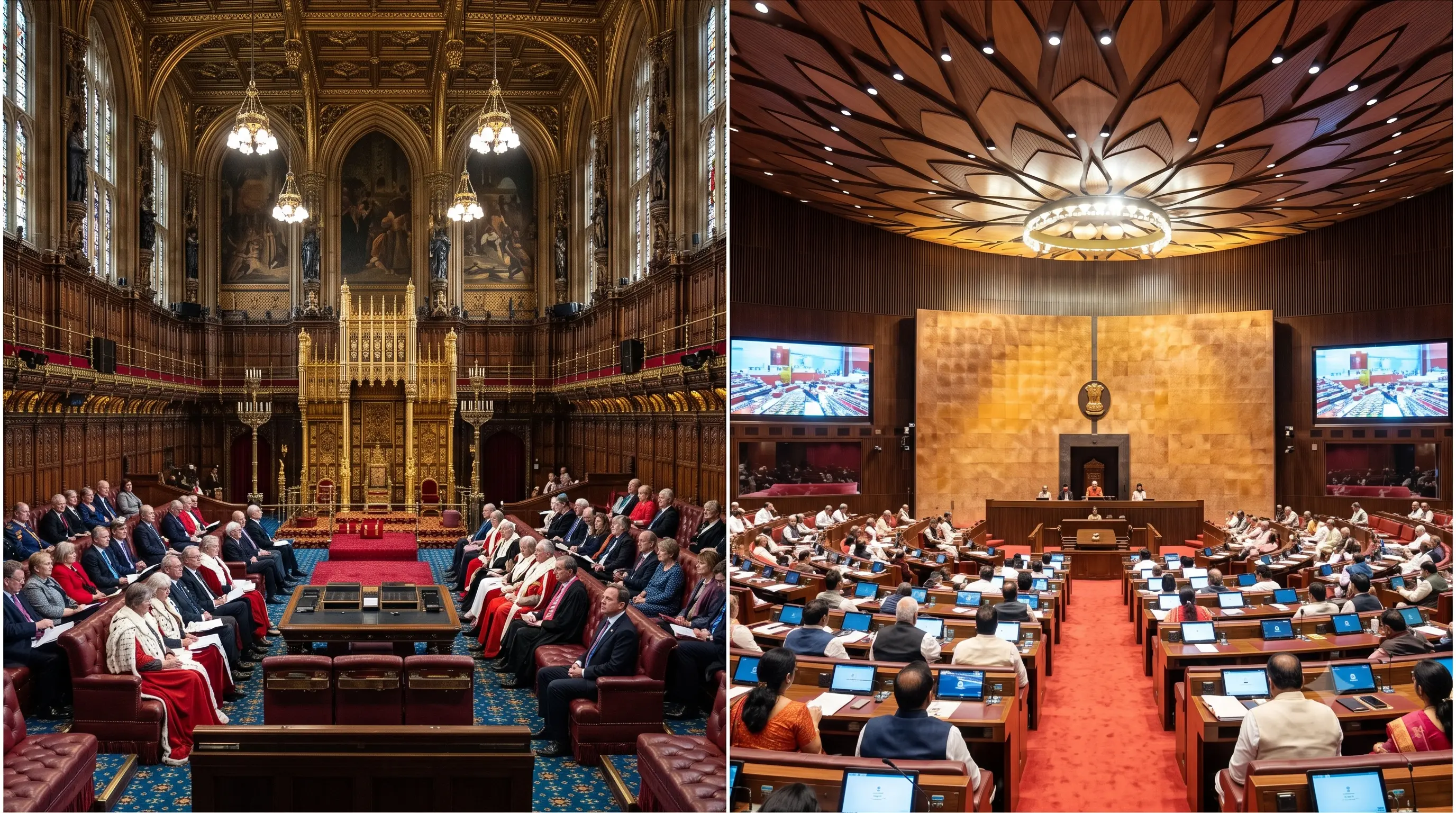
The House of Lords functions as the upper chamber of the Parliament of the United Kingdom. Unlike most bicameral systems where upper houses are elected, this chamber is predominantly unelected and operates mainly as a revising and scrutinising body, leading to debates over its democratic legitimacy when compared to federal upper houses like India's Rajya Sabha.
Introduction
Context & Background
Key Points
- •Life Peers: Appointed by the Monarch on the PM's or an independent commission's advice. They hold membership for life but cannot pass the title down, forming the largest segment of the chamber.
- •Hereditary Peers & Lords Spiritual: Membership includes a limited number of hereditary aristocrats (internally elected when vacancies arise) and senior bishops of the Church of England, reflecting historical and religious ties.
- •Legislative Scrutiny: The chamber acts primarily as a revising body. It conducts detailed, clause-by-clause examinations of bills passed by the House of Commons and suggests improvements.
- •Delaying Power: The House of Lords can postpone the passage of ordinary (non-money) bills for up to one year, but it cannot permanently veto legislation approved by the elected chamber.
- •Judicial Separation: Until 2009, the House of Lords served as the UK's highest court of appeal. This function was transferred to the Supreme Court following the Constitutional Reform Act of 2005.
Comparative Analysis: House of Lords vs. Rajya Sabha
| Dimension | House of Lords (United Kingdom) | Rajya Sabha (India) | Bookmark |
|---|---|---|---|
| Institutional Nature | Predominantly appointive chamber; members include life peers, limited hereditary peers, and senior bishops. | Indirectly elected chamber; members are elected by State Legislative Assemblies through proportional representation. | |
| Federal Representation | Does not represent territorial or regional units; operates within a unitary constitutional system. | Represents states and Union territories, reflecting India’s federal structure. | |
| Size and Membership Structure | No constitutionally fixed strength; membership size varies over time. | Constitutionally prescribed maximum strength of 250 members, ensuring structural stability. | |
| Tenure of Members | Life peers hold membership for life, providing continuity but limited turnover. | Members serve six-year terms; one-third retire every two years, ensuring periodic renewal. | |
| Role in Financial Legislation | May delay Money Bills for a limited period but cannot amend or permanently block them. | Cannot amend Money Bills; may recommend changes which the lower house may accept or reject. | |
| Democratic Legitimacy | Legitimacy debated due to non-elective composition and appointment-based membership. | Derives indirect democratic legitimacy through elected state legislatures. | |
| Special Constitutional Powers | Does not possess specific federal constitutional powers beyond scrutiny and delay functions. | May authorise Parliament to legislate on State List matters in national interest and can facilitate creation of All India Services. |
Related Entities
Impact & Significance
- •Expertise-Driven Scrutiny: The inclusion of life peers ensures that highly experienced professionals from academia, law, and public service actively participate in refining legislation.
- •Checks on Hasty Lawmaking: The power to delay ordinary legislation acts as a buffer, forcing the government and the lower house to reconsider flawed or highly controversial bills.
- •Institutional Continuity: Because members do not face regular elections, they can take long-term views on complex legislative issues without the pressure of populist demands.
Challenges & Criticism
- •Democratic Deficit: As an unelected body, it lacks direct accountability to the public, raising questions about its legitimacy in overruling or delaying the elected House of Commons.
- •Unwieldy Size: Unlike upper houses globally, it has no constitutionally fixed membership cap, making it one of the largest legislative bodies in the world and raising efficiency concerns.
- •Political Patronage: The appointment of Life Peers is often criticized as a mechanism for Prime Ministers to reward political cronies, donors, or loyalists.
- •Lack of Federal Character: It does not represent specific regions or territories, making it unrepresentative of the UK's increasingly devolved political landscape.
Future Outlook
- •Membership Caps: Addressing concerns about its unwieldy size by establishing a constitutionally fixed maximum strength, similar to the Rajya Sabha.
- •Democratic Reforms: Ongoing political debates surrounding the transition to a partially or fully elected upper house to eliminate the 'democratic deficit'.
- •Curbing Political Patronage: Enhancing the power of independent appointments commissions to ensure peerages are awarded strictly on merit and expertise rather than political loyalty.
- •Federal Representation Models: Exploring territorial representation to give constituent nations of the UK (Scotland, Wales, Northern Ireland) a structured voice, moving closer to federal upper house models.
UPSC Relevance
- • GS-2 (Polity & Governance): Comparison of the Indian constitutional scheme with that of other countries.
- • GS-2 (Legislature): Structure, functioning, and powers of Parliament and State Legislatures.
- • Mains Focus: Analyzing the relevance of second chambers, federalism, and bicameralism.
Sample Questions
Prelims
Which of the following statements is correct regarding the House of Lords in the United Kingdom?
1. The House of Lords provides institutional representation to the regional territories of the United Kingdom.
2. Like the Rajya Sabha, the House of Lords has a constitutionally fixed maximum membership strength.
3. The House of Lords serves primarily as a revising chamber and cannot permanently veto ordinary legislation passed by the elected chamber.
4. The judicial functions of the highest court of appeal are currently exercised by the House of Lords.
Answer: Option 3
Explanation: Statement 3 is correct; it is a revising chamber that can delay but not veto bills. Statement 1 is incorrect (it lacks federal/regional representation). Statement 2 is incorrect (it has no fixed size). Statement 4 is incorrect (judicial functions were moved to the Supreme Court in 2009).
Mains
Despite both functioning as upper chambers in a parliamentary democracy, the British House of Lords and the Indian Rajya Sabha differ fundamentally in their institutional character and democratic legitimacy. Analyze.
Introduction: Introduce both houses as the second chambers of their respective parliaments. Highlight that while bicameralism serves the purpose of legislative review in both nations, their foundations—tradition vs. federalism—create stark operational differences.
Body:
• Institutional Character & Composition: Contrast the appointive nature (Life peers, hereditary peers) of the House of Lords with the indirectly elected, proportional representation mechanism of the Rajya Sabha.
• Federal vs. Unitary Role: Explain how the Rajya Sabha represents states in a federal setup and holds special powers (Article 249, 312), whereas the House of Lords operates in a unitary system with no territorial representation.
• Powers and Democratic Legitimacy: Discuss the House of Lords' role purely as a revising chamber with delaying powers and no democratic mandate, versus the Rajya Sabha's co-equal status in ordinary bills and electoral accountability via state legislatures.
Conclusion: Conclude that while both chambers act as checks against hasty legislation, the Rajya Sabha is deeply integrated into India's federal democratic design, whereas the House of Lords remains an evolving legacy of historical continuity.