
Cash Row and Judicial Accountability: The Case of Justice Yashwant Varma
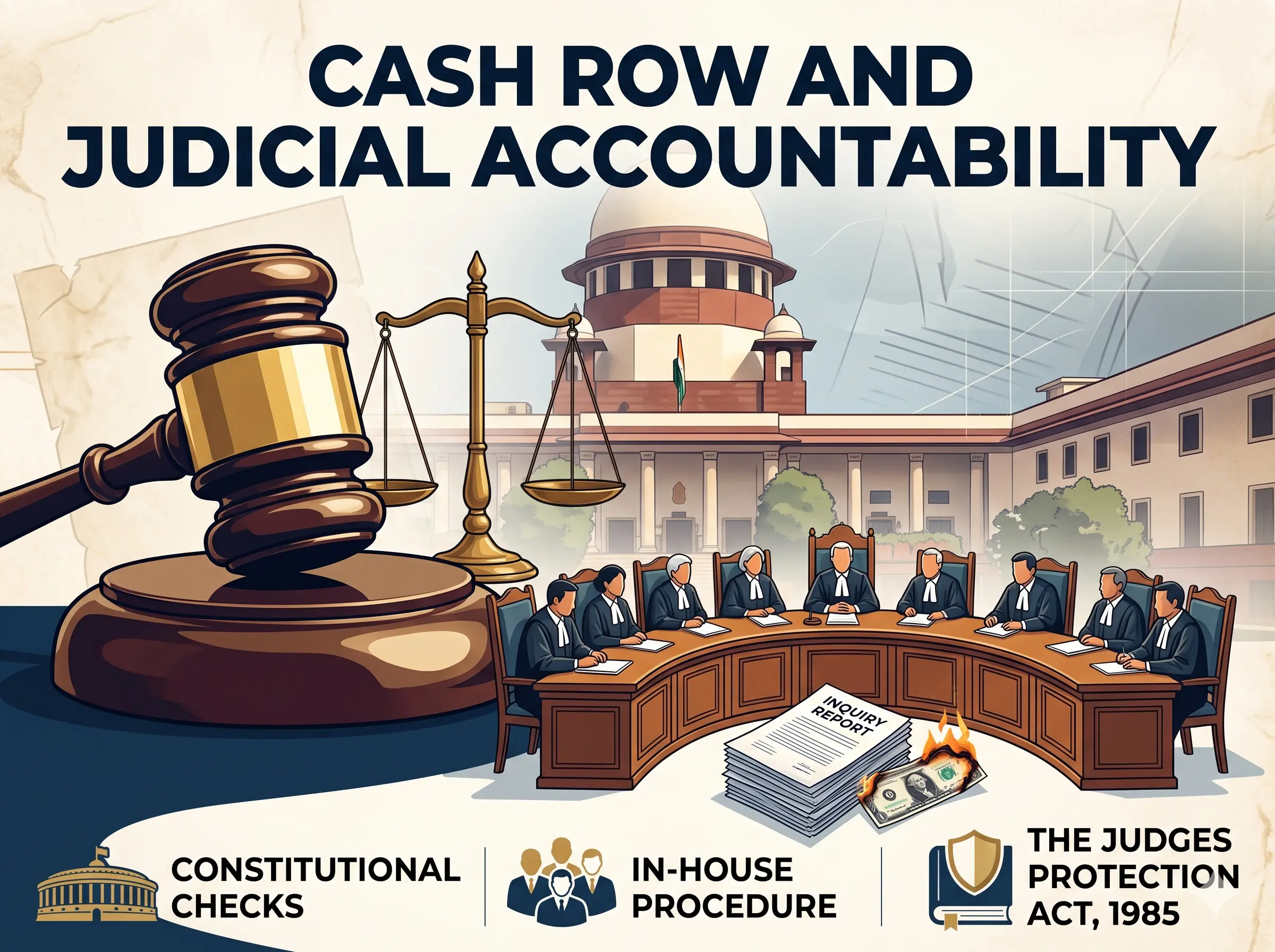
The reconstitution of a parliamentary inquiry committee to investigate allegations against Justice Yashwant Varma has brought judicial accountability into the spotlight. This article explores the constitutional framework for removing High Court judges, the internal mechanisms for addressing misconduct, and the delicate balance between judicial independence and accountability under the Judges Protection Act, 1985.
Introduction
Context & Background
Key Points
- •Constitutional Removal Process: High Court judges can only be removed through a rigorous parliamentary process. It begins with a motion signed by MPs, admitted by the Speaker or Rajya Sabha Chairman, followed by an inquiry committee investigating 'proved misbehaviour or incapacity'.
- •Role of the Inquiry Committee: The reconstituted three-member committee acts purely as a fact-finding body. It examines evidence and determines if the charges meet constitutional standards, guiding Parliament on whether to proceed with impeachment.
- •In-House Procedure (1999): Designed to internally handle judicial misconduct without invoking full impeachment. It draws on the Restatement of Values of Judicial Life (1997) and Bangalore Principles of Judicial Conduct (2002). Past cases like Justice Soumitra Sen demonstrate its potential effectiveness.
- •The Immunity Balance: The Judges Protection Act, 1985 shields judges from frivolous civil and criminal proceedings. However, Section 3(2) explicitly states this immunity is not absolute and does not bar the State or superior judiciary from initiating disciplinary or criminal action.
- •Institutional Significance: The Varma case highlights the layered safeguards protecting judicial independence while emphasizing the necessary role of Parliament and the Constitution in upholding public trust and accountability.
Composition of In-House Complaint Committees
| Target of Complaint | Committee Composition | Bookmark |
|---|---|---|
| High Court Judge | Two Chief Justices from other High Courts + one High Court judge | |
| High Court Chief Justice | One Supreme Court judge + two Chief Justices from other High Courts | |
| Supreme Court Judge | Three judges of the Supreme Court |
Key Legal Frameworks for Judicial Accountability
| Law / Mechanism | Purpose | Key Feature | Bookmark |
|---|---|---|---|
| Articles 124, 217, 218 & Judges (Inquiry) Act, 1968 | Governs the formal impeachment and removal of judges. | Requires a rigorous parliamentary process and a high voting threshold. | |
| In-House Procedure (1999) | Addresses complaints of judicial misconduct internally. | Relies on peer review by committees of senior judges. | |
| Judges (Protection) Act, 1985 | Provides immunity to judges for official acts to ensure fearless judging. | Section 3(2) still allows the State/higher judiciary to initiate action for misconduct. |
Related Entities
Impact & Significance
- •Testing Constitutional Machinery: The activation of the inquiry committee demonstrates the practical application of India's stringent impeachment protocols, which are rarely utilized.
- •Reaffirming Public Trust: By visibly investigating serious allegations involving recovered cash, the system attempts to reassure the public that judicial officers are subject to the rule of law.
- •Legal Precedent: The outcome of the committee’s findings and the Supreme Court’s interpretation of the Judges Protection Act will set critical benchmarks for future cases of alleged judicial misconduct.
Challenges & Criticism
- •High Impeachment Threshold: The requirement for a special parliamentary majority makes the actual removal of a judge exceptionally difficult, sometimes leading to prolonged suspensions without final resolution.
- •Politicization Risks: Because the removal process involves Members of Parliament, there is an inherent risk that proceedings can be influenced by political considerations rather than pure factual merits.
- •Limitations of Internal Checks: In-house procedures lack statutory backing and are often criticized for lacking transparency, as peers judge peers behind closed doors.
Future Outlook
- •Supreme Court Clarification: The impending SC verdict on Justice Varma’s plea challenging the in-house inquiry will set a vital precedent on the exact limits of immunity under the Judges Protection Act.
- •Refining Internal Checks: The ongoing proceedings may prompt the judiciary to further streamline and bring transparency to its 1999 In-House Procedure.
- •Balancing Independence: Ensuring that the rigorous standards for impeachment continue to protect judges from political targeting while not allowing genuine misconduct to go unpunished.
UPSC Relevance
- • GS-2 (Polity): Structure, organization, and functioning of the Judiciary; Separation of powers between various organs.
- • Prelims Focus: Provisions of the Judges (Inquiry) Act 1968, Articles 124 and 217, and the composition of in-house inquiry committees.
- • Mains Focus: Analyzing the tension between judicial independence and accountability, and evaluating the effectiveness of internal oversight vs. parliamentary impeachment.
Sample Questions
Prelims
Consider the following statements regarding the accountability and protection of High Court judges in India: 1. A motion for the removal of a High Court judge can only be admitted by the Speaker of the Lok Sabha. 2. Under the In-House Procedure, a complaint against a High Court judge is examined by a committee comprising three Supreme Court judges. 3. The Judges (Protection) Act, 1985 does not bar the State Government or superior judiciary from initiating criminal or departmental action against a judge. Which of the statements given above is/are correct?
1 and 2 only
3 only
2 and 3 only
1, 2, and 3
Answer: Option 1
Explanation: Statement 1 is incorrect; the motion can be admitted by the Speaker of the Lok Sabha OR the Chairman of the Rajya Sabha. Statement 2 is incorrect; the committee for an HC judge consists of two Chief Justices from other HCs and one HC judge. Statement 3 is correct as per Section 3(2) of the Judges Protection Act, 1985.
Mains
“Judicial independence is a cornerstone of democracy, but it cannot serve as an absolute shield against accountability.” Examine the existing constitutional and statutory mechanisms for the removal and disciplining of higher judiciary judges in India.
Introduction: Define the delicate balance between judicial independence and accountability. Briefly mention recent developments invoking parliamentary inquiry committees to contextualize the answer.
Body:
• Constitutional Mechanisms (Impeachment): Discuss Articles 124(4) & 217, and the Judges (Inquiry) Act 1968. Explain the high threshold (proved misbehaviour/incapacity) and the complex parliamentary procedure.
• Internal & Statutory Safeguards: Highlight the In-House Procedure (1999) for internal peer review. Discuss the Judges Protection Act, 1985, specifically noting how Section 3(2) ensures immunity is not total and permits state/judicial action for misconduct.
• Challenges: Address the rarity of successful impeachments, the potential opacity of in-house inquiries, and the risk of politicization.
Conclusion: Conclude that while stringent removal processes correctly protect judges from frivolous targeting, transparent and robust application of these mechanisms is essential to maintain public faith in the justice system.