
CCUS as India’s Decarbonisation Catalyst
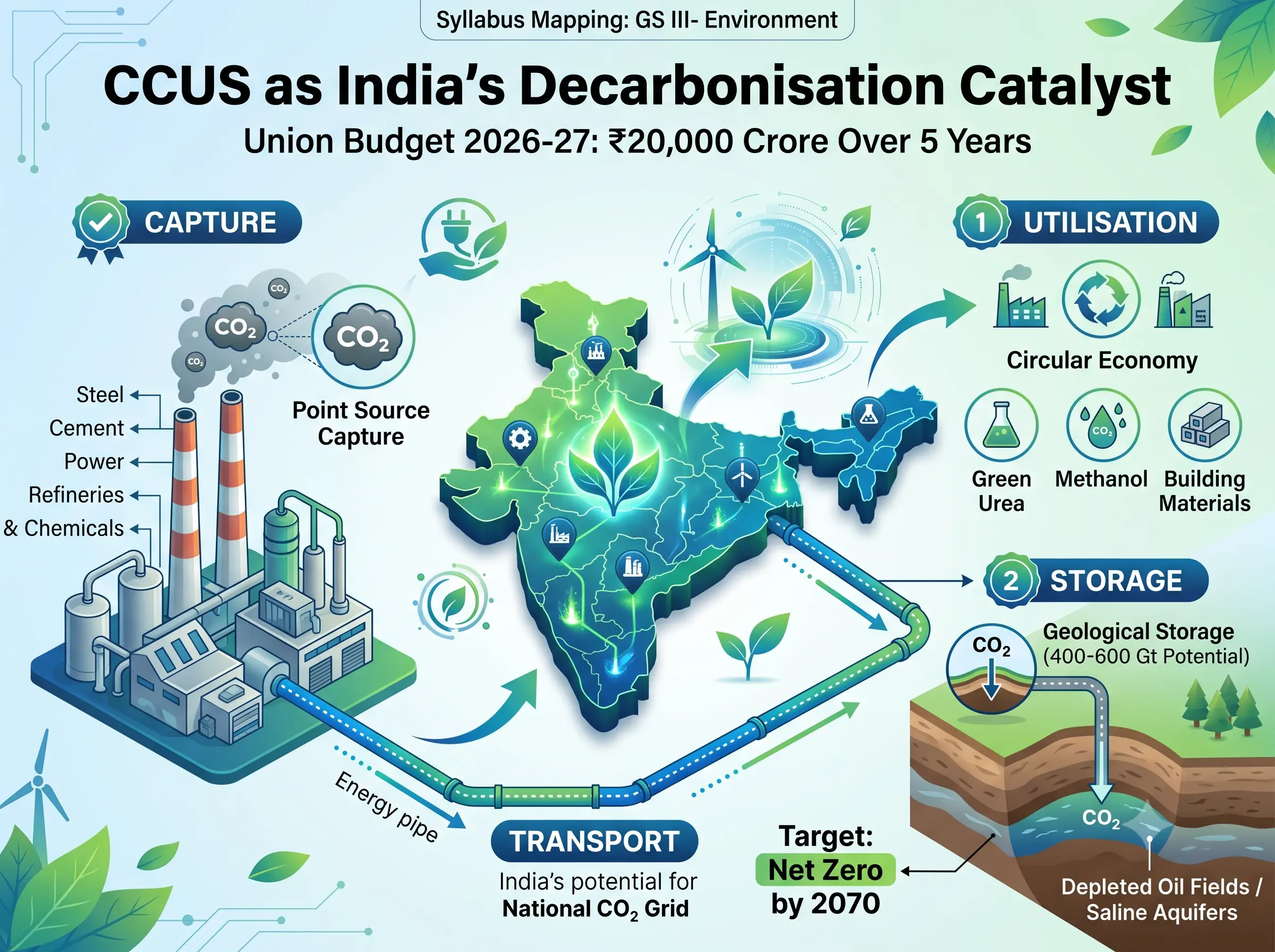
In the Union Budget 2026–27, a ₹20,000 crore scheme over 5 years was introduced to promote Carbon Capture, Utilisation and Storage (CCUS) technologies, targeting hard-to-abate sectors. This aligns with the 'R&D Roadmap for CCUS' launched in December 2025 to help achieve India's Net Zero by 2070.
Introduction
Context & Background
Key Points
- •Budget 2026-27 Allocation: The Union Budget allocated ₹20,000 crore over 5 years for CCUS, targeting five 'hard-to-abate' sectors: Power, Steel, Cement, Refineries, and Chemicals.
- •R&D Roadmap for CCUS: Launched by the Department of Science and Technology (DST) in December 2025. It proposes a three-phase approach: end-of-pipe solutions, CCUS-compliant plant design, and advanced 'CCUS-in-One-Pot' conversion technologies.
- •What is CCUS?: It refers to technologies designed to capture carbon dioxide (CO2) emissions from large point sources and either reuse them in industrial processes or store them permanently in geological formations.
- •The 'Energy Penalty': A major hurdle for CCUS is thermodynamics. Capturing CO2 can consume 15% to 30% of a power plant’s total energy output, significantly increasing the Levelized Cost of Electricity (LCOE).
- •Geological Storage Potential: India’s sedimentary basins offer a massive 400–600 Gt CO2 storage potential, which is critical for making the Net Zero 2070 goal a reality.
- •Need for Carbon Pricing: Until India's Carbon Credit Trading Scheme (CCTS) matures and carbon prices hit $50–$100 per ton, the private sector will likely view CCUS implementation as a liability rather than a profitable asset.
Potential Role of CCUS in Tackling Climate Change
| Role | Description | Global/Indian Example | Bookmark |
|---|---|---|---|
| Mitigation of Industrial Emissions | Reduces emissions from hard-to-abate sectors (steel, cement) where renewable substitution is limited. | Norway’s Sleipner Project (Deep saline aquifers in North Sea) | |
| Complement to Renewable Energy | Tackles existing emissions and enables low-carbon hydrogen production (Blue Hydrogen). | Shell’s Quest Project in Canada | |
| Pathway to Negative Emissions | When paired with bioenergy (BECCS), it can deliver net negative emissions to offset aviation/shipping. | Drax power station in the UK | |
| Enhancing Energy Security | CO2 utilization in Enhanced Oil Recovery (EOR) boosts fossil recovery while reducing emissions. | US Permian Basin EOR projects | |
| India’s Potential | India possesses 400–600 Gt CO2 storage potential. Captured CO2 can be used for green urea, methanol, etc. | NTPC and IOCL pilot projects for thermal plants/refineries |
Challenges in Scaling CCUS in India
| Category | Challenge | Description | Bookmark |
|---|---|---|---|
| Economic | Energy Penalty & High LCOE | Capturing CO2 consumes 15-30% of a plant's energy; it can increase power generation costs by 50-80%. | |
| Infrastructural | Cluster-to-Coast Gap | Lack of a National CO2 Grid to transport captured gas via pipelines to offshore storage sites. | |
| Regulatory & Legal | Long-term Liability & MRV | No clear transfer-of-liability framework for storage sites; lack of standardized Monitoring, Reporting, and Verification standards. | |
| Technical | Water Intensity | CCUS plants need massive amounts of cooling water, causing resource conflicts in water-stressed regions. | |
| Strategic & Social | Moral Hazard & NIMBY | Critics view CCUS as a 'license to keep burning coal'; locals fear groundwater contamination and seismic activity. |
Related Entities
Impact & Significance
- •Decarbonising Heavy Industry: CCUS allows critical economic sectors like steel and cement to drastically reduce their carbon footprints, ensuring they remain globally competitive under changing climate tariffs (e.g., EU's CBAM).
- •Catalysing a Circular Economy: Utilising captured CO2 to manufacture synthetic fuels, methanol, and green building materials reduces raw import dependency and creates entirely new industrial value chains.
- •Energy Security: Implementing Enhanced Oil Recovery (EOR) using captured CO2 helps maximize yields from domestic fossil fuel reserves, buffering against volatile global energy markets.
- •Negative Emissions: When integrated with bioenergy (BECCS), CCUS is one of the few technologies capable of actively removing historic CO2 from the atmosphere.
Challenges & Criticism
- •The 'Moral Hazard' Argument: Environmentalists frequently criticize CCUS as providing a 'license to keep burning fossil fuels', potentially slowing down the structural transition to 100% renewables.
- •High Resource Intensity: CCUS is not just energy-intensive; it requires vast amounts of cooling water, which poses a severe 'resource conflict' in India's water-stressed industrial regions.
- •Public Perception & NIMBY: Strong 'Not In My Backyard' (NIMBY) sentiments persist regarding underground CO2 storage due to fears of groundwater contamination or induced seismic activity.
- •Long-term Liability: Without sovereign assurance or clear regulatory frameworks, private companies hesitate to take on the indefinite liability of managing and monitoring geological storage sites.
Future Outlook
- •Cluster-Based Approach: Developing industrial CCUS hubs—particularly in steel and cement clusters—with shared CO2 pipelines and storage facilities to significantly reduce per-unit transportation costs.
- •Robust Carbon Market: Integrating CCUS deeply into India’s Carbon Credit Trading Scheme, supported by viability gap funding and targeted tax incentives to make projects commercially viable.
- •Clear Regulatory Framework: Defining long-term storage liability, creating an independent monitoring authority, and developing a national CO2 storage atlas with certification norms to provide policy certainty.
- •Promoting CO2 Utilisation: Incentivising the production of green methanol, synthetic fuels, and low-carbon building materials, linking CCUS directly with India's Green Hydrogen Mission.
UPSC Relevance
- • GS-3 (Environment & Ecology): Conservation, environmental pollution and degradation, climate change mitigation.
- • GS-3 (Science and Technology): Indigenization of technology, developing new technologies.
- • Essay Topics: 'Technology as the Silver Bullet for Climate Change', 'Balancing Economic Growth with Ecological Security'.
- • Mains Focus: Analyzing the viability of CCUS in India, its economic challenges, and its role in achieving the Net Zero 2070 target.
Sample Questions
Prelims
With reference to Carbon Capture, Utilisation, and Storage (CCUS) in India, consider the following statements: 1. The Union Budget 2026-27 scheme primarily targets the agricultural and transportation sectors to capture diffuse emissions. 2. The 'R&D Roadmap for CCUS' was launched by the Department of Science and Technology (DST) in December 2025. 3. Captured CO2 can be utilised in Enhanced Oil Recovery (EOR) and in the manufacturing of green urea. Which of the statements given above is/are correct?
1 and 2 only
3 only
2 and 3 only
1, 2 and 3
Answer: Option 2
Explanation: Statement 1 is incorrect: The budget focuses on five 'hard-to-abate' point-source sectors: Power, Steel, Cement, Refineries, and Chemicals (agriculture is excluded due to diffuse emissions). Statement 2 is correct: DST launched the roadmap in Dec 2025. Statement 3 is correct: Captured CO2 is heavily used globally for EOR and can be converted into urea, methanol, and building materials.
Mains
Evaluate the role of Carbon Capture, Utilisation, and Storage (CCUS) technologies in achieving India's Net Zero targets by 2070. What are the key infrastructural and economic challenges in scaling these technologies in India?
Introduction: Introduce the context with the ₹20,000 crore outlay for CCUS in the Union Budget 2026-27 and the DST's R&D Roadmap. Briefly define CCUS.
Body:
• Role of CCUS: Indispensable for decarbonising 'hard-to-abate' sectors (steel, cement); enables net-negative emissions via BECCS; facilitates blue hydrogen production and circular economy via value-added CO2 products (green urea, methanol).
• Economic Challenges: High 'Energy Penalty' (uses 15-30% of plant output); raises LCOE by 50-80%; low domestic carbon pricing makes it commercially unviable without heavy subsidies.
• Infrastructural Challenges: Lack of a National CO2 Grid (Cluster-to-Coast gap); absence of 'Injection-Ready' certified storage sites; massive water intensity requirements conflicting with regional water security.
Conclusion: Conclude that while CCUS cannot substitute the transition to renewable energy, it is an essential complementary tool. Developing industrial clusters, robust MRV standards, and public-private partnerships will be vital to making CCUS commercially viable in India.