
The Changing Battlefield and the Indian Armed Forces: Multi-Domain Warfare and India’s Preparedness
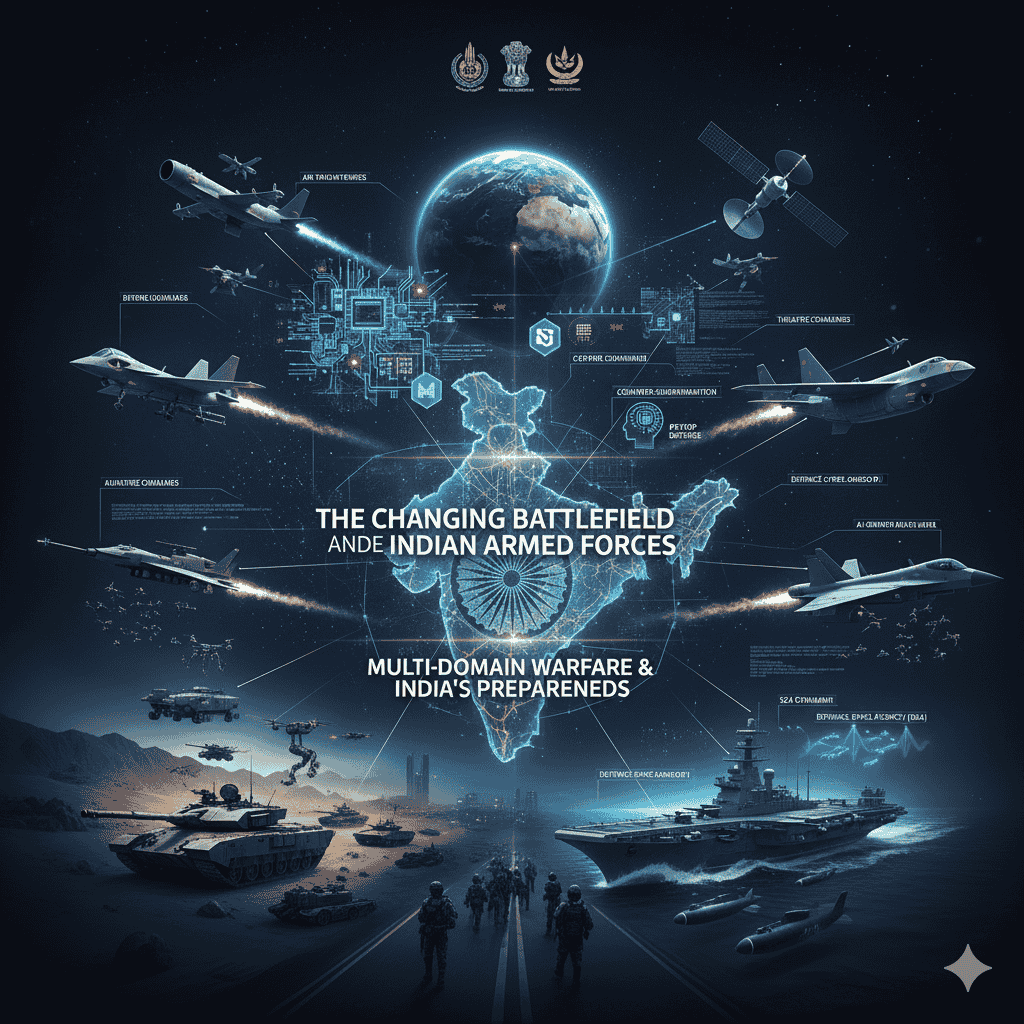
Modern warfare now spans land, sea, air, cyber, space, and information domains. AI, drones, cyberattacks, and multi-domain operations require India to restructure its armed forces, adopt new doctrines, and enhance technological capabilities to handle China–Pakistan threats.
Introduction
Context & Background
Key Points
- •Technology-Driven Conflict: Modern wars rely heavily on advanced technologies like AI, autonomous drones, surveillance satellites, and precision-guided weapons. These reduce the need for large armies but increase vulnerability because attacks can be launched from thousands of kilometres away. Even small actors can buy drones online and attack critical infrastructure.
- •Multi-Domain Operations (MDO): The next war will not wait for ground battles to start. Cyberattacks may take down power grids on day one. Satellites may be jammed. Information warfare may spread panic on social media. All domains—land, sea, air, cyber, space, and information—will be active at the same time, making coordination between services essential.
- •Information Dominance: Decision-making time in war is becoming shorter. Commanders need real-time intelligence from drones, satellites, sensors, and cyber networks. Countries that can analyse data faster using AI and take quick decisions will win—this is known as winning the ‘OODA loop’ (Observe-Orient-Decide-Act).
- •Hybrid Warriors: Modern soldiers must know both physical combat and technical skills. They must understand drones, coding, electronic warfare, GPS jamming, cyber defence, and information operations. The Indian soldier of 2030 will be a ‘digital soldier’ using smart helmets, battlefield tablets, and AI-assisted decision tools.
- •Cheaper but Deadlier Weapons: Low-cost drones costing a few thousand rupees can destroy tanks worth crores. Loitering munitions can circle overhead and dive onto targets with high accuracy. This creates asymmetric warfare where weaker forces can cause high damage.
- •Fluid and Fast-Moving Frontlines: Traditional divisions are slow to mobilise. Modern operations require small, agile, self-contained units like Integrated Battle Groups (IBGs) that combine infantry, armour, artillery, engineers, and drones in one formation, allowing rapid offensive or defensive action.
Future Battlefield vs Traditional Battlefield
| Feature | Traditional Warfare | Modern Warfare | Bookmark |
|---|---|---|---|
| Domains | Land, Sea, Air | Land, Sea, Air, Cyber, Space, Information | |
| Decision Cycle | Slow, hierarchical | Fast, AI-driven, real-time | |
| Weapons | Tanks, jets, artillery | Drones, AI, hypersonics, anti-satellite weapons | |
| Frontlines | Fixed, physical | Distributed, networked, multi-domain | |
| Soldier Skills | Physical combat focused | Tech-savvy, cyber-literate, multi-skilled |
Related Entities
Impact & Significance
- •Ensures India is Ready for Two-Front Threats: China advances rapidly in AI warfare, cyber capabilities, and drone swarms. Pakistan is improving asymmetric tools. Modernising India’s armed forces improves survival and performance during simultaneous threats from both sides.
- •Boosts India’s Deterrence: When adversaries see that India can respond quickly across domains—space, cyber, sea, and land—it discourages them from launching aggression. Strong deterrence reduces the chances of war.
- •Improves Jointness and Efficiency: Theatre commands, shared logistics, and tri-service operations reduce duplication. This saves money, speeds up response, and increases effectiveness during crises.
- •Strengthens Maritime Security: Integrated maritime and air defence networks improve India’s ability to monitor the Indian Ocean, counter Chinese presence, and protect sea lanes.
- •Builds Long-Term Technological Competence: Investments in AI, drone swarms, quantum communication, and electronic warfare push India’s defence ecosystem toward future readiness and reduce dependency on imports.
- •Enhances Crisis Response: Cyber, space, and information units help India respond quickly to non-traditional threats like cyberattacks on banks, satellites, or communication networks.
Challenges & Criticism
- •Slow Implementation of Theatre Commands: India has proposed theatre commands, but disagreements between the services on structure, leadership, and resource sharing have slowed progress. Without theatre commands, India cannot achieve fully integrated operations.
- •Unvalidated Doctrines: Concepts like Integrated Battle Groups (IBGs) and multi-domain operations are promising but not extensively tested in real conflict-like scenarios. Lack of field validation creates uncertainty.
- •Technology Gap with China: China leads in drone swarms, hypersonics, electronic warfare, space warfare, and AI-enabled battlefield systems. India lags behind in indigenous development, scaling, and deployment.
- •Weak Civil–Military–Industry Linkages: India lacks seamless coordination between the armed forces, DRDO, private sector, and academia. This slows innovation and delays new technology adoption.
- •Interoperability Limitations: Army, Navy, and Air Force use different communication systems and digital platforms. Without unified standards, real-time information sharing remains difficult.
- •Logistics and Infrastructure Weaknesses: Rapid movement during war requires strong logistics and joint supply chains. India’s logistics nodes, border infrastructure, and maintenance ecosystem need significant improvement.
Future Outlook
- •Implement theatre commands in phases, starting with those facing immediate threats (Northern, Maritime). Regular war-gaming and simulations must be used to refine command structures.
- •Create a strong Civil–Military Fusion ecosystem by integrating DRDO, ISRO, academia, startups, and private companies into defence planning, research, and rapid prototyping.
- •Transform professional military education to train future officers in AI, cyber defence, robotics, space strategy, data analytics, and information warfare.
- •Develop universal digital communication standards for the Army, Navy, and Air Force to enable real-time tri-service data sharing.
- •Prioritise indigenous development of next-gen technologies such as drone swarms, hypersonic missiles, directed-energy weapons (lasers), quantum-secure communication, and space-based ISR.
- •Adopt a ‘Test, Fail Fast, Adapt’ culture where systems are tested in real conditions, improved rapidly, and obsolete systems retired early.
- •Strengthen India’s defence industrial base by creating manufacturing clusters, specialised testing facilities, and a tri-service procurement approach for drones, sensors, and secure networks.
UPSC Relevance
- • GS-3: Defence modernisation, internal security, cyber warfare.
- • GS-2: India-China relations and national security preparedness.
- • Essay: Technology in warfare, future of armed forces, security challenges.
Sample Questions
Prelims
Which of the following best describes Multi-Domain Operations (MDO)?
1. Warfare only on land and sea
2. Operations conducted across land, sea, air, cyber, space, and information domains simultaneously
3. A naval strategy used only in the Indo-Pacific
4. A type of joint exercise between Army and Navy
Answer: Option 2
Explanation: MDO involves simultaneous operations across physical, virtual, and cognitive domains.
Mains
The battlefield is shifting towards multi-domain, technology-driven warfare. Discuss the key reforms required for the Indian Armed Forces to maintain operational credibility.
Introduction: Modern warfare now spans cyber, space, information, and AI-enabled technologies. To counter China-Pak threats, India must reform its doctrines, structures, and technological capabilities.
Body:
• Nature of Modern Warfare: Cyberattacks, drone swarms, satellite disruption, information dominance.
• Indian Reforms: Theatre commands, integrated battle groups, cyber & space units, AI-enabled systems.
• Gaps: Slow integration, technological lag, interoperability issues, logistics constraints.
• Way Forward: Civil-military fusion, PME reforms, next-gen technologies, unified communication standards.
Conclusion: India must accelerate military modernisation and embrace multi-domain integration to stay operationally effective in future conflicts.