
Climate Models & Cloud Seeding in Delhi: Science, Challenges, and Policy Debates
This combined brief explains the science behind climate models, their strengths and limitations, and evaluates Delhi’s cloud seeding experiment in the context of severe winter pollution. It provides multi-dimensional scientific, policy, governance, and ethical analysis relevant for UPSC GS-1, GS-3, and Essay Paper.
Introduction
Context & Background
Key Points
- •Earth System Complexity: Climate models include atmospheric chemistry, biosphere, ocean circulation, snow and ice dynamics, and human activities.
- •Grid-Based Simulation: Climate models divide Earth into grids horizontally and vertically; each cell tracks temperature, wind, humidity, CO₂, and radiation.
- •Types of Climate Models: Energy Balance Models (EBM), General Circulation Models (GCMs), Earth System Models (ESMs), Regional Climate Models (RCMs).
- •India’s Modelling Ecosystem: IITM-ESM, Bharat Forecast System (6 km resolution), PRECIS, CMIP5/6 GCMs, CESM, CCSM.
- •Ensemble Techniques: REA, Bayesian Averaging, Multi-Model Ensemble (MME) used to minimize errors.
- •Success Stories: 1970s models accurately predicted warming linked to CO₂ rise; predicted Arctic melt, sea-level rise, monsoon variability trends.
- •Limitation Hotspots: Aerosol-cloud interaction, monsoon dynamics, snowfall changes, and urban heat island modelling remain uncertain.
- •Delhi Pollution Science: Winter inversion, stable air mass, lack of rainfall, weak winds, crop burning, vehicular emissions, photochemical interactions.
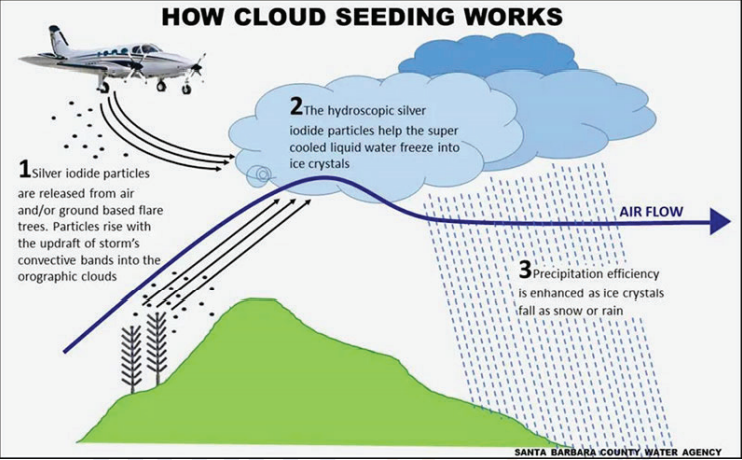
- •Cloud Seeding Mechanism: Silver iodide (ice nuclei), sodium chloride (condensation nuclei). Works only when clouds exist.
- •Delhi Experiment: ₹3.21 crore project using modified Cessna-206H; 3 sorties produced negligible rain (0.1–0.2 mm) and temporary PM dip.
- •Scientific Consensus: Cloud seeding can't create clouds; best results seen only in moist monsoon conditions (e.g., CAIPEEX, Solapur).
Related Entities
Impact & Significance
- •Governance: Climate models guide Paris Agreement targets, NDC updates, carbon budgeting, and adaptation strategies.
- •Urban Planning: Used for flood modelling, heat action plans, coastal vulnerability mapping, smart city planning.
- •Agriculture: Seasonal forecasts support crop choice, crop insurance, and drought planning.
- •Disaster Management: Inputs into cyclone prediction, heatwave alerts, and rainfall extremes.
- •Cloud Seeding Significance: Offers short-lived pollutant washout but not structural pollution reduction.
- •Health Impact: Better forecasting enables public health warnings, school closures, hospital preparedness.
- •Climate Justice: Developing nations need better models to plan adaptation and secure climate finance.
Challenges & Criticism
- •Modelling Challenges: Sparse oceanic & Himalayan observations, uncertainties in cloud microphysics, computational limits.
- •Global South Bias: Models calibrated in Europe/US perform poorly in monsoon regions.
- •Cloud Seeding Concerns: Doubts over efficacy, high cost-per-sortie, unpredictable impacts, chemical residue concerns.
- •Ethical Issues: Weather modification can trigger inter-state water disputes; no legal frameworks exist.
- •Policy Misdirection: Reliance on cloud seeding shifts focus away from emission control, public transport, C&D dust enforcement, stubble solutions.
- •Data Security: Climate models require vast datasets; lack of data-sharing affects accuracy.
Future Outlook
- •India will upgrade to petascale and exascale supercomputing for climate modelling.
- •National framework for weather modification may be developed within a decade.
- •Expansion of dense automatic weather stations and ocean buoys for high-resolution data.
- •AI/ML will be integrated with RCMs to improve monsoon prediction.
- •Delhi and NCR expected to adopt long-term airshed management approach.
- •South–South collaboration will grow through BRICS climate centre and Indian Ocean Observing System.
- •India likely to propose regional monsoon model architecture under WMO.
UPSC Relevance
- • GS-1: Climate systems, atmospheric processes, geographical factors of pollution.
- • GS-3: Environmental pollution, climate science, technology for disaster management.
- • Essay: Climate justice, science & society, environmental ethics, technology vs governance.
Sample Questions
Prelims
With reference to climate models and cloud seeding, consider the following statements:
- (a)Cloud seeding is more effective in warm, moisture-rich clouds than in dry winter clouds.
- (b)IITM-ESM is India’s contribution to the CMIP6 project.
- (c)Silver iodide is used as a hygroscopic salt in warm cloud seeding.
- (d)Temperature inversion conditions assist pollutant dispersion in winter.
Mains
Cloud seeding has been proposed as a technological solution to Delhi’s air pollution. Critically evaluate this approach in light of scientific principles and long-term environmental governance needs.
Introduction: Cloud seeding is a weather-modification technique using silver iodide or salts to enhance rainfall. Delhi tried it to wash out winter pollutants, but results remained minimal.
Body:
• Scientific Constraints: Winter clouds over Delhi are thin, moisture-poor, and unsuitable for seeding. Cloud seeding cannot create clouds from clear skies.
• Limited Impact: Even if rainfall is induced, pollutant washout lasts 24–48 hours. Rapid rebound occurs due to ongoing emissions.
• Environmental Risks: Chemical accumulation, water contamination, and ecological disturbance.
• Governance Issues: High cost, lack of legal frameworks, interstate rainfall conflicts, and misplaced policy priority.
• Better Alternatives: Airshed management, stubble control, vehicular reforms, renewable energy transition, strict CAQM enforcement.
Conclusion: Cloud seeding cannot substitute structural measures. Sustainable improvement requires science-backed, multi-state, long-term governance frameworks rather than episodic technological interventions.