
India's Largest Drone & Counter-Drone Exercise 'Cold Start' and Sudarshan Chakra
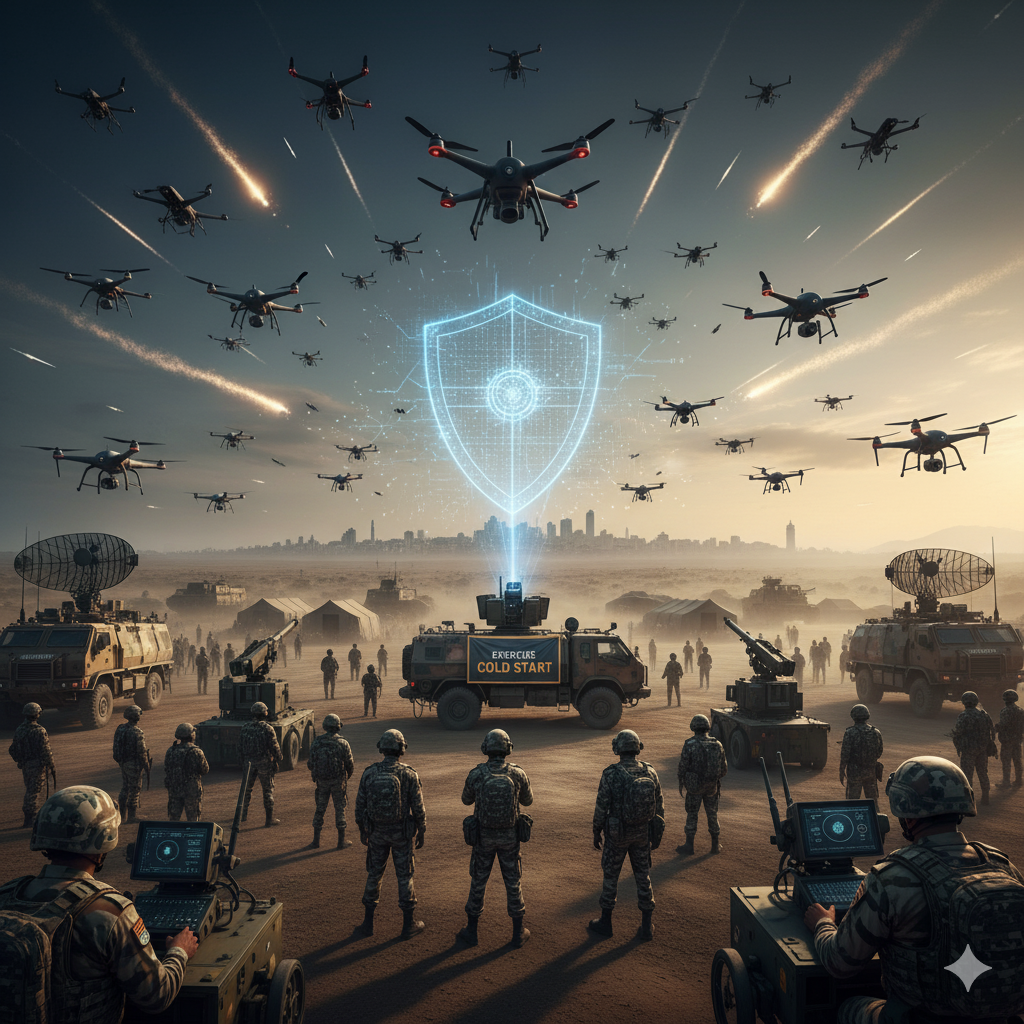
India will conduct its biggest-ever tri-service drone and counter-drone exercise, 'Cold Start', in October 2025, testing cutting-edge counter-UAS technologies and feeding lessons into the indigenous Sudarshan Chakra air defence program.
Introduction
Context & Background
Key Points
- •Exercise Cold Start Objectives: Simulate diverse drone warfare scenarios including swarms (large groups of coordinated drones), loitering munitions (drones that can wait over an area before attacking), and strike drones.
- •Testing Counter-Drone Tech: Evaluate technologies like electronic jamming (disrupting drone signals), radar detection, high-energy lasers, and physical interceptors.
- •Enhance Tri-Service Interoperability: Improve coordination between the Army, Navy, and Air Force in drone operations.
- •Testbed for Sudarshan Chakra: Provide a live environment to test systems being developed under the Sudarshan Chakra air defence program.
- •Civilian Infrastructure Defence: Strengthen readiness to protect critical civilian sites like power plants and airports from drone threats.
- •Sudarshan Chakra Components: Includes wide sensor networks (radar, electro-optical, IR, satellite), AI/ML-powered Command & Control (C2), multi-layer interceptors (missiles, directed energy weapons), and cross-domain integration.
- •Recent Milestones (Sudarshan Chakra): Successful first integrated test firing combining missile and laser interception (2025); Government committee formed and initial budget cleared.
Related Entities
Impact & Significance
- •Countering Asymmetric Threats: Directly addresses the challenge of low-cost drones being used effectively in modern warfare, especially at borders.
- •Strengthening Deterrence: Building capacity against drone swarms acts as a deterrent (discouraging potential attackers).
- •Boosting 'Atmanirbhar Bharat': Supports India's drive for self-reliance in defence manufacturing and technology.
- •Preparing for Future Wars: Develops capabilities for multi-domain, network-centric warfare.
- •Protecting Critical Infrastructure: Enhances security for essential civilian facilities.
- •Regional Power Projection: Demonstrates India's advanced defence capabilities in the South Asian region.
Challenges & Criticism
- •High Deployment Costs: Equipping India's vast geography with advanced systems is expensive.
- •Rapid Technological Change: Drone and counter-drone technologies evolve very quickly, risking obsolescence.
- •Integration Difficulties: Integrating new AI-driven systems with older, existing defence platforms is complex.
- •Risk of False Positives: Differentiating between harmless civilian drones and hostile ones is difficult and critical.
- •Electronic Warfare Vulnerability: Systems are susceptible to enemy jamming, signal spoofing, and cyberattacks.
- •Legal & Ethical Issues: Using counter-drone measures (like jamming or shooting down) in civilian airspace raises complex legal questions.
- •Adversary Adaptation: Opponents will develop countermeasures like stealth drones or AI-driven swarms.
Future Outlook
- •Post-'Cold Start' Actions: Expect changes in military doctrine (official methods and principles of warfare) and defence procurement priorities based on exercise results.
- •Sudarshan Chakra Rollout: Pilot projects likely to be deployed first in sensitive regions (e.g., border areas, major cities).
- •Project Kusha Progress: Look for key testing milestones for these long-range interceptor missiles starting from 2026.
- •Akashteer Integration: The Army's command system will be progressively rolled out to link with Sudarshan Chakra.
- •International Defence Cooperation: India may pursue partnerships with countries like Israel, the US, and Russia for specific advanced technologies.
- •Drone Regulations: Development of a clear national drone law to manage military vs. civilian drone operations is expected.
UPSC Relevance
- • GS Paper 2: International relations (India-Pakistan), Security challenges & their management in border areas, Role of technology in national security.
- • GS Paper 3: Achievements of Indians in science & technology; indigenization of technology (Sudarshan Chakra, Project Kusha), Defence technology, Cyber warfare, Challenges to internal security through communication networks (drone vulnerabilities).
- • Essay/Ethics: Technology as a double-edged sword, Ethics of autonomous weapons, Asymmetric warfare and national security, Role of indigenous technology in strategic autonomy.
Sample Questions
Prelims
Which of the following statements about India's 'Cold Start' exercise (planned for 2025) is/are correct?
- (a)It is primarily focused on traditional tank and infantry warfare.
- (b)It is described as India's largest tri-service exercise dedicated to drone and counter-drone operations.
- (c)It will serve as a testing ground for components of the indigenous 'Sudarshan Chakra' air defence system.
Mains
Drone warfare has emerged as a significant security challenge, particularly in border regions. Analyze India's response in light of the planned 'Cold Start' exercise and the ongoing 'Sudarshan Chakra' programme. What are the key hurdles India faces in implementing these measures effectively?
Introduction: The proliferation of low-cost, high-impact drones presents a major asymmetric warfare challenge, vividly demonstrated in recent border skirmishes. India's response involves both tactical refinement through exercises like 'Cold Start' and strategic capability building via the 'Sudarshan Chakra' programme.
Body:
• 'Cold Start' Exercise: This large-scale tri-service exercise aims to develop and validate doctrines for drone usage (swarms, loitering munitions) and test various counter-drone technologies (jamming, lasers, interceptors), improving inter-service coordination specifically for this domain.
• 'Sudarshan Chakra' Programme: This is a long-term, indigenous effort to build a multi-layered, integrated air defence shield. It focuses on integrating advanced sensors, AI-powered command, and diverse interceptors (missiles like Project Kusha, directed energy) to counter a wide spectrum of aerial threats, including sophisticated drones.
• Synergy and Significance: Cold Start provides practical feedback and identifies gaps that inform the development and deployment strategy of Sudarshan Chakra. Together, they aim to enhance deterrence, protect critical assets, and boost self-reliance (Atmanirbhar Bharat) in a crucial defence technology area.
• Key Hurdles (Challenges): India faces substantial challenges including the high cost of deploying such advanced systems nationwide, the rapid pace of technological obsolescence in drone tech, difficulties in integrating new systems with legacy platforms, the risk of false positives with civilian drones, vulnerability to electronic warfare, and complex legal/ethical considerations for operating counter-measures.
Conclusion: 'Cold Start' and 'Sudarshan Chakra' signify India's proactive approach to the evolving drone threat. While strategically vital, their ultimate success depends on sustained investment, rapid indigenous innovation, effective integration across domains and services, and the formulation of clear operational guidelines and legal frameworks.