
Defence Budget for Effective Deterrence
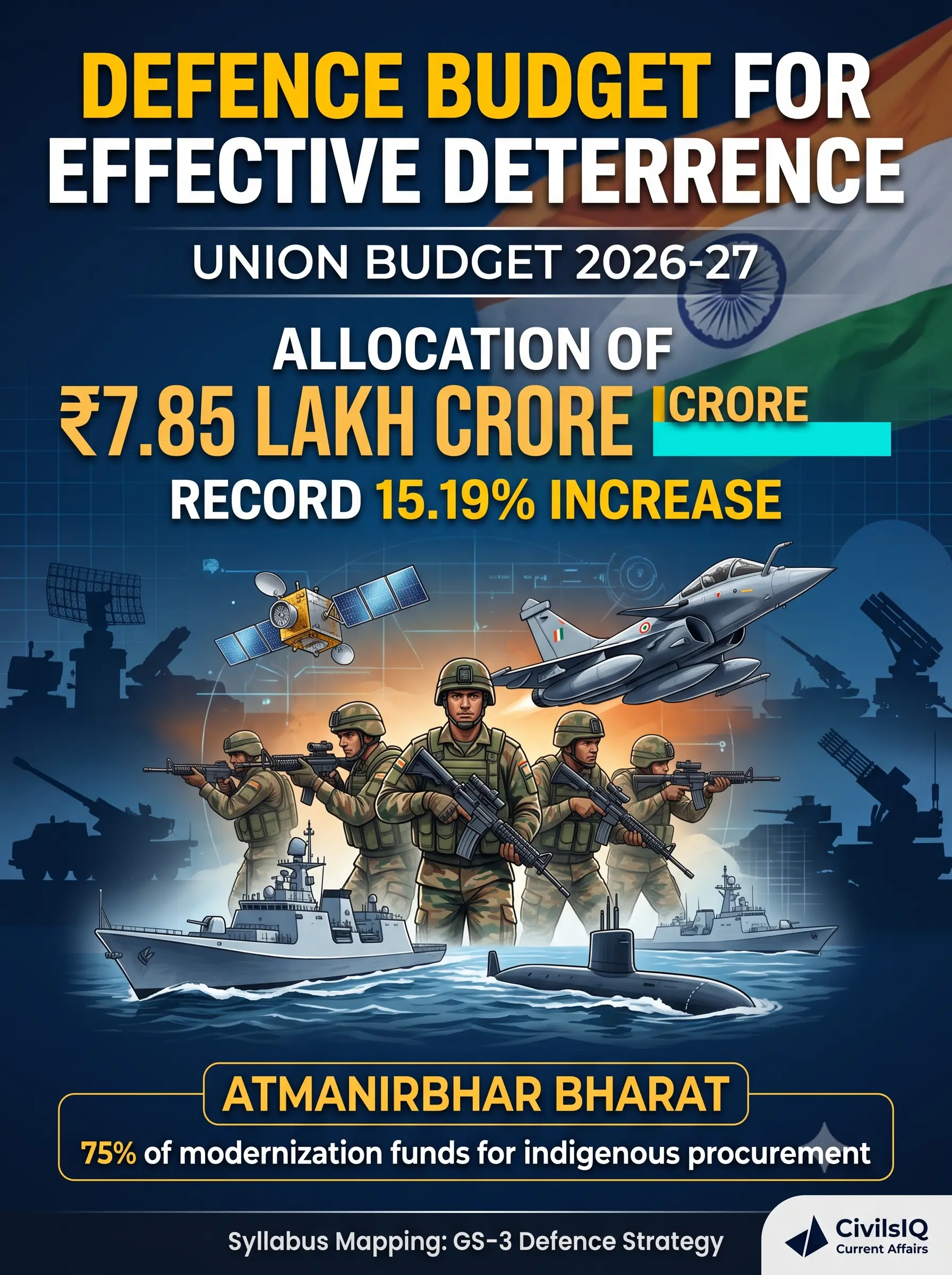
Union Budget 2026-27 has significantly bolstered India's national security framework with a record allocation of Rs 7.85 lakh crore. This budget represents a 15.19 per cent increase over the previous year and focuses heavily on capital outlay, indigenous procurement (Atmanirbhar Bharat), and closing capability gaps to ensure credible deterrence against regional threats.
Introduction
Context & Background
Key Points
- •Link Between Budget and Deterrence: India’s defence spending aims to create credible denial capabilities that secure peace. Credible deterrence comes from tangible capability, not just slogans.
- •Closing Capability Gaps: For years, India faced a mismatch between strategic ambitions and military capabilities (e.g., legacy platforms, dwindling fighter squadron strength, stretched naval assets).
- •Operational Lessons — 'Operation Sindoor': Recent military engagements exposed issues in readiness and force modernisation, prompting institutional recognition that preparedness cannot be deferred.
- •Regional Security Environment: India's neighbourhood features persistent threats, including China's military expansion along the LAC and Indian Ocean, and Pakistan’s conventional/nuclear force posture.
- •Two-Front Security Calculus: A deepening China-Pakistan strategic nexus adds pressure, making credible deterrence central to India’s defence outlook to discourage coercion.
- •Strategic Autonomy Imperative: Global geopolitical unpredictability and shifts in US foreign policy highlight the need for a self-reliant defence capability in a multipolar world.
Key Highlights of Defence Budget 2026-27
| Parameter | Allocation / Figure | Significance | Bookmark |
|---|---|---|---|
| Total Allocation | Rs 7.85 lakh crore | 15.19% increase over previous year's estimates | |
| Capital Outlay | Sharper rise of ~21.8% | Focused on procurement and modernization | |
| Indigenous Procurement | ~75% of modernization funds | Aligns with Atmanirbhar Bharat vision | |
| Long-term Trend | Nearly tripled since 2013–14 | Grew from ₹2.53 lakh crore to ₹7.85 lakh crore |
Recommendations for India's Defence Strategy
| Strategic Reform | Action Required | Outcome/Benefit | Bookmark |
|---|---|---|---|
| Prioritise Indigenous Capability | Enhance domestic arms production and R&D. | Reduces import dependence and builds industrial depth. | |
| Increase Capital Outlay | Shift budget composition toward capital expenditure. | Requires reducing personnel and pension burdens. | |
| Streamline Procurement | Shorten acquisition cycles and integrate private sector. | Speeds up delivery of advanced defense systems. | |
| Build Multi-Domain Deterrence | Balance deterrence across land, air, sea, cyber, and space. | Strengthens second-strike capability and surveillance. |
Related Entities
Impact & Significance
- •Enhanced Deterrence Posture: Upgrading military capability naturally discourages adversary coercion and reduces the likelihood of risk-taking along disputed borders.
- •Industrial & Economic Catalyst: By heavily funding indigenous R&D and domestic procurement, the budget acts as a catalyst for India's domestic defence manufacturing ecosystem.
- •Strengthened Second-Strike Capability: Expansions in domains like sea-based nuclear assets (submarine triad) consolidate India's strategic deterrent in the region.
- •Autonomy in Foreign Policy: Reducing reliance on foreign military hardware ensures that India’s strategic choices are not constrained by external geopolitical pressures or supply chain disruptions.
Challenges & Criticism
- •Personnel and Pension Burdens: A significant structural challenge remains the high proportion of the budget absorbed by revenue expenditures (salaries and pensions), which limits the total funds available for tech modernization.
- •Procurement Delays: Despite recent reforms, bureaucratic bottlenecks in the acquisition cycle still exist, which can delay the delivery of critical advanced systems.
- •Technological Asymmetry: While domestic production is rising, achieving parity in cutting-edge multi-domain technologies (cyber, space, advanced aviation) with primary adversaries remains a steep challenge.
Future Outlook
- •Expansion of Defence Start-ups: Innovation summits (like in Visakhapatnam) highlight emerging synergies between the military, industry, and start-ups that will be further expanded.
- •Reforming Personnel Costs: Undertaking structural reforms to reduce personnel and pension burdens over time, freeing up future allocations for next-generation technology.
- •Space and Cyber Focus: Directing future capital towards space-based surveillance and robust cyber defence projects to achieve true multi-domain deterrence.
- •Deepened Global Partnerships: Engaging in strategic partnerships, such as with France, for joint manufacturing of platforms like Rafale aircraft to enhance interoperability and tech transfer.
UPSC Relevance
- • GS-3 (Security & Defence Strategy): Role of the Union Budget in modernizing the armed forces, border security challenges, and the indigenization of defence technology.
- • GS-2 (International Relations): India's strategic autonomy, managing the two-front threat (China-Pakistan nexus), and regional security partnerships.
- • Essay Topics: 'Credible deterrence comes from capability, not slogans', 'Self-reliance in defence as a pillar of strategic autonomy'.
Sample Questions
Prelims
Consider the following statements regarding India's Defence Budget trends:
1. The entire defence capital outlay in FY 2026-27 is mandated to be spent exclusively on foreign procurements.
2. Capital expenditure in the defence budget is primarily aimed at the procurement of new equipment and modernization of the armed forces.
3. India's defence budget has seen a steady decline since the financial year 2013-14.
Answer: Option 2
Explanation: Statement 1 is incorrect as nearly three-fourths of modernization funds are earmarked for indigenous procurement. Statement 3 is incorrect as the budget has nearly tripled since 2013-14. Statement 2 is correct.
Mains
“India’s recent defence budgets reflect a strategic shift from an arms race narrative towards building credible deterrence and strategic autonomy.” Analyze this statement in the context of the Union Budget 2026-27.
Introduction: Introduce the Rs 7.85 lakh crore allocation in FY 2026-27 and define the core concepts of 'credible deterrence' and 'strategic autonomy'.
Body:
• Building Credible Deterrence: Record allocation of Rs 7.85 lakh crore and a 21.8% rise in capital outlay aimed directly at closing legacy capability gaps (fighter squadrons, naval assets).
• Operational & Regional Drivers: Lessons from 'Operation Sindoor' and the persistent two-front threat from the China-Pakistan nexus necessitating immediate modernization.
• Strategic Autonomy through Indigenization: Earmarking ~75% of the modernization budget for domestic industries (Atmanirbhar Bharat) to reduce import dependence amidst global geopolitical unpredictability.
Conclusion: Conclude by emphasizing that streamlining procurement and balancing allocations towards capital expenditure will be vital to sustaining this multi-domain deterrence strategy in a multipolar world.