
Development as Adaptation: India’s Strategic Pivot in Climate Action
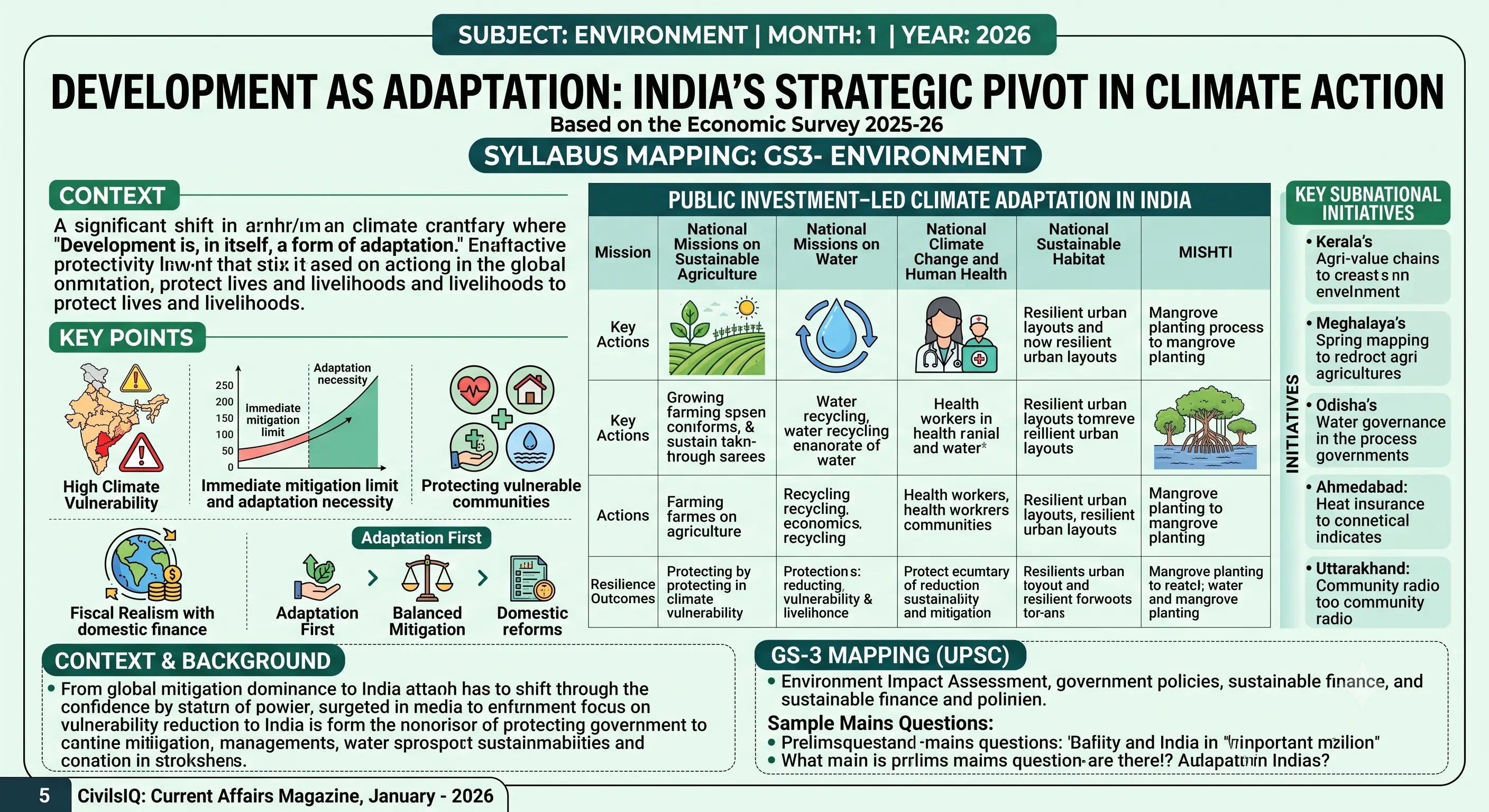
In a significant departure from conventional climate narratives, the Economic Survey 2025-26 has introduced a paradigm shift: 'Development is, in itself, a form of adaptation.' This article explores India's strategy to integrate climate resilience directly into its developmental trajectory, prioritizing adaptation amidst severe global climate finance gaps.
Introduction
Context & Background
Key Points
- •Adaptation First: India puts adaptation first to protect lives, livelihoods, water, and food security from climate impacts, using public investment, state planning, and community-led development to reduce losses and build local resilience.
- •Concurrent Mitigation: At the same time, India pursues mitigation by expanding renewables, efficiency, green hydrogen, and nuclear, while prioritizing reliable, affordable energy despite challenges of technology access, critical minerals, and finance.
- •Domestic Resource Mobilization: With limited global climate finance, India relies largely on domestic reforms and innovative tools like green bonds and sustainable finance frameworks to mobilize capital for climate action.
- •Kerala (KERA Project): A $285 million subnational project modernizing agri-value chains for 400,000 farmers to boost resilience.
- •Ahmedabad Heat Action Plan: Features a Parametric Heat Insurance scheme for informal workers, triggering automatic payouts when temperatures cross specific thresholds.
- •Community-Led Governance: Initiatives like Odisha’s Pani Panchayats have boosted high-value vegetable farming by 105%, while Uttarakhand’s Mandakini ki Aawaz uses community radio for disaster early warnings.
Public Investment–Led Climate Adaptation in India
| Mission / Programme | Focus Area | Key Actions / Components | Outcomes for Climate Resilience | Bookmark |
|---|---|---|---|---|
| National Mission on Sustainable Agriculture | Climate-resilient farming | Efficient irrigation under 'Per Drop More Crop', integrated rainfed farming, soil health management via Soil Health Cards | Improves water use efficiency, sustains farm productivity, and enhances resilience to droughts and climate variability | |
| National Water Mission | Water conservation and equitable access | Integrated water resource management, state-specific water plans, rainwater harvesting with financial support to States/UTs | Strengthens water security and reduces vulnerability to water stress | |
| National Programme on Climate Change and Human Health | Climate and public health | Awareness on climate-related health risks, strengthening health systems for vulnerable groups | Reduces health impacts from heatwaves, disasters and changing disease patterns | |
| National Mission on Sustainable Habitat | Climate-resilient urban development | Integration with Swachh Bharat Mission and sustainable urban transport | Enhances urban liveability and resilience to heat, floods and pollution | |
| National Coastal Mission | Coastal and marine resilience | Integrated coastal zone management and climate-resilient coastal infrastructure | Protects coastal communities from sea-level rise and extreme weather | |
| MISHTI (Mangrove Initiative for Shoreline Habitats & Tangible Incomes) | Mangrove restoration and livelihoods | Restoration of 540 sq km of mangroves (2023–28) across coastal States/UTs through convergence with existing schemes | Creates coastal protection, carbon sink (4.5 Mt), jobs (22.8 million person-days) and nature-based livelihoods | |
| National Plan for Conservation of Aquatic Ecosystems | Wetland and aquatic ecosystem protection | Expansion and conservation of wetlands | Provides natural buffers for floods and improves long-term water security | |
| Mission LiFE (Lifestyle for Environment) | Behavioural and community action | Promotes mindful resource use and sustainable lifestyles | Supports ecosystem-led, development-integrated climate resilience through citizen participation |
Related Entities
Impact & Significance
- •Protecting Lives and Livelihoods: Investments in health, housing, and agriculture directly reduce mortality, income losses, and displacement during extreme climate events.
- •Reducing Inequality: Poor and informal workers are most exposed to climate shocks; development as adaptation ensures equity by protecting the most vulnerable first.
- •Long-Term Economic Stability: Climate-resilient infrastructure and human capital lower disaster-recovery costs and prevent growth reversals, making adaptation economically prudent.
- •Fiscal and Institutional Realism: By relying on domestically funded development programs, India creates a scalable adaptation pathway independent of uncertain global climate finance.
Challenges & Criticism
- •Severe Climate Finance Gap: Global climate finance favors Mitigation (Solar, EVs) for commercial returns. The UNEP Adaptation Gap Report 2025 notes developing countries need $310–$365 billion annually by 2035, yet current flows are a mere $26 billion.
- •Fiscal Stress & Competing Priorities: High adaptation spending strains government finances when balanced against poverty reduction and social welfare.
- •Climate-Blind Infrastructure Legacy: Existing infrastructure was designed for historical, not future, climate conditions, making retrofitting highly expensive.
- •Data and Early-Warning Gaps: A lack of granular climate-risk data, forecasting capacity, and precise impact assessment tools undermines evidence-based planning.
- •Coordination Deficits: Fragmented mandates across climate, disaster management, and infrastructure agencies often dilute accountability and delay integrated action.
Future Outlook
- •Strengthen Climate-Ready Health Systems: Scale up heat-action plans, disease surveillance, and resilient healthcare infrastructure to manage rising heat stress, vector-borne diseases, and disaster-related health shocks.
- •Invest in Climate-Resilient Infrastructure: Redesign roads, bridges, housing, and power grids using climate-risk assessments so critical infrastructure remains functional during floods, cyclones, and heatwaves.
- •Enhance Agricultural Productivity and Resilience: Promote climate-resilient crops, efficient irrigation, soil health management, and risk-transfer tools to protect the 45% of the workforce dependent on agriculture.
- •Ensure Reliable and Affordable Energy Access: Balance renewable expansion with grid stability, storage, and diversified energy sources to provide dependable power.
- •Integrate Resilience into Development Planning: Make climate-risk screening mandatory across sectors so investments collectively enhance society’s capacity to absorb and recover from climate shocks.
UPSC Relevance
- • GS-3 (Environment & Disaster Management): Climate change adaptation strategies, sustainable agriculture, and climate finance.
- • GS-3 (Economy): Infrastructure development, economic resilience, and energy security.
- • Essay Topics: 'Development vs. Environment: A False Dichotomy?', 'Climate Change and the Global South'.
- • Mains Focus: Analyzing why developing nations must prioritize adaptation and the failure of global climate finance.
Sample Questions
Prelims
Consider the following statements regarding climate adaptation initiatives in India:
1. MISHTI is primarily aimed at wetland and aquatic ecosystem protection in inland regions.
2. The 'KERA Project' is an initiative of Kerala aimed at modernizing agri-value chains for farmers.
3. Global climate finance is currently heavily skewed toward Adaptation rather than Mitigation.
Answer: Option 2
Explanation: Statement 1 is incorrect; MISHTI focuses on Mangrove restoration in coastal states. Statement 2 is correct. Statement 3 is incorrect; global finance is heavily skewed toward Mitigation (e.g., Solar, EVs) because they offer commercial returns, while adaptation remains underfunded.
Mains
“For developing nations like India, development is, in itself, a form of adaptation.” In light of the Economic Survey 2025-26, discuss this statement. What are the key challenges in financing and executing this paradigm shift?
Introduction: Define the paradigm shift introduced in the Economic Survey 2025-26. Briefly explain why mitigation alone cannot prevent near-term climate impacts for a geography as diverse as India.
Body:
• Need for Development as Adaptation: High vulnerability; Limits of mitigation-only global approaches; Need to protect livelihoods and reduce inequality; Securing long-term economic stability.
• Key Strategies (Examples): National Mission on Sustainable Agriculture, MISHTI, State initiatives like Ahmedabad Heat Action Plan and KERA project.
• Challenges: Severe climate finance gap skewed towards mitigation; Fiscal stress on the state; Uneven institutional capacity; Legacy of climate-blind infrastructure.
Conclusion: Conclude by emphasizing that integrating resilience into development planning is not just an environmental mandate but an economic necessity, calling for reformed global climate finance mechanisms.