
DISCOMs Recorded a Positive Turnaround in FY 2024-25
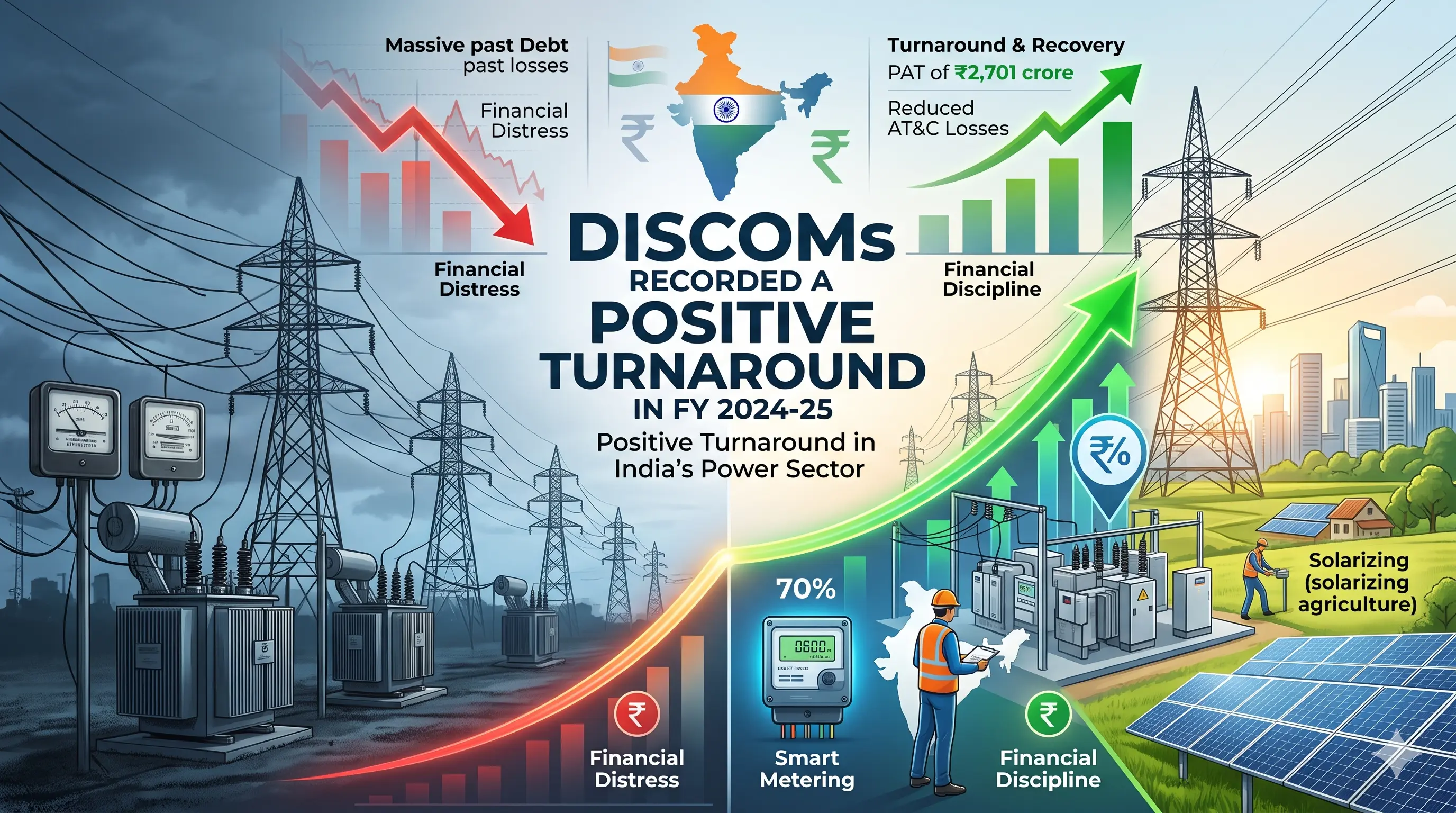
After years of financial distress, DISCOMs recorded a turnaround in FY 2024-25, marked by reduced AT&C losses, a narrowing of the ACS-ARR gap, and improved financial discipline.
Introduction
Context & Background
Key Points
- •Reform Incentive (RDSS): The Revamped Distribution Sector Scheme (RDSS) successfully tied the release of central funds directly to the implementation of performance-based reforms by the states.
- •Statutory Enforcement: The Late Payment Surcharge (LPS) Rules, 2022, compelled utilities to clear legacy dues through interest-free EMIs, enforcing strict liquidity discipline.
- •Smart Metering: The accelerated rollout of prepaid smart meters has significantly curbed power theft and improved billing accuracy, especially in traditionally high-loss areas.
- •Dynamic Pricing: Amended Electricity Rules prevented the accumulation of new deficits by automatically passing through fuel cost variations to the end consumers.
- •Feeder Segregation: The separation of agricultural loads in states like Gujarat allowed for more precise energy auditing and targeted power supply.
Current Financial and Operational Status of DISCOMs (FY 2024-25)
| Indicator | Previous Status | Current Status (FY 2024-25) | Bookmark |
|---|---|---|---|
| Profit After Tax (PAT) | Loss of ₹67,962 crore (FY 2013-14) | Profit of ₹2,701 crore | |
| Aggregate Technical and Commercial (AT&C) Losses | 22.62% | 15.04% | |
| ACS-ARR Gap | High revenue deficit | ₹0.06 per unit (near-complete cost recovery) | |
| Outstanding Dues to Generators | ~₹1.4 lakh crore | Under ₹5,000 crore (by Jan 2026) |
Related Entities
Impact & Significance
- •Reduced Fiscal Burden on States: With DISCOMs achieving profitability and near-complete cost recovery (ACS-ARR gap of just ₹0.06 per unit), the immense pressure on state exchequers to provide repeated bailouts is minimized.
- •Revival of the Generation Sector: The strict liquidity discipline and reduction of outstanding dues to generators (from ₹1.4 lakh crore to under ₹5,000 crore) have restored cash flows for power generation companies, encouraging new investments.
- •Enhanced Energy Security: Better financial health allows DISCOMs to invest in grid modernization and renewable energy integration, which is crucial for meeting India's growing peak power demand.
- •Consumer Accountability: The transition to smart metering and dynamic pricing fosters a culture of prompt payment and energy conservation among end consumers.
Challenges & Criticism
- •Structural Dependency: The recorded profitability is often artificial; many states still rely heavily on subsidy payouts and RDSS grants to cover operational losses rather than fixing structural inefficiencies.
- •Tariff Under-recovery: Political hesitation leads to “non-cost reflective tariffs”, creating a persistent revenue gap that undermines the economic foundation of DISCOMs.
- •Infrastructure Deficit: Obsolete distribution infrastructure, especially in rural areas, leads to high technical losses that frequently exceed the 6-8% global benchmark.
- •Data Blindspots & Cross-Subsidisation: Unmetered flat-rate supply in agriculture prevents accurate measurement of power leakage. Meanwhile, excessively high tariffs for industrial consumers to cross-subsidize this supply push industries toward captive power plants, shrinking the high-paying customer base for DISCOMs.
Future Outlook
- •Solarise Agriculture: Deploying schemes like PM-KUSUM to solarise farm pumps will permanently reduce power procurement costs for DISCOMs.
- •Arrest Leakage: Enforcing universal metering and expanding feeder segregation is necessary to capture accurate, real-time consumption data.
- •Protect Autonomy: Empowering State Electricity Regulatory Commissions (SERCs) to mandate cost-reflective tariffs without political interference is critical for sustained financial health.
- •Grid Modernisation & Competition: Adopting AI-enabled 'Smart Grid' technologies for demand forecasting, and delicensing distribution to separate 'Carriage and Content', allowing consumers to choose their power supplier.
UPSC Relevance
- • GS-3 (Indian Economy): Infrastructure (Energy), issues relating to planning, mobilization of resources, growth, and development.
- • GS-2 (Governance): Government policies and interventions for development in various sectors (Power Sector Reforms).
- • Mains Focus: Analyzing the structural issues of DISCOMs, the impact of recent reforms like RDSS and LPS rules, and the way forward for the power sector.
Sample Questions
Prelims
Consider the following statements regarding the Power Distribution Sector in India:
1. DISCOMs were created by unbundling State Electricity Boards under the Electricity Act, 1948.
2. The Revamped Distribution Sector Scheme (RDSS) ties central funding directly to the implementation of performance-based reforms.
3. Cross-subsidisation in the Indian power sector generally implies that agricultural consumers subsidize industrial consumers.
Answer: Option 2
Explanation: Statement 1 is incorrect; unbundling happened under the Electricity Act, 2003. Statement 2 is correct. Statement 3 is incorrect; in India, industrial and commercial consumers pay higher tariffs to cross-subsidize agricultural and domestic consumers.
Mains
“Despite a recent positive financial turnaround, India’s power distribution companies (DISCOMs) continue to face structural and operational vulnerabilities.” Analyze the reasons behind the recent performance improvement of DISCOMs and suggest measures for achieving their long-term sustainability.
Introduction: Define DISCOMs and highlight their recent achievement (PAT of ₹2,701 crore in FY 25, drop in AT&C losses) contrasting it with their historical financial distress.
Body:
• Drivers of Turnaround: Implementation of RDSS (performance-linked funds); Late Payment Surcharge Rules, 2022 reducing legacy dues; smart metering curbing theft; dynamic pricing and feeder segregation.
• Persistent Vulnerabilities: Structural dependency on state subsidies; 'Non-cost reflective tariffs' creating revenue gaps; outdated rural infrastructure leading to high AT&C losses; data blindspots due to unmetered agricultural supply; cross-subsidisation burdening industrial consumers.
• Measures/Way Forward: Solarising agriculture via PM-KUSUM; ensuring autonomy of SERCs for tariff determination; modernising the grid with AI; delicensing distribution (separating carriage and content).
Conclusion: Conclude by emphasizing that the transition from a 'bailout-dependent' model to a 'commercially viable' entity is essential not just for the power sector, but for India's overall macroeconomic stability and energy transition goals.