
Early 8th-Century Telugu Inscription Discovered in Andhra Pradesh
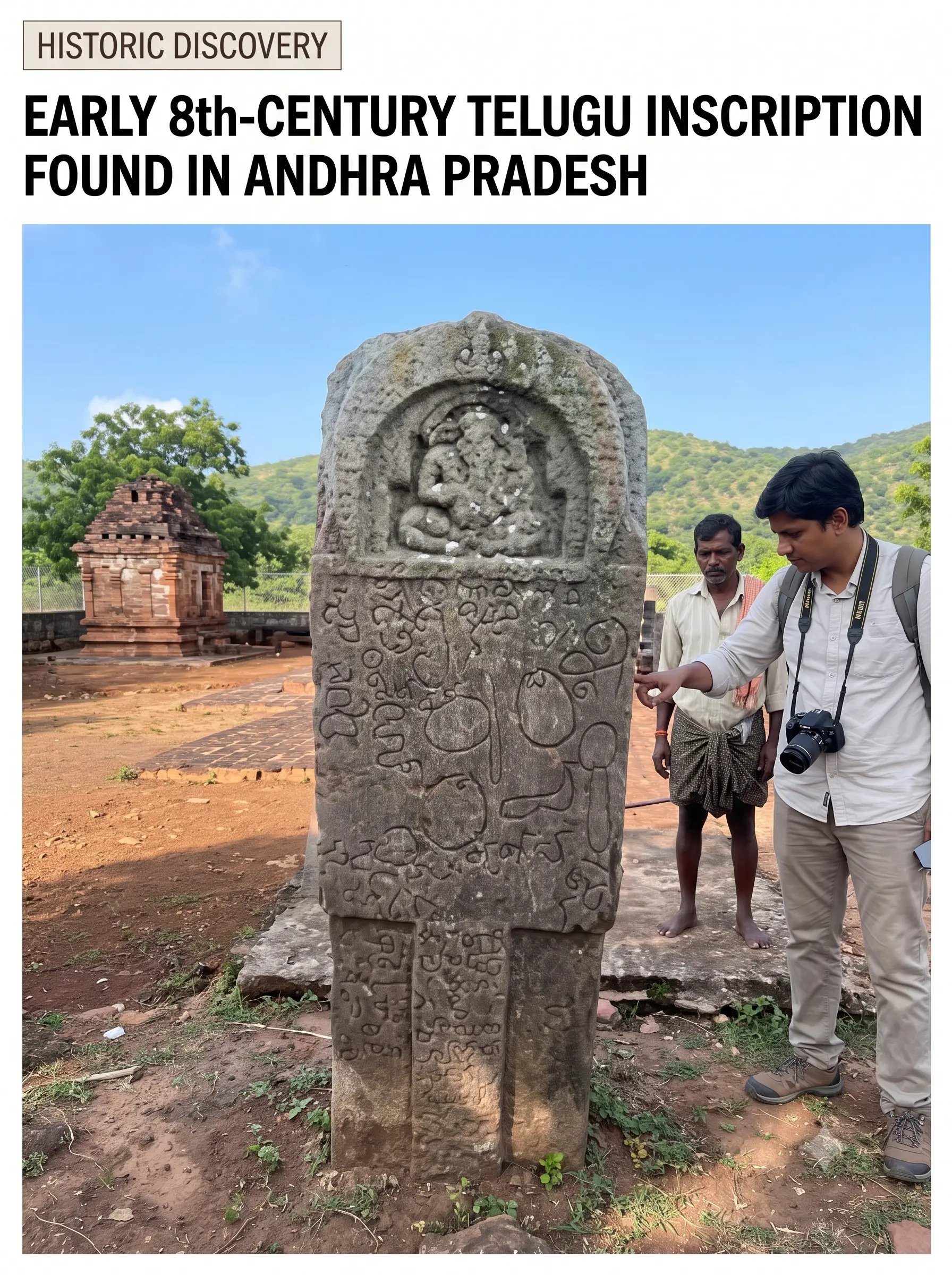
An early 8th-century Telugu inscription has been discovered at the Pitikesvara temple in Pitikayagulla, Andhra Pradesh. This rare find records the construction of a new embankment and provides vital insights into the transition of the Telugu script and early medieval regional administration.
Introduction
Context & Background
Key Points
- •Historical Dating: The inscription is dated to the early 8th century CE, making it one of the earliest known Telugu inscriptions identified in the region.
- •Location and Context: It was found engraved on a stone slab erected directly in front of the historic Pitikesvara temple at Pitikayagulla.
- •Public Infrastructure Record: Epigraphists have translated the text, which primarily records the construction of a new embankment, referred to locally as a nava katta.
- •Role of Artisans: The embankment work is attributed to Pranimilli Achari, who is identified as a sculptor or craftsman. This highlights the active and respected role of artisans in building public infrastructure during that era.
- •Linguistic Shift: The text is written in early Telugu using a transitional script. It underscores the historical shift away from dominant Prakrit and Sanskrit influences toward a distinct and independent Telugu literary tradition.
Key Details of the Discovery
| Attribute | Details | Bookmark |
|---|---|---|
| Location | Pitikayagulla, Andhra Pradesh (in front of the Pitikesvara temple) | |
| Period | Early 8th Century CE | |
| Language/Script | Early Telugu / Transitional script | |
| Key Figure Mentioned | Pranimilli Achari (Sculptor/Craftsman) | |
| Core Subject | Construction of a new embankment (nava katta) |
Related Entities
Impact & Significance
- •Filling the Chronological Gap: The discovery bridges a critical historical gap between the older Brahmi-based inscriptions and the more evolved Telugu records of the later medieval periods.
- •Insights into Regional Governance: By recording local administrative actions like the construction of a nava katta, the slab offers direct evidence of early medieval regional governance, land relations, and resource management.
- •Elevating the Artisan Class: The specific naming of the craftsman (Pranimilli Achari) signifies that artisans held recognized and important roles in the social and administrative organization of the period.
Challenges & Criticism
- •Preservation of Stone Records: Open-air stone inscriptions located in front of temples are highly vulnerable to natural weathering, soil erosion, and human interference over centuries.
- •Deciphering Transitional Scripts: Transitional scripts are notoriously difficult to translate because they mix older alphabetical forms with newly evolving characters, requiring highly specialized epigraphical expertise.
- •Contextual Isolation: Often, single inscriptions provide a localized snapshot, making it challenging for historians to map out the broader macro-level political environment without corroborating archaeological evidence.
Future Outlook
- •Epigraphical Mapping: Scholars anticipate that this discovery will prompt further focused epigraphical surveys in Andhra Pradesh to find more records from the transitional 8th-century period.
- •Digital Preservation: There is a growing need to use 3D scanning and digital archiving to preserve this and similar transitional script slabs from weathering and environmental degradation.
- •Linguistic Research: The find will serve as a primary source for linguists tracing the exact chronological evolution of the Telugu script from earlier Brahmi-based variants.
UPSC Relevance
- • GS-1 (Indian Heritage and Culture): Evolution of literature and scripts in India, specifically the development of Dravidian languages like Telugu.
- • GS-1 (Ancient & Early Medieval History): Regional administration, public works (embankments/water management), and social organization (role of artisans) in early medieval South India.
- • Prelims Focus: Key terms like 'nava katta', location of Pitikesvara temple, and the timeline of the Telugu script's evolution from Prakrit/Sanskrit influences.
Sample Questions
Prelims
With reference to the recently discovered early 8th-century Telugu inscription at Pitikayagulla, which of the following statements is correct?
1. The inscription is written purely in Sanskrit, detailing royal conquests.
2. It records the construction of a new embankment and highlights the role of a craftsman.
3. It dates back to the Mauryan period and is written in Ashokan Brahmi.
Answer: Option 2
Explanation: Option 2 is correct. The inscription records the construction of a new embankment (nava katta) by a sculptor/craftsman named Pranimilli Achari. It is written in early Telugu, not pure Sanskrit, and dates to the 8th century CE, not the Mauryan period.
Mains
Assess the significance of recent epigraphical discoveries in reconstructing the socio-economic and linguistic history of early medieval South India.
Introduction: Introduce epigraphy as the study of inscriptions. Mention the recent unearthing of an 8th-century Telugu inscription in Andhra Pradesh as a contextual starting point.
Body:
• Linguistic Evolution: Discoveries like the early 8th-century Telugu inscription at Pitikayagulla trace the transition from Brahmi, Prakrit, and Sanskrit to independent regional languages.
• Socio-Economic Insights: Inscriptions often record public infrastructure projects (e.g., embankments/nava katta), highlighting agricultural focus and water management.
• Role of Artisans: Mentions of craftsmen like Pranimilli Achari indicate the elevated social status and active participation of artisans in early medieval governance and infrastructure.
Conclusion: Conclude by stating that epigraphy remains the most reliable primary source for filling chronological gaps and understanding the grassroots administrative realities of ancient and early medieval India.