
ED and Writ Petitions: Constitutional Status and Federal Dynamics
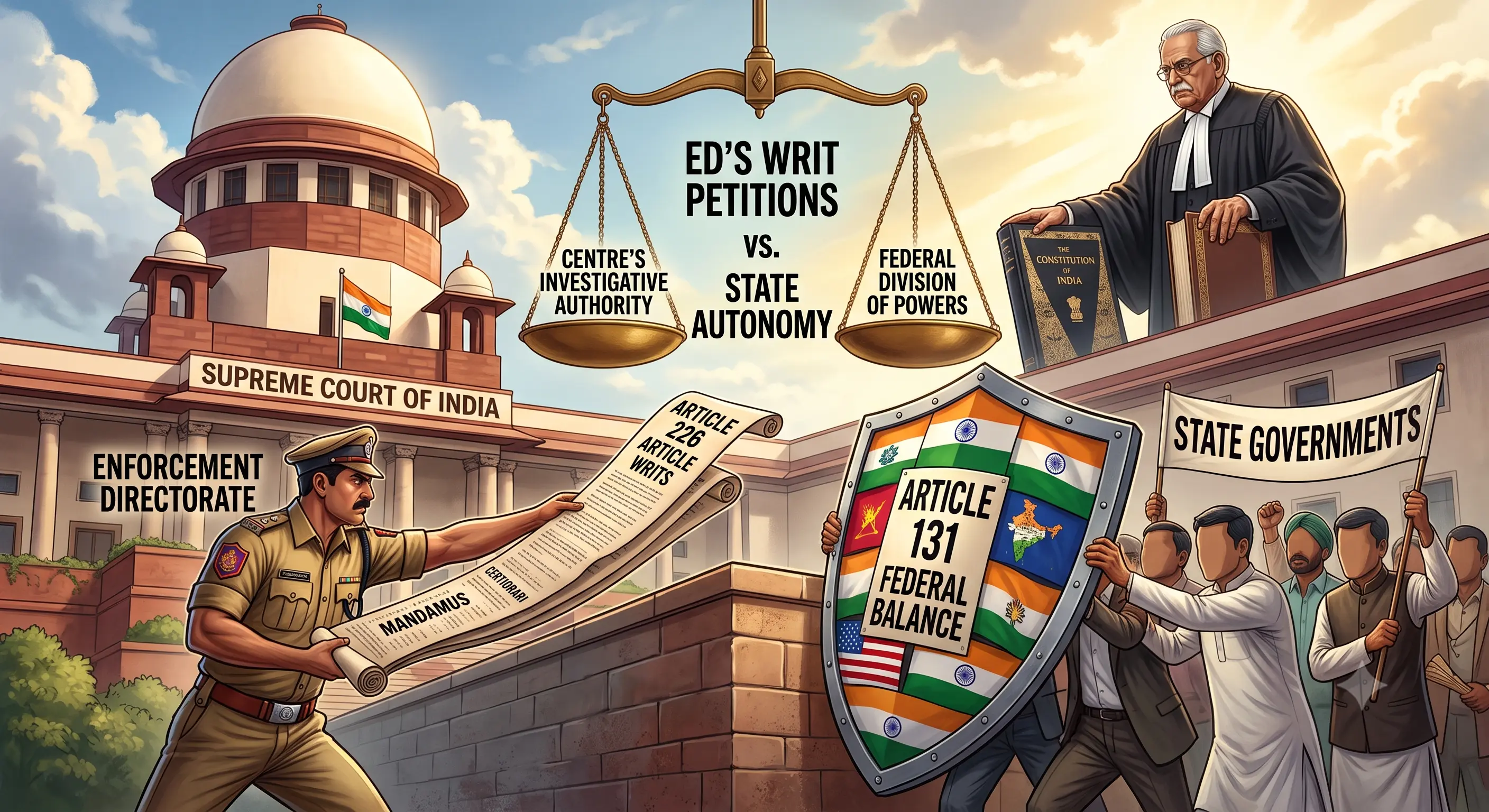
The Supreme Court is considering whether the Enforcement Directorate (ED) can invoke the writ jurisdiction of constitutional courts. Emerging from a jurisdictional dispute in the Kerala gold smuggling case, this issue raises crucial questions about the legal standing of central statutory bodies, limits of judicial remedies, and Centre-State federal relations.
Introduction
Context & Background
Key Points
- •The Core Dispute: The central constitutional issue is whether the Enforcement Directorate (ED) possesses the locus standi (legal standing) to approach High Courts under Article 226 to file writ petitions.
- •State Governments' Stance: States like Kerala and Tamil Nadu argue the ED is merely a department of the Union Government, not a juristic person. They contend that allowing the ED to file writs bypasses Article 131, which grants the Supreme Court exclusive jurisdiction over Centre-State disputes.
- •ED and Union's Stance: The Centre asserts that ED officials act as independent statutory authorities empowered under FEMA and PMLA, justifying their access to constitutional remedies. Denying this would hinder law enforcement.
- •High Court Precedents: Both Kerala (2021) and Madras High Courts previously ruled that the ED is a statutory authority performing quasi-judicial functions, granting them the legal capacity to approach courts independently.
- •Evolution of ED: Created in 1956 as an 'Enforcement Unit', it is currently under the Department of Revenue, Ministry of Finance.
- •Appointment of the Director: Appointed by the Central Government on the recommendation of a committee led by the CVC, functioning under the CVC Act, 2003 with a fixed tenure of 2 years.
Statutory Functions of the Enforcement Directorate (ED)
| Law | Purpose | ED's Role | Bookmark |
|---|---|---|---|
| Prevention of Money Laundering Act, 2002 (PMLA) | Criminal statute to curb money laundering and confiscate illicit assets. | Investigate origin of assets, provisionally attach properties, and assist in prosecution. | |
| Foreign Exchange Management Act, 1999 (FEMA) | Civil law regulating foreign exchange transactions and external trade. | Investigate violations, conduct adjudication, and impose penalties. | |
| Fugitive Economic Offenders Act, 2018 (FEOA) | Prevent economic offenders from evading Indian legal proceedings. | Identify/attach properties of declared FEOs and facilitate confiscation to the Centre. |
Types of Writs (Under Article 32 & 226)
| Writ Type | Description | Bookmark |
|---|---|---|
| Habeas Corpus | Orders the release of a person unlawfully detained. | |
| Mandamus | Directs a public authority to perform a legal duty. | |
| Prohibition | Restrains a lower authority from exceeding its jurisdiction. | |
| Certiorari | Quashes an unlawful order or decision. | |
| Quo Warranto | Challenges the legality of a person holding a public office. |
Related Entities
Impact & Significance
- •Institutional Standing: If the Supreme Court permits the ED to file writs, it will elevate the agency to a status on par with independent statutory bodies like the RBI, vastly strengthening its legal agility.
- •Federal Balance: If the court rules against the ED, it will reinforce State autonomy, dictating that any institutional dispute between a central agency and a State must strictly be resolved under Article 131.
- •Procedural Precedent: The ruling will serve as a landmark precedent for other central investigative bodies (like the CBI or SFIO), defining the exact boundaries of their executive authority and judicial recourses.
Challenges & Criticism
- •Erosion of Federalism: States fear that granting central agencies writ powers will blur the constitutional division of powers, leading to unchecked interference in State administration.
- •Executive Overreach: Critics argue that this mechanism could be misused by the Centre to sidestep constitutional safeguards and target state machinery under the guise of statutory independence.
- •Bypassing Article 131: Treating central departments as 'juristic persons' might render Article 131 redundant, as the Centre could theoretically litigate against States through its agencies in High Courts rather than the Supreme Court.
Future Outlook
- •Legislative Clarification: Parliament may need to explicitly define the ED’s legal status, juristic personality, and its exact powers under FEMA and PMLA regarding independent litigation.
- •Judicial Guidelines: The Supreme Court is expected to establish clear principles and guardrails detailing the locus standi of central investigative agencies.
- •Strengthening Cooperative Federalism: A sustainable balance must be struck between enabling effective law enforcement by central agencies and respecting the constitutional limits of state autonomy.
UPSC Relevance
- • GS-2 (Polity & Governance): Statutory, Regulatory and various Quasi-judicial bodies.
- • GS-2 (Federalism): Issues and challenges pertaining to the federal structure, separation of powers, and Centre-State relations (Article 131 vs. Article 226).
- • Mains Focus: Analyzing the jurisdiction of central agencies in state domains and the balance between anti-corruption efforts and federal principles.
Sample Questions
Prelims
Consider the following statements regarding the Enforcement Directorate (ED) and constitutional provisions:
1. The Enforcement Directorate operates under the administrative control of the Ministry of Home Affairs.
2. Original jurisdiction over disputes between the Union and one or more States falls under Article 131 of the Constitution.
3. The Director of the Enforcement Directorate is appointed directly by the President of India without any committee recommendation.
Answer: Option 2
Explanation: Statement 1 is incorrect; ED is under the Department of Revenue, Ministry of Finance. Statement 2 is correct; Article 131 grants original jurisdiction to the Supreme Court for Centre-State disputes. Statement 3 is incorrect; the Director is appointed by the Central Government based on a committee's recommendation (led by the CVC).
Mains
Discuss the constitutional implications of central investigative agencies like the Enforcement Directorate (ED) invoking the writ jurisdiction of High Courts. How does this impact the federal structure and Centre-State relations in India?
Introduction: Define the Enforcement Directorate's mandate and briefly introduce the current Supreme Court consideration regarding its locus standi to file writs under Article 226.
Body:
• Context & Legal Standing: Discuss the background (Kerala gold smuggling case) and the core debate over whether the ED is a juristic person or merely a Union department.
• Impact on Federalism: Analyze the States' arguments regarding Article 131 (exclusive SC jurisdiction over Centre-State disputes) vs. the ED's argument of exercising independent statutory authority under Article 226.
• Challenges & Consequences: Highlight the risks of executive overreach, potential erosion of division of powers, and the necessity of independent financial enforcement.
Conclusion: Conclude by emphasizing the need for a definitive judicial pronouncement or legislative clarity to balance cooperative federalism with the necessity of unhindered financial investigations.