
Emerging Geopolitics in the Indian Ocean & The Strategic Role of Quad
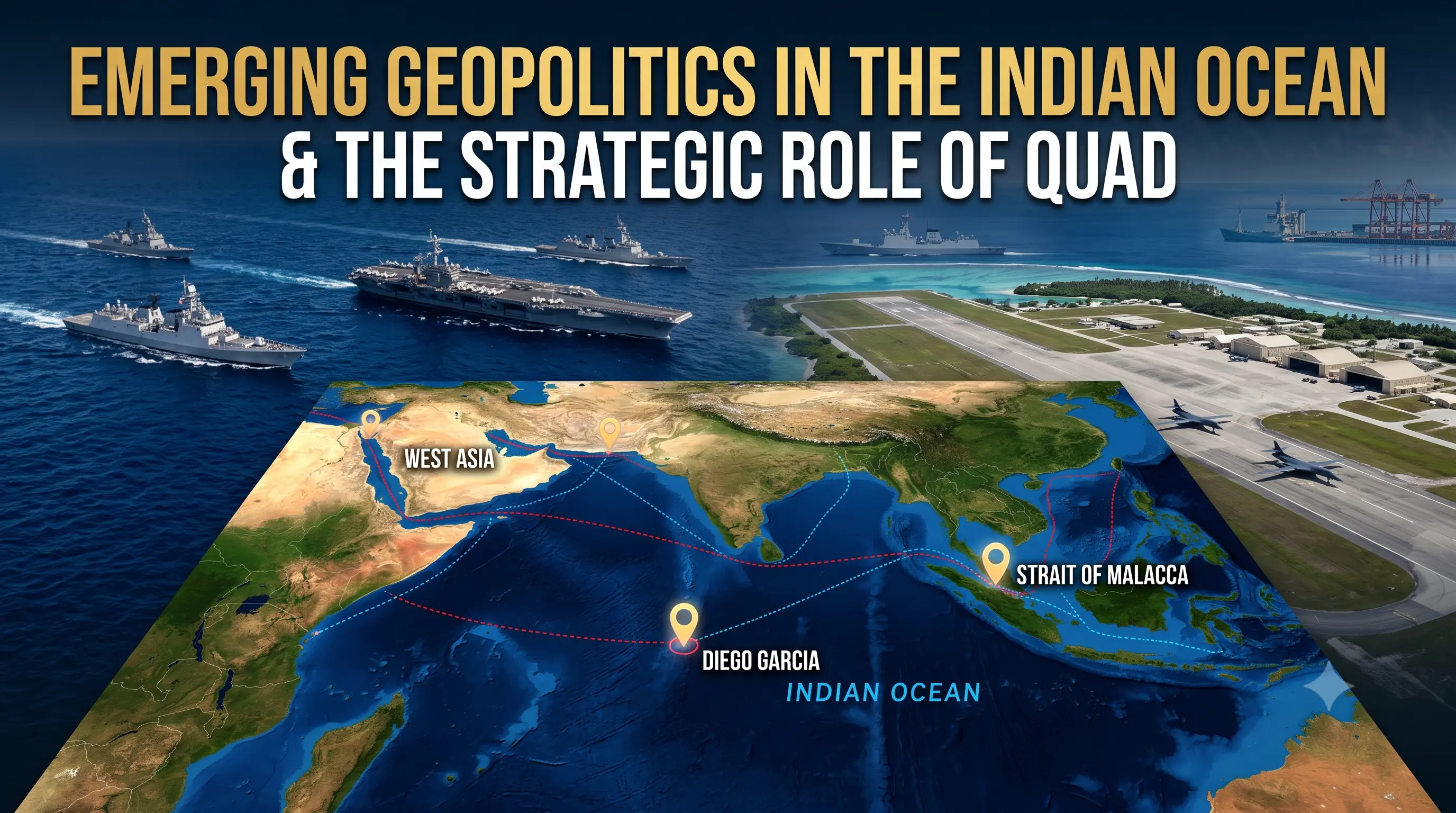
Historically centered in the Western Pacific, global strategic flashpoints are rapidly shifting to the Indian Ocean Region (IOR). Amidst U.S.-Iran tensions, the Chagos sovereignty pause, China's expanding footprint, and Af-Pak instability, the IOR has emerged as a primary theatre of geopolitical contestation. Simultaneously, the U.S. has reaffirmed the Quadrilateral Security Dialogue (Quad) as a vital platform to counterbalance these shifts and ensure a free and open Indo-Pacific.
Introduction
Context & Background
Key Points
- •Shift in Strategic Gravity: The global geopolitical focal point is transitioning from the U.S.-China rivalry in the Western Pacific (Taiwan Strait, South China Sea) to the broader Indian Ocean Region.
- •Quad as a Stabilizing Force: U.S. Assistant Secretary of State S. Paul Kapur emphasized the Quad as central to maintaining Indo-Pacific stability. A strong, independent India is viewed as a natural limit to China's strategic expansion [1].
- •Defense and Tech Integration: The October 2025 ten-year defense cooperation framework between the U.S. and India highlights growing interoperability, logistics coordination, and defense procurement [1].
- •Quad Critical Minerals Initiative (QCMI): Launched in Washington, D.C. (July 2025), this initiative aims to reduce supply-chain vulnerabilities, build transparent supply networks, and foster private-sector coordination among Quad nations.
- •Energy Realignment: The Quad's agenda pushes for energy diversification, highlighted by the U.S. acknowledging India's reduction in Russian oil dependency in favor of increased U.S. energy purchases.
Emerging Geopolitics in the IOR and Implications for India
| Geopolitical Development | Details | Implication for India | Bookmark |
|---|---|---|---|
| Global Flashpoints Shift | Focus moving from Western Pacific to Indian Ocean (Iran, West Asia, South Asia). | Neighborhood becomes a frontline theatre, demanding higher naval readiness and diplomacy. | |
| U.S.-Iran Confrontation | Militarisation of IOR; U.S. reliance on bases like Diego Garcia. | Threatens Gulf energy imports, shipping routes, and Indian diaspora safety in West Asia. | |
| Diego Garcia & Chagos Issue | Pause in UK-Mauritius sovereignty transfer; U.S. retaining military base. | Forces India to balance anti-colonial support for Mauritius with strategic security realities. | |
| China's Maritime Footprint | BRI projects, port access (Gwadar, Hambantota), and naval deployments. | Challenges traditional dominance; requires stronger partnerships (Quad, IORA). | |
| Af-Pak Instability | Pakistan-Afghanistan border clashes linking continental and maritime insecurity. | Cross-border instability complicates India's Afghanistan outreach policy. |
Quadrilateral Security Dialogue (Quad) Overview
| Aspect | Description | Bookmark |
|---|---|---|
| Nature & Members | A strategic forum (not a military alliance) comprising India, USA, Japan, and Australia. | |
| Core Purpose | Promote a free, open, inclusive Indo-Pacific and uphold a rules-based global order. | |
| Key Focus Areas | Maritime security, cybersecurity, counterterrorism, supply chains, climate, and health. | |
| Military Interoperability | All members participate in the annual Malabar naval exercise. |
Related Entities
Impact & Significance
- •Energy Security Vulnerability: The militarisation of the Persian Gulf and Arabian Sea directly threatens India's primary energy import routes.
- •Technological Sovereignty: Through QCMI, India stands to gain access to resilient critical mineral chains, vital for both its green energy transition and advanced defense manufacturing.
- •Defense Modernization: Elevated U.S.-India interoperability accelerates India's acquisition of cutting-edge military technology, reducing historical dependencies on Russian hardware.
Challenges & Criticism
- •Diplomatic Tightrope: India faces a dilemma on the Chagos Archipelago issue—supporting Mauritius’s decolonization claims while recognizing the U.S. presence at Diego Garcia as a necessary counter to China.
- •Economic vs. Security Interests: Navigating Chinese investments in neighboring countries (like Sri Lanka and Maldives) where India must offer viable economic alternatives, not just security rhetoric.
- •Non-Military Limitations of Quad: Critics argue that because the Quad lacks a mutual defense pact, its deterrence value against aggressive unilateral actions by China remains untested.
Future Outlook
- •Deepened Defense Interoperability: The U.S.-India 10-year defense framework (signed Oct 2025) will likely lead to expanded joint military exercises, real-time intelligence sharing, and advanced technology transfers [1].
- •Critical Mineral Supply Chains: Through the QCMI, Quad nations will heavily invest in alternative, shock-resistant supply chains for critical minerals, reducing global reliance on Chinese processing monopolies.
- •Democratic Alignments: The U.S. intends to link democratic transitions in nations like Bangladesh and Nepal with the broader Quad strategy, promoting values-based governance across South Asia.
UPSC Relevance
- • GS-2 (International Relations): Bilateral, regional and global groupings and agreements involving India and/or affecting India’s interests (Quad).
- • GS-2 (Neighbourhood of India): Geopolitical dynamics in the Indian Ocean Region, Af-Pak instability, and China's String of Pearls.
- • GS-3 (Security): Maritime security challenges, Chokepoints in the IOR, and defense technology transfers.
- • Essay Topics: 'The Indian Ocean: The New Theatre of Global Great Power Competition', 'Multilateralism vs. Bilateralism in India's Foreign Policy'.
Sample Questions
Prelims
With reference to the geopolitical dynamics in the Indian Ocean and the Quad, consider the following statements: 1. The Quad Critical Minerals Initiative (QCMI) was launched to establish a joint Quad military base in the Indian Ocean. 2. Diego Garcia is an overseas military base located in the Chagos Archipelago. 3. The Quad is a formal military alliance with a mutual defense treaty akin to NATO. Which of the statements given above is/are correct?
1 and 2 only
2 only
2 and 3 only
1, 2, and 3
Answer: Option 2
Explanation: Statement 1 is incorrect; QCMI is focused on supply chain resilience, not military bases. Statement 2 is correct; Diego Garcia is a key U.S. base in the Chagos Archipelago. Statement 3 is incorrect; the Quad is a strategic dialogue and explicitly NOT a formal military alliance.
Mains
“The strategic centre of gravity has shifted from the Western Pacific to the Indian Ocean Region.” Evaluate this statement in the context of recent geopolitical developments and discuss the role of the Quad in securing India's maritime interests.
Introduction: Define the geographical and strategic scope of the IOR. Briefly mention the historical dominance of the Western Pacific and state the thesis of the current shift.
Body:
• Drivers of the Shift: U.S.-Iran militarization, the Chagos sovereignty dispute (Diego Garcia), China's BRI and port acquisitions (Gwadar, Hambantota), and continental spillover from the Af-Pak region.
• Implications for India: Threats to energy security (Gulf reliance), challenges to traditional maritime dominance, and the need to balance anti-colonial stances with security imperatives.
• Role of the Quad: Counterbalancing without formal alliance, securing critical mineral supply chains (QCMI), enhanced interoperability (Malabar exercises), and 10-year defense frameworks.
Conclusion: Conclude that while the IOR is increasingly contested, proactive platforms like the Quad enable India to evolve from a regional balancing power to a net security provider in a multipolar Indo-Pacific.