
The Paradox of India's Green Energy: Why a Cleaner Grid Needs Energy Efficiency
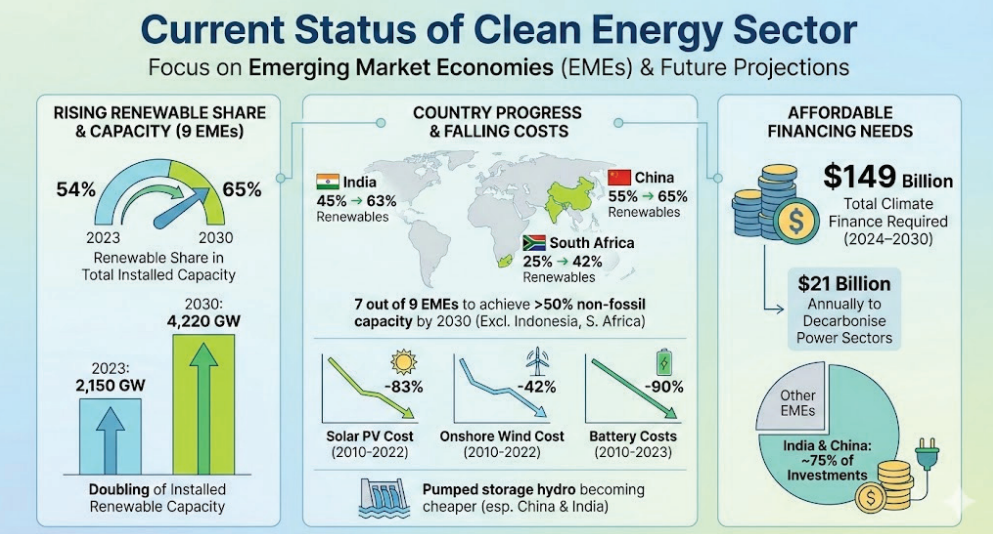
India has aggressively expanded its renewable energy capacity, yet the carbon intensity of its electricity grid is rising. This article explores this 'Green Paradox'—why adding solar and wind hasn't immediately lowered emissions per unit of power—and why 'Energy Efficiency' is the missing link in India's transition.
Introduction
This article explains this 'Green Paradox': Why is the smoke increasing if we are building more solar panels? And how can Energy Efficiency—simply using less power to do the same work—fix this?
Context & Background
Analogy: Imagine owning a Ferrari (High Capacity) but only driving it in a traffic jam (Low Generation).
India has installed a huge 'capacity' of solar panels. But because the sun sets at 6 PM and the wind doesn't always blow, these plants sit idle for much of the day. To keep the lights on 24/7, we still rely heavily on Coal, which works all the time. This reliance on coal is why emissions remain high.
Key Points
- •What is Grid Emission Factor (GEF)? Think of GEF as the 'Carbon Report Card' of our electricity. It measures how many grams of CO₂ are puffed into the air to produce 1 unit of electricity.
The Bad News: India's score got worse (from 0.703 to 0.727). This means our grid is getting 'dirtier' despite the green labels. - •The 'Evening Peak' Problem:
Scenario: It is 7 PM. You come home, turn on the lights, TV, and AC. Millions of others do the same. Power demand shoots up.
Problem: The sun has set, so solar panels are producing Zero electricity.
Solution: The grid operator frantically turns on coal plants to meet this sudden demand. This 'Coal Rush' locks in high carbon emissions every single evening. - •Energy Efficiency (EE) - The 'First Fuel': The cheapest energy is the energy you don't use.
The Concept of 'Negawatts': If you replace an old fan with a super-efficient one, you save 50 watts. That is 50 watts the coal plant doesn't need to burn coal to produce. This saved energy is called a 'Negawatt'. - •Difference between Efficiency vs. Conservation:
1. Conservation: Switching off the light to save power (Requires behavior change/sacrifice).
2. Efficiency: Using an LED bulb that gives the *same* light for less power (No sacrifice, just better tech). - •Government Schemes Made Simple:
1. PAT Scheme (For Factories): Think of this as a 'Weight Loss Contest' for factories. The government sets a target to lose 'energy fat'. If a factory loses more fat than required, they get a certificate (prize) they can sell to lazy factories.
2. UJALA (For Homes): The government made LED bulbs incredibly cheap so everyone would switch from old yellow bulbs.
3. Star Rating (For Shopping): The stars on your AC or Fridge tell you how 'fuel-efficient' it is. More stars = Lower electricity bill.
Why Green Capacity ≠ Green Power (The Technical Mismatch)
| Factor | The Problem | Real World Analogy | Bookmark |
|---|---|---|---|
| Capacity Utilization Factor (CUF) | Solar plants only work ~20% of the time (when sunny). Coal plants work ~80% of the time. | Like paying a full-time salary to an employee who only works 2 hours a day. | |
| Base Load vs. Peak Load | We need steady power 24/7 (Base Load). Solar is intermittent. | Solar is like a rain shower (comes and goes); Coal is like a tap (steady flow). | |
| Storage Crisis | We don't have enough giant batteries to save afternoon sunlight for the night. | Like having a bumper crop of mangoes but no fridge to store them—they go to waste. |
Benefits of Energy Efficiency: Why should you care?
| Benefit Type | Explanation | Example | Bookmark |
|---|---|---|---|
| Economic (Money) | Lowers production costs. | A textile mill using efficient motors spends less on power, making cheaper shirts. | |
| National Security | Reduces imports. | Less power needed = Less coal/oil imported from abroad = Safer economy. | |
| Environmental | Reduces Peak Load. | Efficient ACs reduce the 8 PM surge, so we burn less coal at night. |
Related Entities
Impact & Significance
- •Meeting Paris Goals: India promised the world it would reduce its 'Emission Intensity'. Lowering the GEF is the only way to keep that promise.
- •Avoiding 'Lock-in': If we buy inefficient machines now, we are stuck with them for 20 years. Switching to efficient tech *now* prevents decades of waste.
- •Grid Stability: An efficient grid is a stable grid. By lowering the peak demand, we reduce the risk of blackouts during hot summers.
Challenges & Criticism
- •The 'Capex' Barrier (Upfront Cost): A 5-Star AC costs ₹40,000, while a 3-Star costs ₹30,000. Most people choose the cheaper one, not realizing they will pay ₹20,000 more in electricity bills over time.
- •MSME Struggles: Small factory owners (MSMEs) run on thin margins. They cannot afford to stop production to install new, efficient machines, even if it saves money later.
- •Hidden Data: We lack real-time data on how much energy is actually being saved in buildings, making it hard to reward good behavior.
Future Outlook
- •Smart Meters & AI: In the future, your 'Smart Meter' might talk to your AC. If the grid is overloaded (and dirty) at 7 PM, the AC might automatically switch to 'Eco Mode' to save money and carbon.
- •Mandatory Standards: The government might eventually ban the sale of 1-Star and 2-Star appliances entirely.
- •Virtual Power Plants: Instead of building a new power plant, utility companies might pay thousands of customers to dim their lights slightly. This collection of small savings acts like a 'Virtual' power plant.
UPSC Relevance
- • GS-3 (Environment & Economy): Energy security, Conservation, Infrastructure (Energy), Inclusive growth.
- • Prelims: Definitions of GEF, PAT Scheme, BEE, Star Rating System.
- • Essay: 'Energy saved is energy produced' - sustainable development.
Sample Questions
Prelims
With reference to the 'Grid Emission Factor' (GEF), consider the following statements:
- (a)It acts as an indicator of the carbon intensity of the power grid.
- (b)A rising GEF indicates a higher share of renewable energy in the electricity mix.
- (c)It helps in calculating carbon credits under the Paris Agreement mechanisms.
Mains
Despite a significant increase in renewable energy capacity, India's Grid Emission Factor has risen in recent years. Analyze the reasons behind this paradox and discuss how Energy Efficiency can serve as a critical pillar in India's clean energy transition.
Introduction: India's renewable capacity has hit 50%, yet GEF has risen to 0.727, revealing a gap between 'building' green plants and 'using' green power.
Body:
• Reasons for the Paradox:
1. Low Utilization: Solar only works when sunny.
2. Evening Peak: We burn coal at night to meet demand.
3. No Storage: Clean energy is wasted without batteries.
• Role of Energy Efficiency: It is the 'First Fuel'. It reduces the demand itself (Negawatts), flattens the evening peak, and saves money.
• Key Initiatives: PAT Scheme (Industry), UJALA (Lighting), Star Labelling (Appliances).
Conclusion: We cannot just build our way out of climate change; we must also save our way out. Prioritizing efficiency is essential to decouple growth from emissions.