
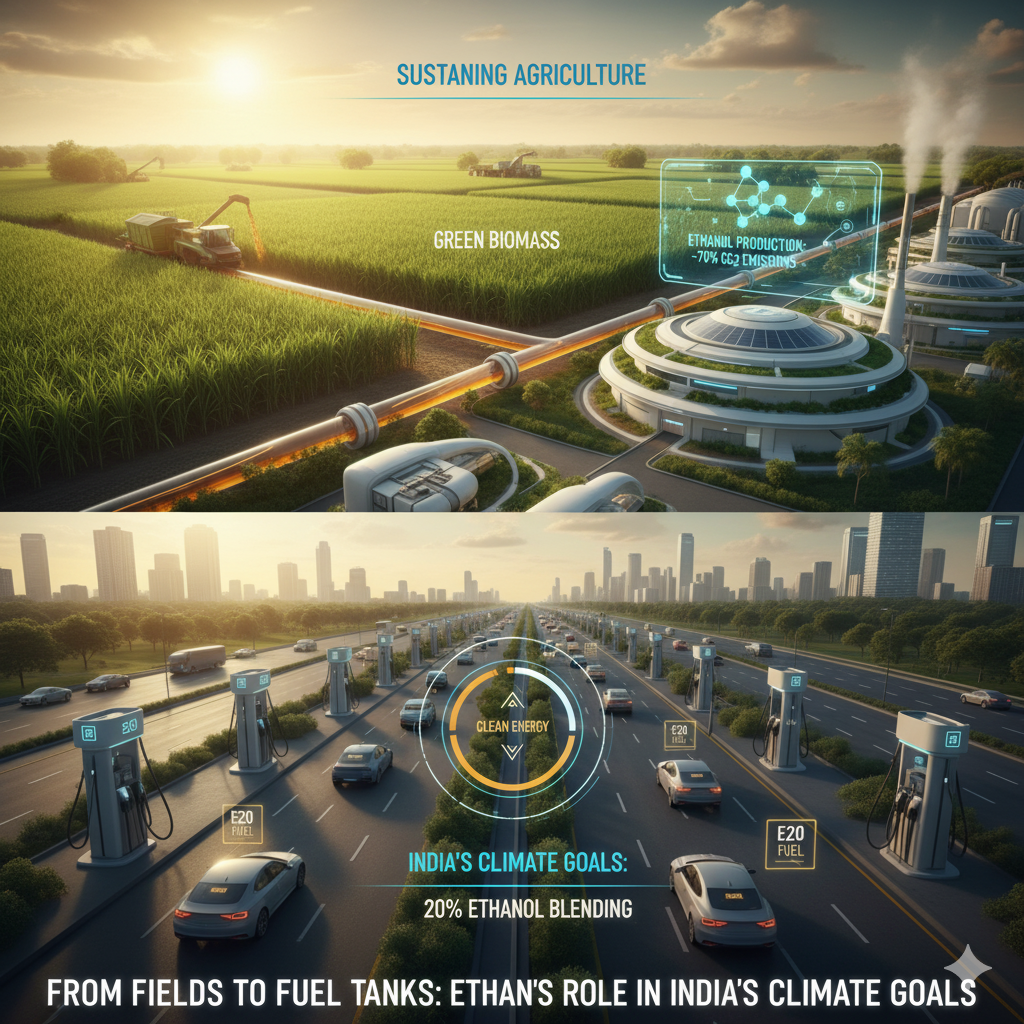
From Fields to Fuel Tanks: Ethanol’s Role in India’s Climate Goals
India’s ethanol blending has risen from 4.2% in FY18 to 18.9% in FY25, nearing the E20 target. While blending has boosted rural incomes and lowered emissions, it has not significantly reduced crude imports or fuel prices.
Introduction
Context & Background
Key Points
- •1) Strategic Energy Security: Ethanol substitutes a part of petrol demand, improving import diversification and buffering against oil-price volatility (OPEC decisions, geopolitics).
- •2) Net-Zero Alignment: Blending contributes to NDCs and the Net Zero 2070 pathway via tank-to-wheel CO2 reduction. For mains, contrast well-to-tank vs tank-to-wheel benefits.
- •3) Lifecycle Assessment (LCA): Ethanol’s climate gains hinge on feedstock choice, process energy (coal vs biomass), and fertiliser inputs. 2G ethanol (crop residues) generally has a lower lifecycle footprint than 1G (sugar/starch).
- •4) Water–Food–Energy Nexus: Sugarcane is water intensive. A UPSC answer should weigh water use per litre of ethanol, aquifer stress, and crop diversification (maize, sorghum, bamboo).
- •5) Air-Quality Co-benefits: Higher oxygen content improves combustion and can lower CO, HC, PM. Pair E20 with evaporation controls and Onboard Diagnostics (OBD) for real-world gains.
- •6) Engine & Material Compatibility: E20 needs ethanol-resistant seals, hoses, fuel rails and ECU retuning. Mention cold-start issues, corrosion, and phase separation risks due to ethanol’s hygroscopic nature.
- •7) Standards & Certification: Role of BIS (E20 fuel specs), ARAI/ICAT (testing & type approval), and warranty policy clarity for OEMs.
E0–E20labelling at retail is essential for consumer safety. - •8) Infrastructure Readiness: Need for blend-ready depots, water-tight storage, dedicated pipelines/tankers, and QC/QA protocols (moisture, octane, phase separation tests).
- •9) Pricing & Procurement: Administered pricing gives investment certainty but can cause OMC margin stress. Consider formula-based pricing linked to feedstock costs and crude benchmarks.
- •10) Feedstock Diversification: Scale up maize, damaged grains, sweet sorghum, cassava, bamboo, and 2G residues to reduce food-vs-fuel and water conflicts.
- •11) 2G/Advanced Biofuels: Straw-to-ethanol plants cut stubble burning, provide rural jobs, and reduce lifecycle emissions; highlight lignocellulosic pretreatment, enzymes, and co-generation.
- •12) Logistics & Seasonalities: Sugarcane crush season and grain availability cause intra-year volatility. Use buffer stocks, long-term offtake contracts, and multi-feedstock flexibility.
- •13) Why Imports Don’t Fall Much Yet: Blending touches only petrol, while India is diesel heavy. Also rising vehicular demand offsets petrol displacement.
- •14) Diesel-Side Strategy: Parallel push for biodiesel (B100/B20), compressed biogas (CBG), and renewable diesel is needed to dent crude imports.
- •15) Industrial Policy & GBA: Long-Term Ethanol Procurement Policy de-risks investment; Global Biofuels Alliance opens export avenues and tech collaboration.
- •16) Equity & Farmer Incomes: Stable ethanol offtake supports MSP logic for grains; but ensure food security buffers and rainfed crop choices in water-stressed regions.
- •17) Sustainability Guardrails: Introduce sustainability certification, MRV systems for GHG savings, water audits, and agronomic best practices (micro-irrigation, fertigation).
- •18) Urban Fuel Transition: Coordinate E20 with EVs and green hydrogen for multi-energy mobility; prioritise E20 in two-wheelers and fleet segments first.
- •19) State-Level Differentiation: Sugar belt states can lead with 1G; north-west & eastern agri-residue hubs suit 2G; tailor state excise/tax incentives.
- •20) Governance & Coordination: Tighten inter-ministerial alignment (Petroleum–Agriculture–Food–Transport–Environment), streamline clearances, and expand city-wise E20 maps for consumers.
Related Entities
Impact & Significance
- •Energy Security: Lowers petrol imports and shields against geo-political shocks.
- •Climate & Health: Cuts CO₂ and toxic emissions; supports clean mobility.
- •Rural Economy: Stable income, crop diversification, rural industries and jobs.
- •Waste-to-Wealth: Crop residue-based ethanol helps reduce stubble burning.
- •Industrial Growth: Encourages distilleries, biofuel parks, technology partnerships.
Challenges & Criticism
- •Diversification Lag: Dependence on water-intensive sugarcane raises food-vs-fuel & water security concerns.
- •Limited Scope: Blending only impacts petrol; diesel, ATF, LPG untouched.
- •Rising Fuel Demand: Increasing vehicle use offsets import reductions.
- •Vehicle Compatibility: Old engines not built for E20; risk corrosion, mileage drop.
- •Logistics & Storage: Ethanol's hygroscopic nature complicates storage & transport.
- •Policy Coordination: Multi-ministry overlap (agri-petroleum-transport-env) causes delays.
Future Outlook
- •2G ethanol will scale as straw-to-fuel plants expand.
- •Flex-fuel engine adoption expected to rise; BIS standards for E20 vehicles in rollout.
- •Integration with EVs, green hydrogen for multi-energy mobility future.
- •Biofuel exports and global collaborations will rise post-GBA formation.
- •Shift toward maize, bamboo, agri-biomass to secure water & food systems.
UPSC Relevance
- • GS1: Agriculture, resources & economic geography
- • GS3: Environment, energy security, technology & biofuels
- • Essay: Energy transition, farmers & sustainable development
- • Prelims: Biofuels, PM-JIVAN, blending targets
Sample Questions
Prelims
With reference to ethanol blending in India, consider the following statements:
1. Ethanol blending primarily reduces petrol consumption in India.
2. Sugarcane is the only feedstock permitted for ethanol production in India.
3. Second-generation ethanol plants use agricultural residues like paddy straw.
4. India has achieved the E20 blending target as of FY25.
Answer: Option 1, Option 3
Explanation: Sugarcane is not the only feedstock (grains and agri-residue also allowed). E20 target nearing but not fully achieved.
Mains
Discuss the role of ethanol blending in India's energy transition. What challenges limit its impact on crude oil imports and fuel pricing?
Introduction: undefined
Body:
• Benefits: Import savings, lower emissions, rural incomes, waste-to-wealth, global leadership via GBA.
• Constraints: Diesel-heavy economy, rising fuel demand, sugarcane dependence, engine readiness, infrastructure gaps.
• Solutions: 2G biofuels, maize diversification, flex-fuel vehicles, blending infra expansion, linking ethanol pricing to market.
Conclusion: Ethanol is a critical pillar in India's multi-fuel strategy alongside EVs and green hydrogen. Success depends on crop diversification, technology upgrades, and balanced energy-agriculture policy alignment.