
The Fading of India’s Environmental Jurisprudence: An Analysis
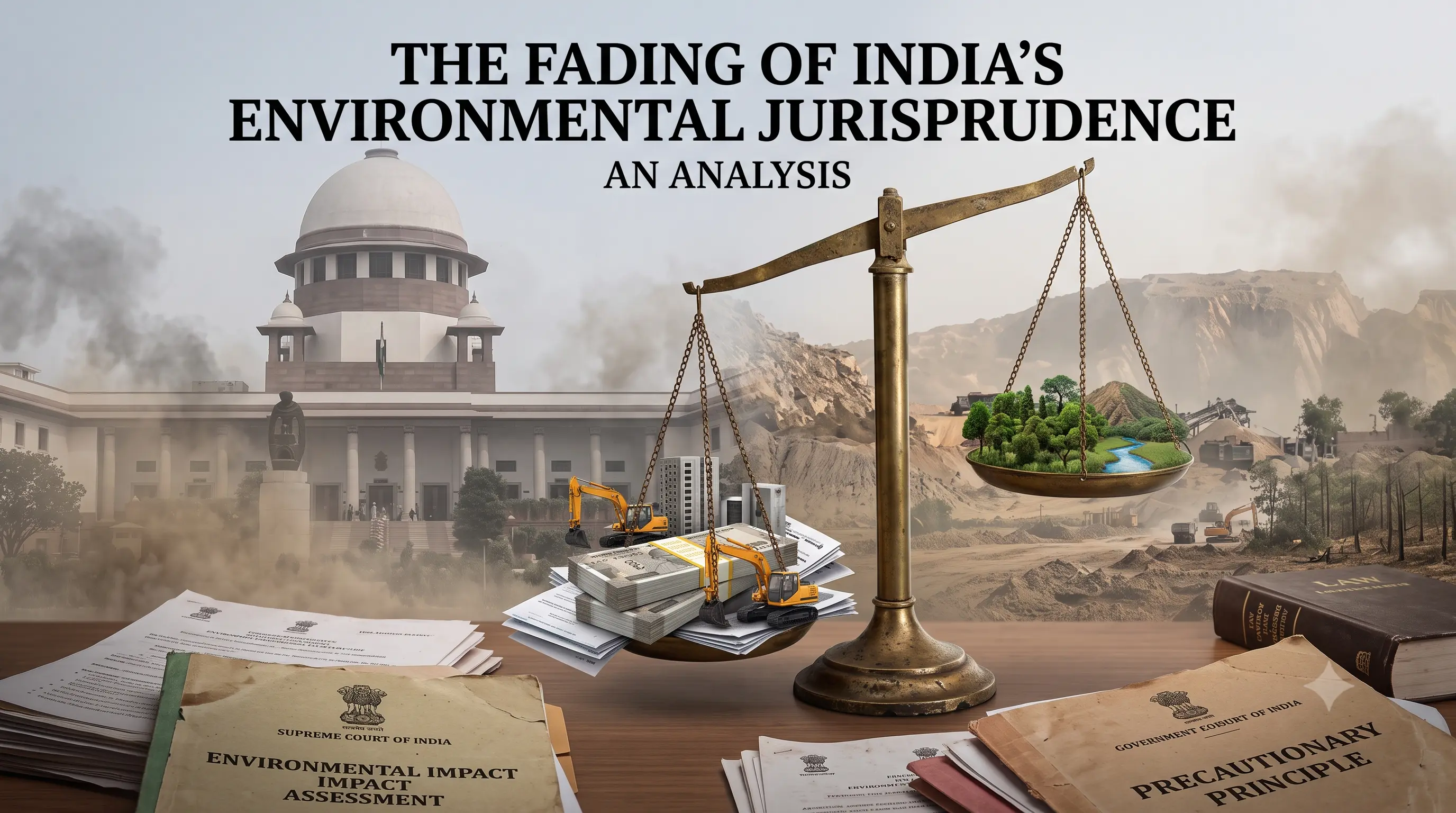
India’s transition from a global leader in environmental constitutionalism under Article 21 to a regime of 'regulatory leniency' marks a shift where immediate economic interests are increasingly prioritized over long-term ecological integrity.
Introduction
Context & Background
Key Points
- •Shift from Constitutionalism to Leniency: The judiciary is moving from a strong protective stance under Article 21 to prioritizing operational continuity of projects over strict environmental compliance.
- •National Security vs. Nature: In projects like the Char Dham Highway, wider roads for 'strategic defense needs' are favored over the protection of the fragile Himalayan ecosystem, despite high risks of landslides.
- •The 'Sunk Cost' Trap: Courts are increasingly hesitant to halt illegal projects if massive financial investments ('thousands of crores') have already been made, effectively making environmental laws secondary to financial capital.
- •Judicial Step-Back: Courts are increasingly declining to review or question the government’s 'policy decisions', leading to a decline in active judicial protection that historically saved forests and rivers.
- •Dilution of Public Trust: There is a growing trend of treating natural resources like land and water as commodities for industrial growth rather than as public assets that the state must protect.
Key Pillars of India’s Environmental Jurisprudence
| Principle/Doctrine | Key Case/Source | Core Philosophy | Bookmark |
|---|---|---|---|
| Public Trust Doctrine | M.C. Mehta vs. Kamal Nath (1996) | The state is the trustee of all natural resources, meant for public use and not private ownership. | |
| Precautionary Principle & Polluter Pays | Vellore Citizens’ Welfare Forum (1996) | Development must stop if there is a threat of 'irreversible damage,' even without scientific certainty. | |
| Inter-generational Equity | General Environmental Law | The present generation must hold natural resources in trust for future generations. |
Evidence of the 'Fading' Jurisprudence
| Issue | Description | Consequence | Bookmark |
|---|---|---|---|
| Reversal on 'Ex Post Facto' Clearances | Recall of the 2025 Vanashakti judgment, permitting retrospective regularization of illegal projects via fines. | Replaces legal deterrence with a 'pay-to-pollute' model, prioritizing continuity over compliance. | |
| Aravalli Definition Controversy | Adopting a restrictive 100-meter elevation threshold for protection (2025 ruling). | Opens low-lying ecological buffers to mining, threatening NCR's groundwater security. | |
| Illusion of Compensatory Afforestation | Trading mature ecosystems (like mangroves) for man-made sapling plantations. | Promotes an 'ecological myth'; plantations cannot replicate complex biodiversity and carbon sequestration. |
Related Entities
Impact & Significance
- •Irreversible Ecological Loss: Replacing mature ecosystems (like mangroves or Himalayan forests) with sapling plantations results in a permanent loss of complex biodiversity and long-term carbon sequestration.
- •Threat to Water Security: Restricting the definition of the Aravallis endangers vital low-lying ecological buffers, directly threatening the groundwater recharge mechanisms of the National Capital Region.
- •Climate Vulnerability: Projects cleared despite ecological warnings heighten the risks of landslides, floods, and extreme weather disasters in fragile ecosystems.
- •Erosion of Deterrence: Retrospective regularization of illegal projects normalizes non-compliance, creating a 'pay-to-pollute' environment for corporations.
Challenges & Criticism
- •The Sunk Cost Fallacy: Allowing illegal projects to continue simply because massive capital has been invested makes environmental compliance secondary to financial risks.
- •Arbitrary Classification: Using unscientific thresholds, such as the 100-meter elevation rule for the Aravallis, ignores holistic geomorphological unity.
- •National Security Exception: Using 'strategic defense needs' as a blanket justification to bypass strict environmental safeguards in ecologically sensitive zones.
- •Policy Abdication: The judiciary's increasing reluctance to interfere in government policy decisions weakens the vital system of checks and balances that once protected public assets.
Future Outlook
- •Strengthening the Green Bench: Regular sittings of specialized 'Green Benches' in the Supreme Court and High Courts are needed to ensure environmental expertise in decision-making.
- •Reviving the Precautionary Principle: The judiciary must shift back from 'mitigation-based approval' (approving projects on the condition of future repair) to 'prevention-based scrutiny.'
- •Institutional Autonomy of the NGT: The National Green Tribunal (NGT) needs to be empowered with more technical members and less interference to function as an effective 'watchdog.'
- •Ecological Accounting: Incorporating the 'Natural Capital' value of an ecosystem into the cost-benefit analysis of every major project, rather than just looking at the 'sunk cost' of construction.
UPSC Relevance
- • GS-3 (Environment): Conservation, environmental pollution and degradation, environmental impact assessment.
- • GS-2 (Governance/Polity): Judiciary's role in policy formulation, judicial activism vs. judicial restraint, functioning of statutory bodies like the NGT.
- • Essay Topics: 'Environment vs. Development: A False Dichotomy?', 'The Evolution of Environmental Justice in India'.
- • Mains Focus: Analyzing the implications of diluting the Precautionary Principle and the Public Trust Doctrine for sustainable development.
Sample Questions
Prelims
Consider the following statements regarding India's environmental jurisprudence:
1. The Public Trust Doctrine implies that the state is the trustee of all natural resources for public use.
2. The Precautionary Principle allows development projects to proceed as long as scientific uncertainty exists regarding their environmental impact.
3. The National Green Tribunal handles civil cases under all environmental laws without exception.
Answer: Option 1
Explanation: Statement 1 is correct (established in M.C. Mehta vs. Kamal Nath, 1996). Statement 2 is incorrect; the Precautionary Principle states that a lack of scientific certainty should not be used as a reason to postpone measures to prevent environmental degradation. Statement 3 is incorrect; the NGT deals with specific environmental laws listed in Schedule I of the NGT Act.
Mains
“India is witnessing a transition from environmental constitutionalism to a regime of regulatory leniency.” Analyze this statement in the context of recent judicial trends and their implications for ecological security.
Introduction: Define environmental jurisprudence in India. Briefly highlight the historical role of the judiciary as the protector of the environment and state the recent paradigm shift.
Body:
• Pillars of Environmental Constitutionalism: Discuss Article 21, the Public Trust Doctrine, and the Precautionary Principle established in the 1990s.
• Evidence of Regulatory Leniency: Cite post-facto clearances (Vanashakti case recall), arbitrary reductionism (Aravalli 100m rule), and the 'sunk cost' trap.
• Implications: Highlight irreversible ecological damage, threats to water security, and the dilution of public trust in governance.
Conclusion: Conclude that sustainable development requires balancing economic growth with ecological integrity. Restoring the autonomy of the NGT and reviving the Precautionary Principle are essential steps forward.