
Fire Safety in India: From Recurrent Tragedies to Systemic Reform
Following a tragic fire in a Goa nightclub in November 2025 that claimed 25 lives, India's fire safety record is under scrutiny again. This article examines the causes behind these recurring urban disasters, the patchwork of laws governing fire safety, and the urgent reforms needed in infrastructure and enforcement.
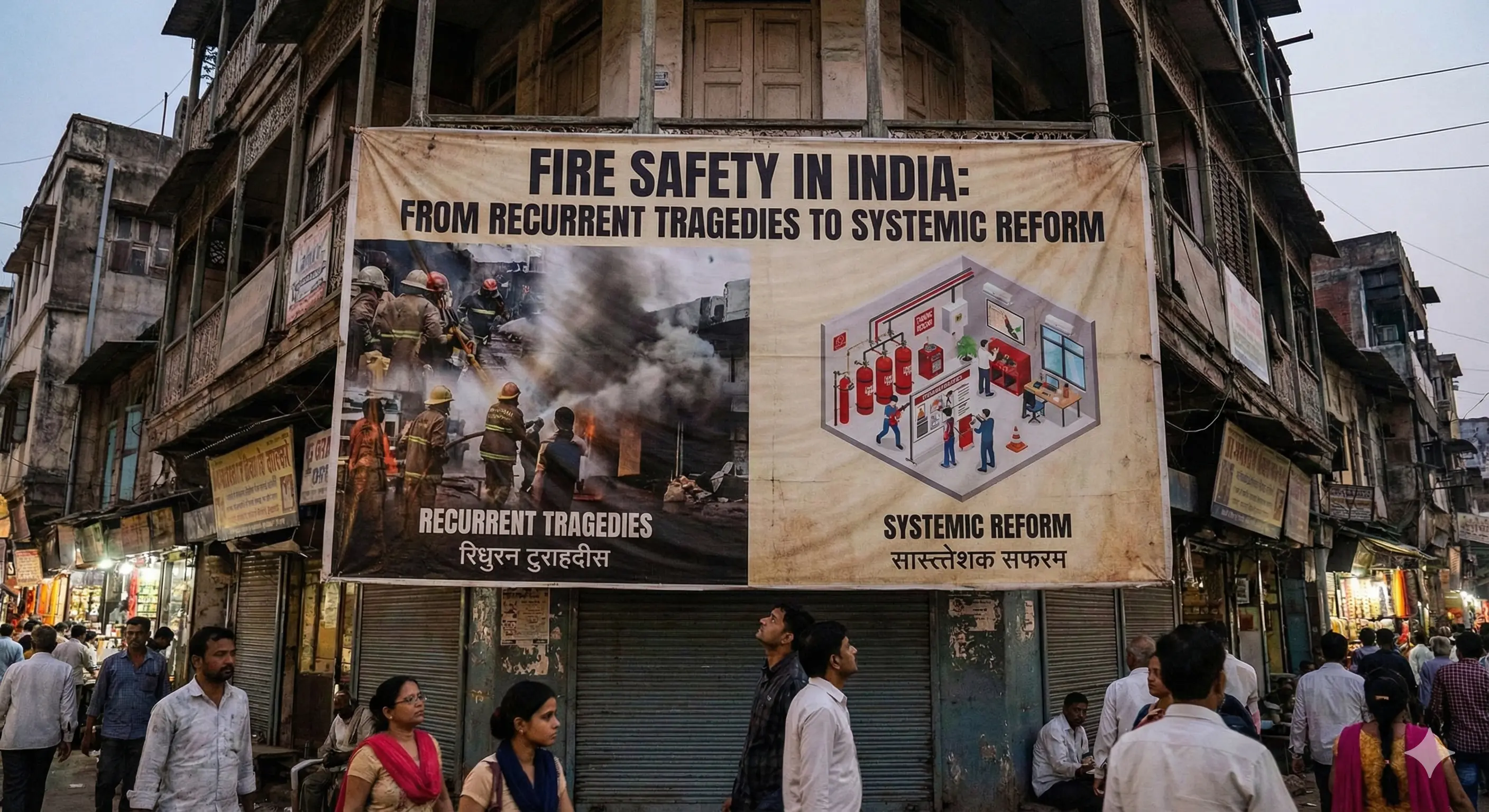
Introduction
Context & Background
Key Points
- •The Constitutional Problem (Who is responsible?): In India, 'Fire Services' are a State Subject. This means the Central Government can only give advice or 'Model Laws', but the actual power to make rules and enforce them lies with the State Governments and Municipal Corporations. This leads to a lack of uniformity—what is illegal in Delhi might be ignored in a smaller town.
- •National Building Code (NBC): This is the 'bible' of construction safety in India, published by the Bureau of Indian Standards (BIS). It tells builders exactly how wide a staircase should be, where fire exits must be, and what materials to use. However, these are often just guidelines until a State Government adopts them into their local law. Many states haven't updated their laws to match the latest NBC (2016).
- •The 'Model Bill' Strategy: The Central Government introduced the Model Bill for Fire and Emergency Services (2019). Think of this as a 'template' law that the Centre wrote and asked States to copy-paste into their own legal systems to modernize their fire departments. Adoption, however, has been slow.
- •Urbanization Challenges:
1. High-Rises: Cities are growing vertically. We have 50-floor buildings, but many fire departments lack ladders that reach beyond the 10th floor.
2. Informal Settlements: In slums or unauthorized colonies, houses are packed so tightly that a fire truck physically cannot enter the lanes.
3. Traffic: In Indian cities, fire engines often get stuck in traffic, losing the 'Golden Hour' (the critical first few minutes) to save lives. - •Infrastructure Deficit: We don't have enough firefighters or equipment. A government report revealed that India has a shortage of nearly 98% in required fire stations and over 80% in rescue vehicles. Most departments operate with only 10% of the manpower they actually need.
- •Climate Change Link: A study in Nature predicts that as global temperatures rise, vehicle fires and outdoor fires (like in garbage dumps) could increase by over 20% by the year 2100. Hotter summers mean electrical wires melt faster and dry waste catches fire easier.
Recent Major Fire Tragedies (2019-2025)
| Incident Location | Year | Lives Lost | Primary Cause/Failure | Bookmark |
|---|---|---|---|---|
| Goa Nightclub | Nov 2025 | 25 | Illegal operations/blocked exits | |
| Hyderabad (Gulzar Houz) | May 2025 | 17 | Commercial activity in residential zone | |
| Rajkot Gaming Zone | May 2025 | 3 | Temporary structure with flammable material | |
| New Delhi Neonatal Clinic | Nov 2024 | 7 (Babies) | Expired license, no fire exits | |
| Takshashila Arcade (Surat) | 2019 | 22 (Students) | Illegal rooftop coaching center; wooden staircase |
Key Legal Frameworks for Fire Safety
| Law/Guideline | Purpose | Limitation | Bookmark |
|---|---|---|---|
| National Building Code (NBC) | Detailed safety standards for construction. | Advisory in nature; needs State adoption. | |
| State Fire Services Acts | The actual law governing fire safety in a state. | Outdated in many states; poor enforcement. | |
| Factories Act, 1948 | Safety rules for industrial workers. | Often ignored in the unorganized/small factory sector. |
Related Entities
Impact & Significance
- •Loss of Life: The most immediate impact is the tragic loss of human capital—often children or young workers, as seen in the Surat and Rajkot fires.
- •Economic Loss: Fires destroy businesses, inventory, and infrastructure. For small businesses in crowded markets, a single fire can lead to permanent bankruptcy.
- •Business Continuity: Frequent fires damage India's reputation as an investment destination. If factories or offices aren't safe, global companies hesitate to set up shop here.
- •Healthcare Strain: Burn injuries require specialized, long-term, and expensive medical care, putting pressure on an already overburdened healthcare system.
Challenges & Criticism
- •The 'Chalta Hai' Attitude: There is a cultural disregard for safety norms. People often lock fire exits to prevent theft, or turn basement parking lots into shops, blocking escape routes.
- •Corruption & Collusion: Many unsafe buildings get 'No Objection Certificates' (NOCs) through bribery, allowing them to operate despite visible safety violations.
- •The 'HVAC' Problem: In modern glass-facade buildings, the Heating, Ventilation, and Air Conditioning (HVAC) systems often spread smoke across all floors instantly, suffocating people before the fire even reaches them.
- •Lack of Accountability: After a fire, junior officers or building managers are arrested, but the systemic failure—why the building was allowed to exist in the first place—is rarely addressed.
Future Outlook
- •Third-Party Audits: Instead of relying only on corruptible government officials, we need mandatory annual inspections by independent, certified private agencies.
- •Blue-Green Infrastructure: This is a modern urban planning concept. 'Blue' refers to water bodies (tanks, lakes) and 'Green' refers to parks. Cities should be designed so that parks act as firebreaks (gaps that stop fire spreading) and water bodies provide emergency water for firefighters.
- •Hazard Identification & Risk Assessment (HIRA): Before a disaster strikes, authorities must map out the city to identify 'hotspots' (like chemical markets or narrow slums) and prepare specific plans for them.
- •Modernizing Equipment: Using drones to detect fires, robots to enter blazing buildings, and purchasing taller hydraulic ladders for high-rises.
UPSC Relevance
- • GS-3 (Disaster Management): Pre-disaster planning, institutional framework (NDMA), and urban hazards.
- • GS-2 (Governance): Issues with federalism (State vs Centre jurisdiction), regulatory bodies, and urban local bodies.
- • Essay Topics: 'Urbanization is a double-edged sword', 'The culture of safety in India'.
- • Mains Focus: Suggesting reforms for the National Building Code and the role of Municipalities in enforcement.
Sample Questions
Prelims
Consider the following statements regarding Fire Safety governance in India:
1. Fire Services are listed in the Union List of the Seventh Schedule of the Constitution.
2. The National Building Code (NBC) is a mandatory legal document binding on all states immediately upon publication.
3. The National Disaster Management Authority (NDMA) provides guidelines for scaling and standardization of fire equipment.
Answer: Option 3
Explanation: Statement 1 is incorrect; Fire Services are a State Subject (12th Schedule/Municipal function). Statement 2 is incorrect; NBC is a guideline (advisory) until adopted by State laws.
Mains
“Fire accidents in India are not just accidents but systemic failures of urban planning and enforcement.” Discuss this statement in light of recent tragedies and suggest measures to strengthen the fire safety architecture in India.
Introduction: Cite the recent Goa or Rajkot fires to highlight the frequency of such events. Define the scope of the problem (NCRB data).
Body:
• Systemic Failures: Poor enforcement of NBC; Corruption in issuing NOCs; Lack of urban planning (narrow lanes, mixed land use); Shortage of infrastructure (manpower/vehicles).
• Why it persists: 'State Subject' status leads to fragmented laws; Lack of third-party accountability; Public apathy.
• Measures/Way Forward: Mandatory Third-Party Audits; Adopting the Model Bill 2019; Integrating 'Blue-Green Infrastructure' in city planning; Community drills and awareness.
Conclusion: Conclude by emphasizing that fire safety must move from a 'reactive' approach (compensation after death) to a 'proactive' approach (prevention and rigorous auditing).