
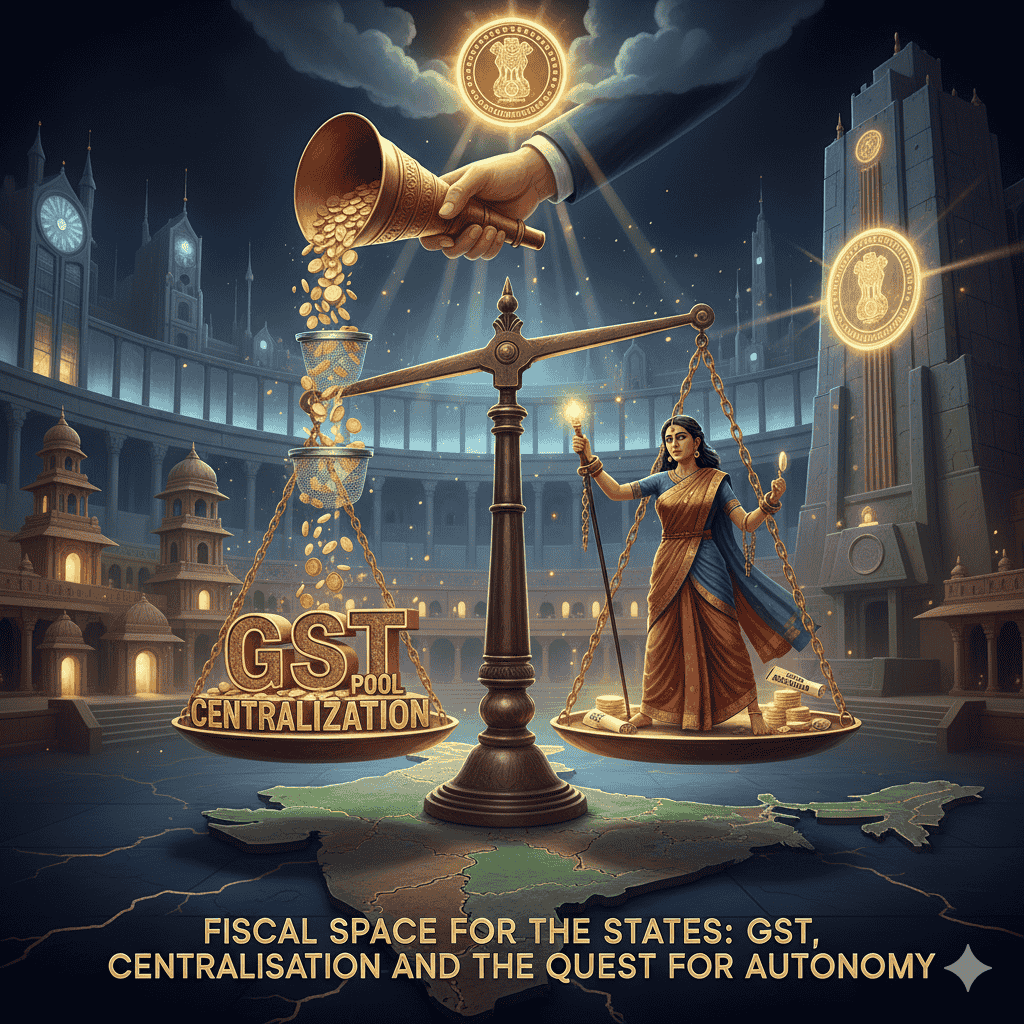
Fiscal Space for the States: GST, Centralisation and the Quest for Autonomy
The introduction of GST (2017) simplified indirect taxation but shifted taxing power to the Centre, reducing States’ fiscal flexibility. The end of the GST compensation cess (2025) and recurring demands for tax autonomy have revived debates on restoring fiscal space for States to ensure cooperative federalism and sustainable public finances.
Introduction
Context & Background
Key Points
- •What is fiscal space? — Think of a household: fiscal space is like disposable income after paying essential bills. If income falls but expenses stay the same, you have less fiscal space to save or invest.
- •What did GST do? — Imagine many small shopkeepers each paying different local taxes being moved to one single tax system so they don’t pay multiple taxes. That is GST: easier but more centralised.
- •Why do States worry? — States are primarily responsible for schools, hospitals, roads and farms. If their predictable income falls, they cannot plan long-term projects or respond to shocks (like floods) effectively.
- •What changed with GST: GST merged many indirect taxes (state VAT, central excise, CST, entry taxes), creating a single tax at source. For beginners: instead of many small jars of money for different governments, most of the money flowed into a single big jar.
- •GST compensation cess: A temporary levy to make good shortfalls for States when GST started. Its abolition in 2025 removed a known compensation stream, leaving some States with holes in budgets.
- •Non-divisible cesses and surcharges: These are special levies whose proceeds are not shared with States (e.g., some health or infrastructure cesses). Because they are excluded from the divisible pool, States get a smaller share of total tax revenue.
- •Finance Commission role: The Finance Commission recommends how the divisible tax pool is shared. But when large amounts are kept out of that pool (as cesses), the Centre’s share grows relative to States'.
- •Dependence & asymmetry: States vary widely: some (like Bihar) depend heavily on central transfers, while others (like Haryana) have stronger own-tax bases. This leads to unequal fiscal abilities across States.
- •Borrowing & FRBM: States face fiscal rules (FRBM) that limit their deficits and borrowing. While these rules intend fiscal discipline, they also limit the ability to borrow for productive investment in times of stress.
- •Potential reforms: Ideas include sharing a slice of Personal Income Tax (PIT) with States, allowing a small state-level PIT surcharge, bringing cesses into the divisible pool, and stronger, formula-based transfers for predictability.
How GST Changed State Fiscal Powers (Simple view)
| Before GST | After GST | Bookmark |
|---|---|---|
| States collected VAT, entry taxes, octroi and had some rate flexibility. | VAT and many local indirect taxes subsumed under GST; rate decisions made by GST Council. | |
| States had visible local tax levers to raise revenues for local projects. | States rely more on transfers, grants, and the divisible pool; local levers reduced. |
Sources of State Revenues — Plain Language
| Source | What it means for the State | Bookmark |
|---|---|---|
| Own taxes (e.g., stamp duty, state excise) | Direct money States collect themselves — gives control. | |
| Central transfers (devolution + grants) | Money Centre gives to States — predictable transfers help planning. | |
| Borrowings | Loans that have to be repaid; used for big projects but limited by rules. | |
| Cesses/surcharges | Special levies often not shared with States; reduce money available to divide. |
Related Entities
Impact & Significance
- •Reduced planning ability: When States cannot be sure about next year’s revenues, they delay multi-year projects like highways and hospitals.
- •Service gaps: Cuts in revenue translate into lesser spending on education, health and rural development — sectors mostly run by States.
- •Borrowing pressure: To fill gaps, States may increase borrowings, raising interest costs that crowd out capital spending later.
- •Political tension: Fiscal centralisation can create friction between Centre and States, especially when governments are politically different.
Challenges & Criticism
- •Consensus requirement: Major changes (like sharing PIT) need agreement among many States and the Centre — politically hard to achieve.
- •Inequality risk: Without careful design, reforms might favour richer States or those with better tax administration, worsening regional inequalities.
- •Implementation capacity: Sharing PIT or adding state surcharges will need strong tax administration to avoid leakage and disputes.
- •Short-term liquidity issues: Sudden removal of compensation mechanisms can cause cash-flow problems for States until longer-term reforms are implemented.
Future Outlook
- •Short-term measures: Centre can offer transitional grants or a temporary special transfer to smooth the removal of GST compensation while structural reforms are designed.
- •Medium-term reforms: Consider sharing a small portion of PIT with States, merging cesses into divisible pool, and incentivising property tax reforms at state/city levels to boost own revenues.
- •Institutional steps: Establish a permanent Centre–State Fiscal Council that meets regularly, shares real-time data, and manages disputes transparently.
- •Capacity building: Invest in state-level tax administration (digital filing, data analytics) and training so States can better mobilise local resources.
- •Safeguards: Any new state revenue tool should include progressive safeguards (protecting poorest states and citizens), transparent formulae, and dispute-resolution mechanisms.
UPSC Relevance
- • GS-3: Public finance, federal relations, fiscal policy and taxation.
- • GS-2: Centre–State relations, cooperative federalism.
Sample Questions
Prelims
Consider the following statements: 1. Article 246A was introduced by the 101st Amendment to enable GST. 2. The Finance Commission recommends the formula for sharing cesses with States. Which of the statements given above is/are correct?
- (a)Article 246A was introduced by the 101st Amendment to enable GST.
- (b)The Finance Commission recommends the formula for sharing cesses with States.
Mains
Examine how the GST has affected the fiscal autonomy of States in India. Suggest measures to restore adequate fiscal space while preserving the benefits of a unified indirect tax.
Introduction: GST harmonised indirect taxes but shifted many local levers to the Centre, reducing State autonomy.
Body:
• Impact: Loss of local taxes, increased dependence on transfers, loss of rate-setting flexibility.
• Reasons: Cesses not shared, end of compensation mechanisms, GST Council centrality.
• Reforms: Share PIT, allow limited state surcharges, bring cesses into divisible pool, strengthen state tax administration, establish permanent fiscal council.
Conclusion: A calibrated mix of institutional, fiscal and administrative reforms can balance uniformity with local autonomy.