
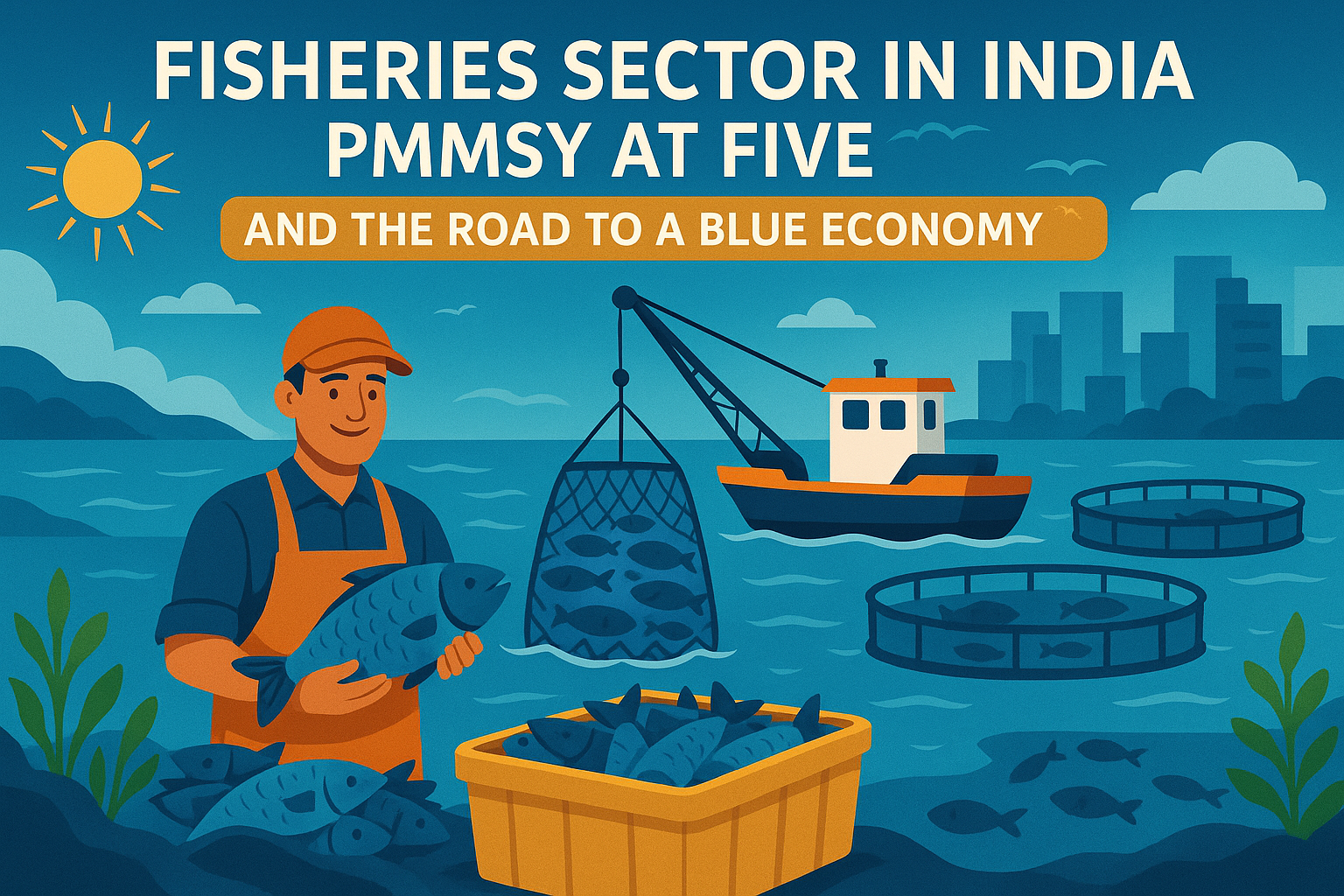
Fisheries Sector in India: PMMSY at Five and the Road to a Blue Economy
With PM Matsya Sampada Yojana completing five years, India—now the world’s #2 fish producer—has scaled output, jobs, and exports, but must tackle overfishing, post-harvest losses, climate risks, and value-chain gaps to unlock full Blue Economy potential.
Introduction
Fisheries have become a core growth engine of India’s Blue Economy, blending livelihoods, nutrition, exports, and regional development. In 2025, India contributes ~8% to global fish output, with aquaculture and inland fisheries driving much of the expansion.
Context & Background
The Pradhan Mantri Matsya Sampada Yojana (PMMSY, 2020–25) injected ₹20,050 crore into the sector to raise production, modernise infrastructure, de-risk fishers, and improve export competitiveness. Over five years, production, productivity, and employment rose markedly, while technology adoption and women’s participation gained traction.
Key Points
- •Macro Profile (2025): Fisheries contribute ~1.24% to GDP and ~7.7% to Agriculture GVA, with ~3 crore livelihoods; exports form ~20% of agri-exports.
- •Production Structure: Three pillars—marine fisheries (coastal capture), inland fisheries (rivers, reservoirs, ponds; India is #1), and aquaculture (freshwater & brackish; India is #1 in shrimp).
- •Geographic Leaders: Andhra Pradesh, West Bengal, Gujarat, Odisha, and Tamil Nadu anchor volumes; inland expansion is accelerating in non-coastal states via reservoirs and ponds.
- •PMMSY Outcomes (2020–25): Output up to ~195 LMT; aquaculture productivity from ~3 to ~4.7 t/ha; 58 lakh jobs created; exports up from ₹46,663 crore (2019–20) to ₹60,525 crore (2023–24); ~1 lakh women empowered via sanctioned projects.
- •Tech Mainstreaming: Biofloc (BFT) and RAS reduce water intensity and enable high-density culture; PFZ satellite advisories cut fuel use; drones/IoT monitor water quality and health; solar cold rooms and reefer logistics reduce losses.
- •Digital Rails: NFDP single-window for schemes, credit, and insurance; e-NAM integration and e-trade pilots for fish marketing; e-NWRs to enable pledge finance and better price realisation.
- •Quality & Export Readiness: Push for traceability, certifications, HACCP/EC standards, and modern processing clusters to tap high-value markets and move up the value chain beyond raw shrimp.
- •Inclusion & Gender: Women-led FFPOs/cooperatives in processing, retail, and feed; targeted skilling and microcredit expand incomes and resilience in coastal and inland communities.
- •Climate & Sustainability Lens: Seasonal bans, mesh-size norms, TURFs/co-management, seaweed/mussel culture diversification, and climate-resilient seed/broodstock to protect stocks and livelihoods.
- •Blue Economy Convergence: Alignment with coastal tourism, seaweed farming, mariculture, ports, and renewable energy to diversify incomes and infrastructure in a sustainable manner.
Related Entities
Impact & Significance
- •Growth & Jobs: High employment elasticity with spillovers to feed, logistics, retail, and processing.
- •Nutrition Security: Affordable animal protein and micronutrients for coastal and inland households.
- •Export Earnings: Stable forex from seafood, particularly shrimp; scope to expand value-added products.
- •Regional Development: Uplifts aspirational coastal/inland districts through enterprise and infrastructure.
Challenges & Criticism
- •Overfishing & Stock Stress: CPUE decline in marine fisheries; need for rights-based and science-led management.
- •Post-Harvest Losses (~20%): Cold-chain gaps, handling, and packaging deficits erode incomes and quality.
- •Climate Risks: Cyclones, SST rise, acidification, coastal erosion, and saline intrusion disrupt traditional fisheries.
- •Informality & Finance: Low formal credit/insurance coverage and fragmented markets drive distress sales.
- •Technology Diffusion: BFT/RAS/IoT remain pilot-heavy; scale needs capex support, skills, and service models.
- •Quality Compliance: Residue, sanitation, and traceability challenges cap access to premium export markets.
- •Governance Frictions: Centre–State overlaps and slow reform cycles delay sustainable harvest policies.
Future Outlook
- •Phase-II PMMSY/Blue Economy roadmap with climate-resilient mariculture, seaweed, and inland reservoir fisheries.
- •Modern processing clusters, e-NWR adoption, and export hubs for value-added seafood and ready-to-cook lines.
- •Universal fisher insurance, portable social security, and disaster-risk financing for coastal resilience.
- •Scaling BFT/RAS via FFPO-run equipment banks and PPP service models (pay-per-use).
- •End-to-end traceability stacks and certification to lift unit values in the US/EU/Japan corridors.
UPSC Relevance
- • GS-3 (Economy/Agriculture): Blue Economy, PMMSY, value chains, exports, climate resilience.
- • GS-2: Federal coordination, social security for fishers, women empowerment via FFPOs.
- • Essay: Sustainable growth vs resource depletion; climate-proofing coastal livelihoods.
Sample Questions
Prelims
With reference to India’s fisheries sector, consider the following: 1) India is the largest global producer of inland fish. 2) Biofloc technology reduces water use and provides in situ feed. 3) PFZ advisories are issued using satellite data. Which of the statements given above are correct?
- (a)1 and 2 only
- (b)2 and 3 only
- (c)1 and 3 only
- (d)1, 2 and 3
Mains
PMMSY has boosted production, productivity, and jobs, yet marine stock stress, post-harvest losses, and climate risks persist. Critically examine India’s fisheries through a Blue Economy lens and outline reforms for sustainable, export-competitive growth.
Introduction:
India’s fisheries—spanning marine, inland, and aquaculture—now anchor livelihoods, nutrition, and exports. PMMSY catalysed scale, but sustainability and value-addition are the next frontier.
Body:
• Performance & Potential: Rising output, aquaculture productivity, jobs, and exports; inland and shrimp aquaculture lead; strong scope in value-added seafood and seaweed/mariculture.
• Binding Constraints: Overfishing/CPUE decline, 20% post-harvest losses, climate shocks, informality/credit gaps, tech diffusion barriers, and quality/traceability deficits.
• Blue Economy Reforms: (a) Science-led harvest control (seasonal bans, mesh norms, co-management/TURFs); (b) Cold-chain, processing clusters, e-NWR finance; (c) Universal social security, disaster insurance; (d) Scale BFT/RAS via FFPO-PPP service models; (e) Export compliance—traceability, certifications, testing labs; (f) Diversification into seaweed, mussel, and reservoir fisheries; (g) Centre–State coordination for unified regulations and swift adoption.
• Inclusion & Gender: Women-led FFPOs/coops in processing/retail; targeted skilling, microcredit, and digital onboarding (NFDP).
Conclusion:
A sustainability-first, value-chain-centric strategy can turn fisheries into a resilient, export-competitive pillar of India’s Blue Economy—securing livelihoods while conserving marine and inland ecosystems.