
The Four Labour Codes: A Overhaul of India’s Labour Laws
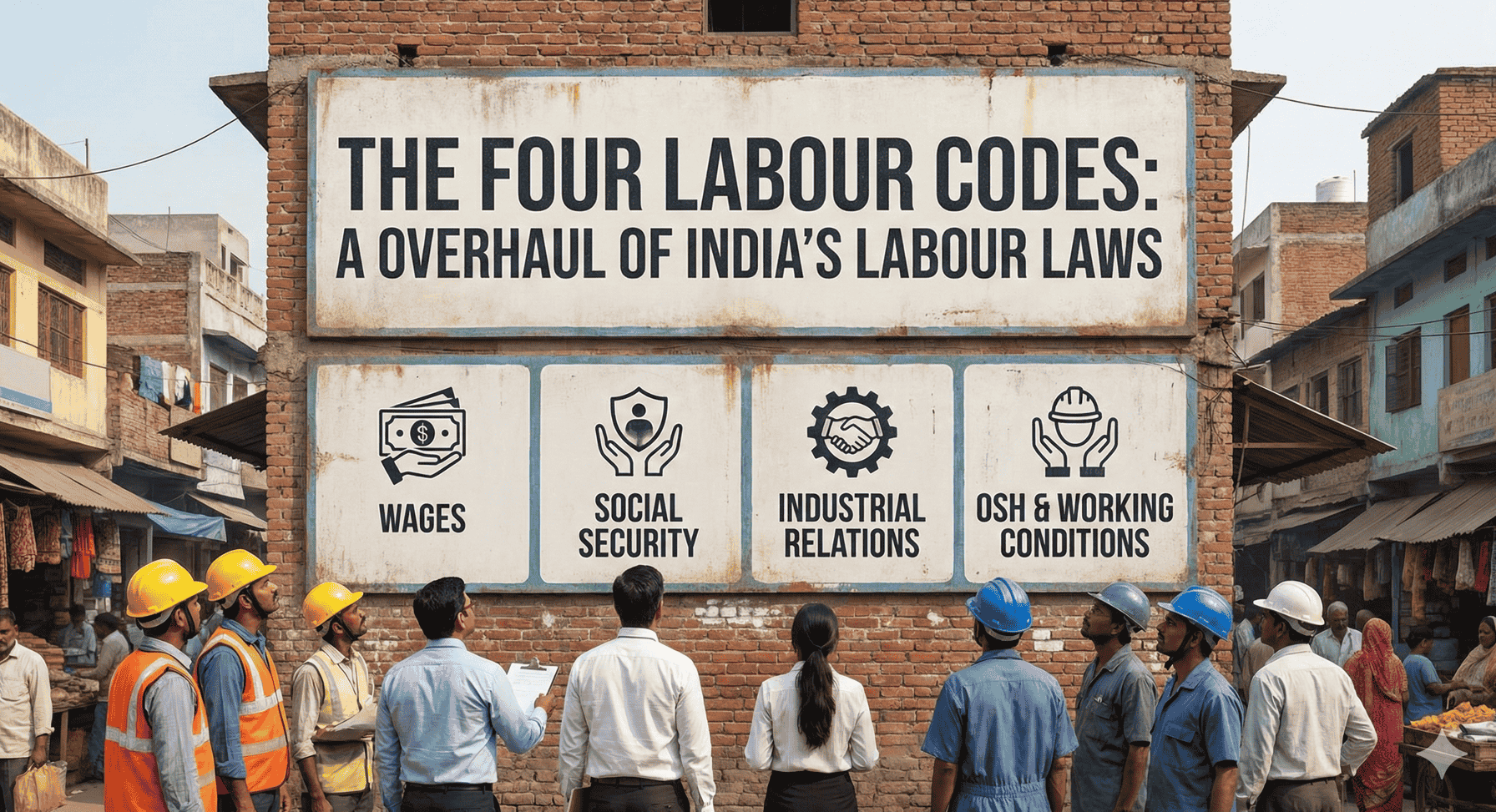
India is rolling out a historic labour reform by merging 29 complex, old central labour laws into four unified 'Codes'. This move aims to simplify business compliance, expand social security to modern workers (like gig workers), and balance employer flexibility with worker welfare.
Introduction
Context & Background
Key Points
- •1. Code on Wages, 2019 (The Paycheck Reform):
For beginners: Previously, different laws had different definitions of 'wages', leading to lawsuits. This Code creates one unified definition. It mandates a National Floor Wage (set by the Centre) below which states cannot set their minimum wages. It also ensures 'Equal Pay for Equal Work' irrespective of gender and mandates that all employees receive timely wages, digital wage slips, and statutory bonuses. - •2. Code on Social Security, 2020 (The Safety Net):
This allows, for the first time, legal recognition of Gig Workers and Platform Workers. It proposes a National Social Security Board and enables the creation of welfare schemes funded through contributions from aggregators. It also expands coverage of EPFO and ESIC, and links benefits with Aadhaar and the e-Shram portal to ensure portability across states. - •3. Industrial Relations Code, 2020 (Hiring & Firing Rules):
This Code raises the threshold for seeking government permission for layoffs, retrenchment, and closure from 100 to 300 workers. It introduces Fixed-Term Employment, allowing firms to hire workers for a specific period with benefits equal to permanent employees. It also simplifies dispute resolution by strengthening Industrial Tribunals. - •4. OSH Code, 2020 (Safety & Health):
Consolidates 13 laws relating to workplace safety. It allows women to work night shifts across sectors with mandatory safety norms and consent. It expands the definition of Inter-State Migrant Workers, drawing lessons from the COVID-19 migrant crisis, and mandates employer-provided accommodation and medical facilities in hazardous sectors. - •5. Reduced Compliance Burden:
Replaces multiple registers and returns with single digital filings, web-based inspections, and risk-based audits. This reduces the scope of Inspector Raj and improves transparency, especially for MSMEs. - •6. Restriction on Strikes:
The definition of strike has been widened to include mass casual leave. A mandatory 14-day notice period applies to all establishments, aiming to ensure industrial peace but raising concerns among trade unions. - •7. COVID-19 as a Turning Point:
The pandemic exposed gaps in migrant worker protection and benefit portability. The labour codes attempt to address these failures through digital worker databases and expanded social security coverage.
Comparison: Old Regime vs. New Labour Codes
| Feature | Previous System | New Labour Codes | Bookmark |
|---|---|---|---|
| Law Structure | 29 fragmented Central Laws | 4 Unified Labour Codes | |
| Gig Workers | No legal status | Legally recognized with welfare schemes | |
| Layoff Threshold | >100 workers | >300 workers | |
| Minimum Wage | Limited coverage | Universal coverage | |
| Women Workers | Night work restrictions | Allowed with safety norms |
Stakeholder Reactions to the Reforms
| Stakeholder | Stance | Key Arguments | Bookmark |
|---|---|---|---|
| Government | Supportive | Formalization, investment, and universal social security | |
| Industry | Strongly Supportive | Predictability, reduced compliance, scale expansion | |
| Trade Unions | Opposed | Fear dilution of job security and right to strike |
Related Entities
Impact & Significance
- •Economic Efficiency: By allowing companies with up to 300 workers to retrench staff without prior government permission, the Codes encourage industries to scale up without fear of rigid laws. This mimics the flexibility seen in manufacturing hubs like Vietnam and China.
- •Formalization of Workforce: With the introduction of a national portal (e-Shram) and Aadhaar-linked benefits, the reforms aim to pull millions of informal workers into the formal social security net.
- •Gender Parity: Explicit provisions for equal pay and night shift permissions can significantly increase Female Labour Force Participation (FLFP) in India.
- •Digital Governance: The shift towards web-based inspections and digital wage slips reduces the scope for harassment by 'Inspector Raj' and improves transparency.
Challenges & Criticism
- •Dilution of Job Security: Critics argue that raising the layoff threshold to 300 workers exposes a vast majority of industrial workers to arbitrary firing, potentially creating a precariat class.
- •Implementation Asymmetry: Since Labour is a concurrent subject, states must frame their own rules. Some states (UP, Gujarat) are fast, while others lag, leading to a fragmented rollout.
- •Enforcement Capacity: India has a severe shortage of labour inspectors. Without a robust digital enforcement mechanism, laws regarding minimum wages and safety may remain only on paper.
- •Exclusion of Very Small Units: Many provisions apply to establishments with a certain number of workers (e.g., 10 or 20). This leaves the vast majority of micro-enterprises (employing <10 people) largely unregulated.
Future Outlook
- •Reskilling Funds: To mitigate the risk of job losses, the government must actively operationalize the 'Reskilling Fund' (funded by employer contributions) to help retrenched workers transition to new jobs.
- •Cooperative Federalism: The Centre needs to handhold states to ensure uniform notification of rules to prevent a race to the bottom where states compete by lowering labour standards.
- •Data-Driven Audits: Utilizing the 29 crore+ registrations on the e-Shram portal to monitor the actual reach of social security benefits.
- •Tripartite Dialogue: Continuous engagement between Workers, Industry, and Government is essential to address the fears of Trade Unions regarding the 'Right to Strike' and job security.
UPSC Relevance
- • GS-2: Government policies and interventions, issues relating to development and management of social sector.
- • GS-3: Indian Economy, Employment, Inclusive Growth, Investment models.
- • Essay: Topics related to Labour Reforms, Gender Equality at Work, and the Gig Economy.
Sample Questions
Prelims
With reference to the Code on Social Security, 2020, consider the following statements:
- (a)It provides the first legal definition for 'Gig Workers' and 'Platform Workers' in India.
- (b)It mandates the Central Government to set a National Floor Wage.
- (c)It restricts the coverage of EPF to government employees only.
Mains
The Four Labour Codes represent a paradigm shift from 'Inspector Raj' to a facilitator of economic growth. Discuss the key provisions of these codes and analyze the balance they attempt to strike between industrial flexibility and worker welfare.
Introduction: Briefly mention the transition from 29 fragmented laws to 4 unified codes aiming to boost investment and social security.
Body:
• Key Provisions: Universal minimum wage, recognition of gig workers, raising layoff thresholds (100 to 300), and fixed-term employment.
• Enhancing Flexibility: How the higher threshold and FTE help industries adjust to market demands.
• Ensuring Welfare: Expansion of ESIC/EPFO, reskilling funds, and OSH codes for migrants/women.
• Concerns: Trade union resistance, dilution of job security, and enforcement challenges.
Conclusion: Conclude that while the intent is transformative, success depends on 'Reform with intent and Perform with integrity' as seen in effective implementation by states.