
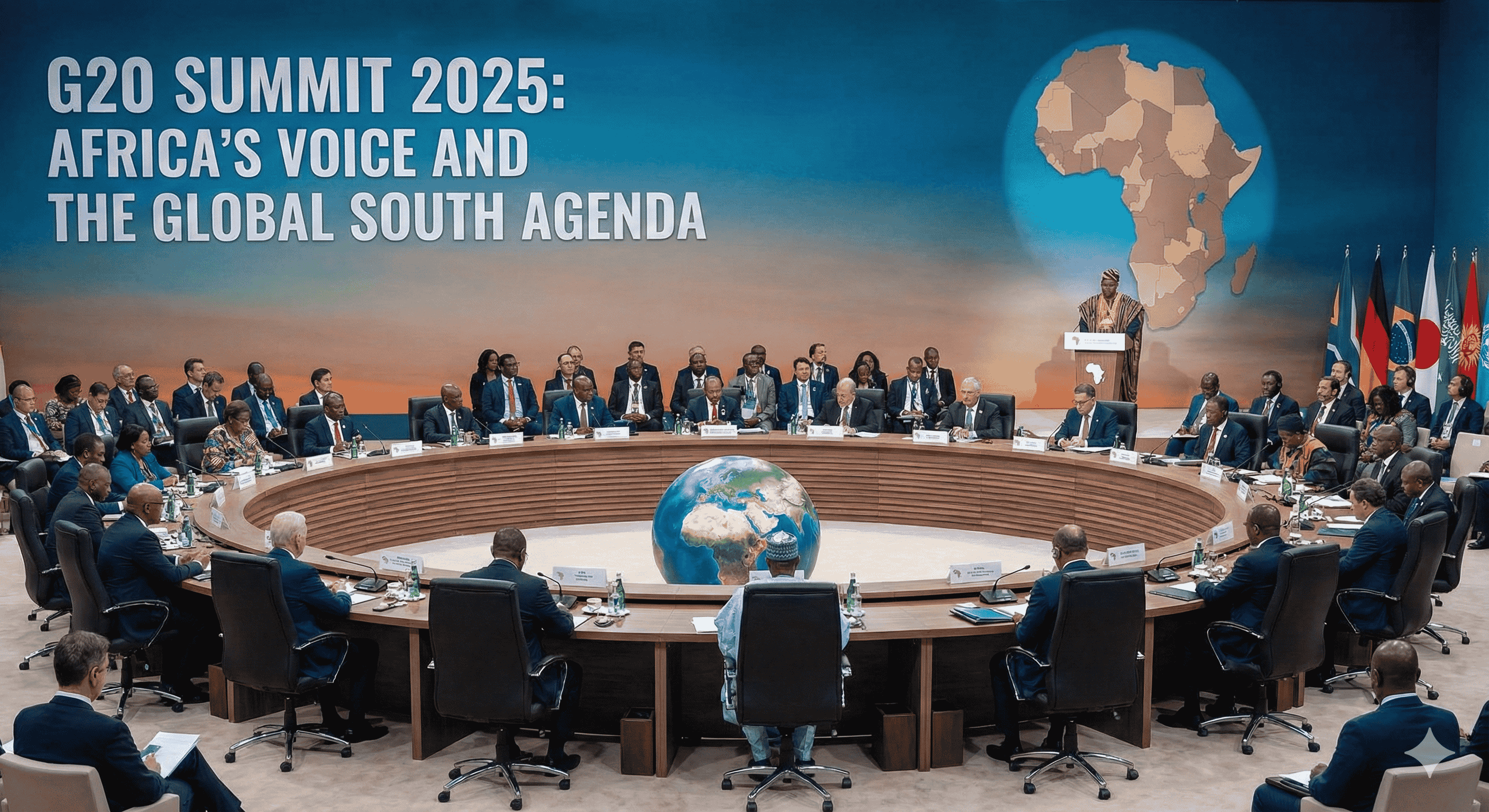
G20 Summit 2025: Africa's Voice, The US Boycott & The Global South Agenda
The 2025 G20 Summit in Johannesburg was a historic event—the first hosted in Africa. It was marked by a unified 'Global South' agenda focusing on debt relief and critical minerals, but also by a significant geopolitical rift: a complete boycott by the US President. Key outcomes included the 'Mission 300' energy pact and the 'Nelson Mandela Bay Target' for youth employment.
Introduction
Context & Background
The 'Global South Run': This summit concluded a powerful four-year streak where developing nations led the G20: Indonesia (2022) → India (2023) → Brazil (2024) → South Africa (2025). This run firmly shifted the G20's focus from Western banking issues to poverty, hunger, and infrastructure.
Key Points
- •1. Debt Crisis (The 'Cost of Capital Commission'): African nations pay interest rates 4-8 times higher than rich countries. The summit launched a new commission to investigate these 'unfair' credit ratings and reduce the 'African Risk Premium', aiming to make loans cheaper for development.
- •2. 'Mission 300' (Energy for Africa): A massive World Bank and African Development Bank (AfDB) initiative endorsed by the G20.
Goal: To connect 300 million Africans to electricity by 2030, primarily using solar and renewable mini-grids. This is the largest energy access program in history. - •3. Critical Minerals Framework (Voluntary):
The Issue: Rich countries extract minerals (Lithium, Cobalt) from Africa but process them elsewhere, keeping the profits.
The Outcome: A new framework encourages 'Beneficiation at Source'—meaning factories must be built where the mines are, creating local jobs. However, this is voluntary, not a strict law. - •4. Youth Employment (The 'Nelson Mandela Bay Target'): A specific, measurable goal was set to reduce the rate of youth who are NEET (Not in Education, Employment, or Training) by 5% by 2030 globally.
- •5. AI for Africa Initiative: To prevent a 'Digital Apartheid', this initiative focuses on giving African nations access to Computing Power and Data Sets so they can build their own Artificial Intelligence tools rather than just buying them from the West.
- •6. Climate Finance Shift: The leaders agreed that climate funding needs to jump from 'Billions' to 'Trillions'. They supported the Loss and Damage Fund operationalization to pay for climate disasters in poor countries.
India's 6-Point Proposal (Championing the Global South)
| Initiative | What it Means (Simple) | Key Detail | Bookmark |
|---|---|---|---|
| Countering Drug-Terror Nexus | Stopping 'Narco-Terrorism' | Focus on stopping synthetic drugs like Fentanyl from funding terror groups. | |
| G20-Africa Skills Multiplier | Skilling the Youth | Train 1 million certified instructors in Africa over 10 years. | |
| Critical Minerals Circularity | Recycling > Mining | Promote 'Urban Mining' (extracting metals from old phones/laptops) to reduce dependence on new mines. | |
| Global Healthcare Response Team | Medical 'SWAT' Team | A mobile team of doctors/experts ready to deploy instantly during the next pandemic. | |
| Global Traditional Knowledge Repository | Digital Library of Cures | Digitize ancient knowledge (Ayurveda, TCM) to prevent 'biopiracy' by big pharma. | |
| Open Satellite Data Partnership | Sharing Space Views | Provide free satellite data to poor nations for crop monitoring and flood warnings. |
Key Summit Outcomes vs. Challenges
| Success Area | Outcome | Remaining Challenge | Bookmark |
|---|---|---|---|
| Gender Equality | Target to achieve 25% gender parity in the workforce by 2030. | Implementation in conservative societies remains slow. | |
| Multilateralism | Joint Declaration issued despite deep divides. | US Boycott weakened the political weight of the agreements. | |
| Minerals | Framework for local processing adopted. | It is non-binding; companies can choose to ignore it. |
Related Entities
Impact & Significance
- •Resilience of the G20: Critics predicted the summit would collapse without the US President. By issuing a consensus declaration, the G20 proved it can function in a multipolar world without relying on a single superpower.
- •Resource Sovereignty: The summit marked a shift from 'Extracting from Africa' to 'Partnering with Africa'. The African Union (AU), now a permanent member, effectively used its veto power to ensure mineral rights were respected.
- •Financial Architecture Reform: The launch of the Cost of Capital Commission is a direct attack on the Western-dominated credit rating system (like Moody's/S&P), which developing nations argue is biased against them.
Challenges & Criticism
- •The US Absence: The US President's decision to skip the summit (citing domestic political reasons and disagreements with South Africa) was seen as a snub. It raises fears that the G20 might split into 'Western' and 'Non-Western' blocs in the future.
- •Funding Gap: While 'Mission 300' is ambitious, the $90 billion needed to fund it has not been fully collected yet.
- •Implementation: The 'Nelson Mandela Bay Target' for youth employment is excellent on paper, but creating jobs in a slowing global economy is extremely difficult.
Future Outlook
- •US Presidency (2026): The next summit will be hosted by the USA. This is expected to be a tense affair, likely shifting the focus back to 'Great Power Competition' (US vs. China) and away from the developmental agenda of the Global South.
- •AI Impact Summit 2026: India's proposal to host a special summit on AI safety was accepted, keeping India at the center of the global tech governance debate.
UPSC Relevance
- • GS-2 (International Relations): Global groupings (G20), India's Foreign Policy (Voice of Global South), Effect of developed countries' policies (US Boycott).
- • GS-3 (Economy/Environment): Critical Minerals, Renewable Energy (Mission 300), Inclusive Growth.
- • Essay Topics: 'Multilateralism in Crisis', 'Resource Nationalism vs. Global Cooperation'.
Sample Questions
Prelims
Consider the following statements regarding the G20 Summit 2025 outcomes:
- (a)The 'Cost of Capital Commission' was launched to address the high interest rates faced by African nations.
- (b)'Mission 300' is an initiative by the IMF to provide food security to 300 million people.
- (c)The 'Nelson Mandela Bay Target' aims to reduce youth unemployment (NEET) rates.
Mains
The G20 Summit 2025 in Johannesburg demonstrated the resilience of the 'Global South' agenda amidst geopolitical fragmentation. Discuss this statement with reference to the outcomes on critical minerals and financial architecture reform.
Introduction: Held in the backdrop of a US boycott, the 2025 Summit solidified the developmental agenda of the Global South, proving the G20's multipolar resilience.
Body:
• Financial Reform: Launch of the 'Cost of Capital Commission' to tackle the 'African Risk Premium' and unfair credit ratings.
• Critical Minerals: The new framework prioritizes 'local value addition', challenging the colonial extraction model.
• India's Role: Proposals like the 'Skills Multiplier' and 'Circular Economy' for minerals bridged the gap between developing and developed nations.
Conclusion: The summit marked a structural shift where African priorities (debt, energy, minerals) became central to global governance, despite Western disengagement.