
Inequality in India: The Widening Gap Between the Rich and the Rest
The Global Inequality Report 2025 reveals a sharp rise in wealth concentration, with India’s top 1% capturing the lion's share of growth. This widening divide poses risks to economic stability, democratic integrity, and social cohesion, prompting calls for wealth taxation and stronger social security nets.
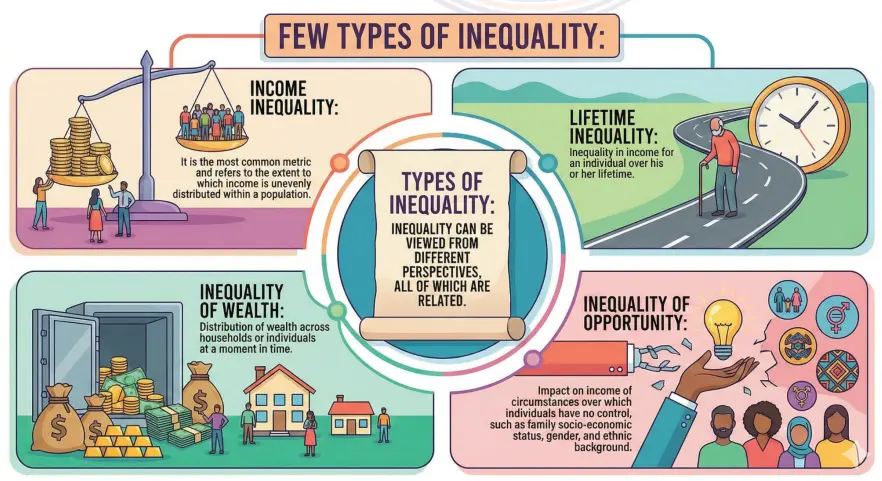
Introduction
Context & Background
Key Points
- •Wealth Concentration in India: The data is alarming. Between 2000 and 2023, the share of wealth held by India's top 1% increased by 62%. India’s millionaire population grew by 6% in 2024, with 191 billionaires now controlling vast resources.
- •Labor vs. Capital Divide: Income comes from two sources: working (wages) or owning assets (capital/investments). The report notes that 97% of Indians earn negligible income from capital. Since 1990, the share of national income going to capital owners has risen, while the share going to workers has fallen. Simply put: Money is earning more money than people are earning wages.
- •Wage Stagnation: While corporate profits soar, worker pay is stagnant. Between 2019–2024, CEO pay jumped 50%, while average worker wages grew by less than 1%. This disconnect deepens the feeling of unfairness in the economy.
- •Regressive Taxation: High indirect taxes (like GST) on essential goods burden the poor disproportionately. A poor person spends a larger percentage of their income on consumption taxes than a rich person, reducing their disposable income.
- •Inheritance and Intergenerational Inequality: Approximately $70 trillion will be passed down to the next generation globally in the coming decade. This means wealth is determined more by birth than by hard work, locking families into cycles of poverty or privilege.
- •The Rural-Urban Gap: In India, rural incomes are roughly 40% lower than urban incomes. This is due to land fragmentation, dependence on low-paying agriculture, and a lack of industrial jobs in villages.
Government Initiatives to Combat Inequality
| Scheme | Target Audience | How it Reduces Inequality | Bookmark |
|---|---|---|---|
| MGNREGA | Rural Poor | Guarantees 100 days of wage employment, setting a 'floor' for rural income. | |
| PM-KISAN | Small Farmers | Direct cash transfer (₹6,000/year) supports those with little land wealth. | |
| Ayushman Bharat | Bottom 40% population | Provides ₹5 lakh health cover, preventing families from falling into poverty due to medical bills. | |
| Jan Dhan Yojana (JAM) | Unbanked Population | Financial inclusion allows the poor to save, access credit, and receive direct subsidies without leaks. |
The Debate: Is Inequality Good or Bad?
| Argument for 'Good' Inequality | Argument for 'Bad' Inequality | Bookmark |
|---|---|---|
| Incentivizes Risk: High rewards encourage entrepreneurs to innovate and start businesses. | Reduces Demand: The poor spend most of their income; the rich save it. If the poor have no money, consumption drops, slowing GDP. | |
| Capital Formation: Wealth accumulation allows for large-scale investments in infrastructure. | Wasted Potential: Poor families cannot invest in education/health, meaning the economy loses out on skilled workers. |
Related Entities
Impact & Significance
- •Economic Slowdown: An economy runs on demand. When the bottom 50% hold only 13% of the income, they cannot buy goods and services. This leads to a demand slump, slowing down GDP growth.
- •Health Disparities: Wealth inequality leads to health inequality. Richer states like Kerala have an Infant Mortality Rate (IMR) of 6, while poorer states like UP have an IMR of 38. Money literally determines life expectancy.
- •Educational Apartheid: Learning outcomes depend on parental income. Only 25% of rural grade-3 children can read grade-2 texts. This creates a trap where the poor stay unskilled and poor.
- •Democratic Erosion: Extreme wealth concentration leads to 'Elite Capture', where policies are shaped to benefit the rich (lobbying) rather than the public good, leading to social unrest and loss of trust in democracy.
Challenges & Criticism
- •Implementation Gaps: While schemes like MGNREGA exist, issues like delayed payments and corruption dilute their impact.
- •Resource Mobilization: Implementing redistribution (like higher welfare spending) requires money. However, the government fears that taxing the rich too heavily (Wealth Tax) might cause Capital Flight (rich people moving their money abroad).
- •Structural Issues: Inequality in India is also social (Caste/Gender). Economic measures alone cannot fix deep-rooted caste-based exclusion where SC/ST poverty rates remain double the national average.
Future Outlook
- •Wealth Taxation: The report suggests a 2% wealth tax and a 33% inheritance tax on the top 1%. In India, this could generate ₹11 lakh crore annually, enough to triple health and education spending.
- •Human Capital Investment: India spends only 2.1% of GDP on health and 2.9% on education. Raising this is the only long-term fix to equalize opportunities.
- •Labor Reforms: Strengthening collective bargaining (unions) can help workers demand a fairer share of corporate profits, reversing the declining labor-income share.
- •Universal Basic Income (UBI): Moving from targeted schemes to a broader income support model to protect vulnerable households against economic shocks.
UPSC Relevance
- • GS-1: Poverty and Developmental issues, Social Empowerment.
- • GS-2: Issues relating to poverty and hunger; Government policies and interventions.
- • GS-3: Inclusive Growth and issues arising from it; Indian Economy.
- • Essay: 'Inequality is a governance fault line'; 'Growth without Equity'.
Sample Questions
Prelims
With reference to the concept of the 'Gini Coefficient', consider the following statements:
- (a)It is a measure used to represent the income or wealth distribution of a nation's residents.
- (b)A Gini coefficient of 0 implies perfect inequality, while 1 implies perfect equality.
- (c)Most countries in the world currently have a Gini score below 0.2.
Mains
“Inequality is not just an economic gap; it is a governance fault line.” Analyze the consequences of rising inequality in India and suggest fiscal and structural measures to address it.
Introduction: Cite the Global Inequality Report 2025 findings (India's top 1% wealth share growth) to establish the context.
Body:
• Consequences: Economic (Demand slump), Social (Health/Education divide, SC/ST poverty), and Political (Democratic strain).
• Fiscal Measures: Wealth tax, Inheritance tax, rationalizing GST (Tax credits for poor).
• Structural Measures: Investing in Human Capital (Health/Education spending), strengthening labor rights, and bridging the rural-urban divide.
Conclusion: Conclude that for India to become a developed nation (Viksit Bharat), growth must be inclusive, moving from a K-shaped recovery to broad-based prosperity.