
When Governors Walk Out: Constitution vs Conscience
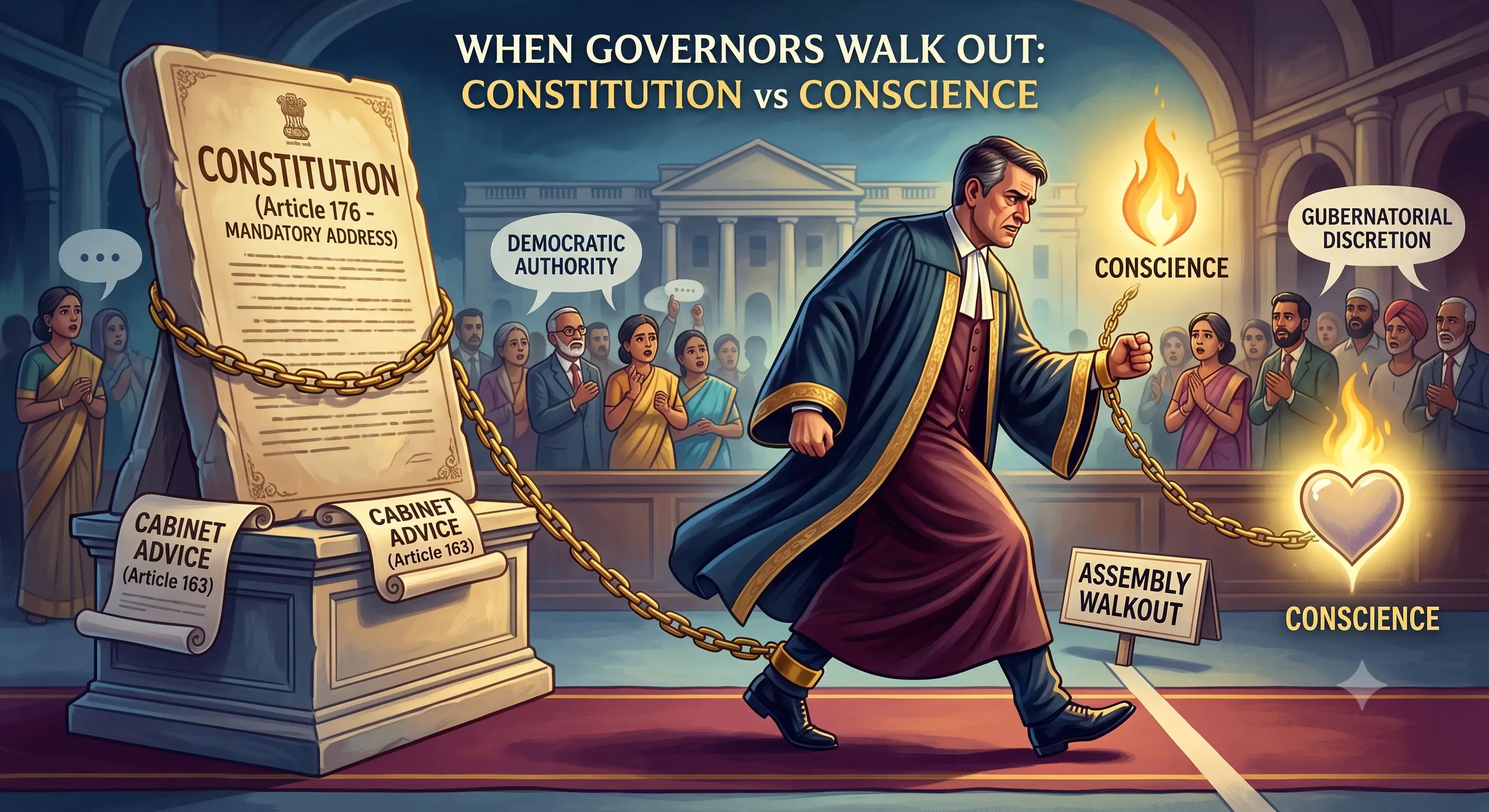
Recent instances of Governors exiting Assembly sessions in states like Karnataka, Tamil Nadu, and Kerala have reignited constitutional debates. This explores the friction between a Governor's personal conscience, the mandatory requirements of Article 176, and the bounds of the "aid and advice" framework under Article 163.
Introduction
Context & Background
Key Points
- •The Mandatory Special Address: Under Article 176(1), the Governor is constitutionally obligated to deliver a Special Address at the first session of a new legislature and the first session of every calendar year. They lack the authority to modify or withhold this.
- •Nature of the Address: The speech is an executive act, drafted entirely by the State Cabinet. It reflects the elected government's policies, drawing from the British 'Speech from the Throne' tradition, with no scope for the Governor to alter the approved text.
- •The Motion of Thanks: The Address is debated and acknowledged via a Motion of Thanks. Rejection of this motion indicates that the incumbent government has lost the confidence of the House.
- •Cornerstone of Federalism: Governors act as a vital bridge between the Centre and States. Their roles include discretionary powers in CM appointments, safeguarding state interests (5th/6th Schedules), and reserving bills for Presidential assent (Article 200).
- •Judicial Consensus: The Supreme Court has repeatedly clarified (e.g., Shamsher Singh, Nabam Rebia) that public dissent by a Governor from established Cabinet policy undermines the parliamentary form of government, and their independent discretion is extremely limited.
Constitutional Provisions for the Governor's Address
| Article | Provision | Nature / Obligation | Bookmark |
|---|---|---|---|
| Article 175(1) | Power to address the Legislative Assembly (or both Houses) at any time. | Discretionary Address | |
| Article 175(2) | Communicate messages to the House on pending Bills or other matters. | Discretionary; Legislature must take up with convenient dispatch | |
| Article 176(1) | Special Address at the first session post-election and the first session every year. | Mandatory; no authority to decline or withhold | |
| Article 176(2) | Mandates the Legislature to set aside time to debate the Governor's Address (Motion of Thanks). | Mandatory procedural requirement |
Landmark Supreme Court Judgments on Governor's Powers
| Case Name | Year | Key Ruling | Bookmark |
|---|---|---|---|
| Shamsher Singh v. State of Punjab | 1974 | Governor functions as a constitutional figurehead and must act on the aid and advice of the Council of Ministers. | |
| Nabam Rebia v. Deputy Speaker | 2016 | Reaffirmed that under Article 163, Governor is ordinarily bound by ministerial advice; personal discretion is strictly confined. | |
| State of Tamil Nadu v. Governor of Tamil Nadu | 2025 | Gubernatorial powers cannot be exercised to delay, frustrate, or weaken a democratically elected government. |
Related Entities
Impact & Significance
- •Erosion of Parliamentary Conventions: Refusal to read the approved text or walking out disrupts constitutional decorum and undermines the foundational principles of the parliamentary system.
- •Aggravation of Centre-State Tensions: Such constitutional standoffs deepen political fault lines, turning the non-partisan office of the Governor into a tool for political posturing.
- •Legislative Paralysis: Continuous friction delays legislative business and detracts from substantive governance and policy discussions in the assembly.
- •Judicial Intervention: Frequent deadlocks force the judiciary to intervene in legislative procedures, as seen in the 2025 State of Tamil Nadu v. Governor case, which warned against frustrating democratically elected governments.
Challenges & Criticism
- •Ambiguity in Textual Requirement: The Constitution requires the Governor to 'address' the House but lacks explicit wording on whether the speech must be read verbatim without omissions.
- •Increasing Politicisation: Elected state governments occasionally use the address to push partisan narratives or highlight Centre-State disputes, turning a constitutional formality into a political battleground.
- •The Claim of Conscience: Governors argue they cannot be constitutionally compelled to voice content they deem factually inaccurate or strictly partisan, creating a clash between duty and personal discretion.
- •Procedural Dilution: State legislatures have resorted to treating the address as 'read' or passing resolutions to record only the Cabinet-approved text after a Governor's walkout, weakening formal constitutional procedures.
Future Outlook
- •Promoting Cooperative Federalism: Establishing a structured and regular dialogue between Governors and State governments to minimize institutional friction and foster trust.
- •Adherence to Conventions: Governors must adhere closely to constitutional provisions and established norms, particularly regarding legislative processes like delivering addresses and granting assent to Bills.
- •Sarkaria and Punchhi Commission Reforms: Implementing long-standing recommendations such as providing Governors with a fixed five-year tenure, protecting them from arbitrary removal by the Centre, and ensuring strict neutrality.
- •Consultative Appointments: The Constitution should ideally codify the procedure of consulting the State's Chief Minister before appointing a Governor, ensuring transparent and merit-based selections.
UPSC Relevance
- • GS-2 (Polity & Governance): Executive, State Legislature, Role of Governor, and Centre-State Relations.
- • GS-2 (Constitutional Bodies/Features): Separation of powers, disputes between constitutional authorities.
- • Essay Topics: 'Cooperative Federalism vs. Partisan Politics', 'The evolving role of the Governor in Indian democracy'.
- • Mains Focus: Analyzing the discretionary powers of the Governor and the necessity of implementing the Sarkaria and Punchhi Commission recommendations.
Sample Questions
Prelims
With reference to the Governor’s Address in a State Legislature, consider the following statements: 1. Under Article 176, the Governor is mandated to address the State Legislature at the commencement of the first session of every year. 2. The Governor has the constitutional discretion to modify or omit parts of the speech drafted by the State Cabinet. 3. Defeat of the Motion of Thanks on the Governor's address implies a loss of confidence in the government. Which of the statements given above is/are correct?
A) 1 and 2 only
B) 2 and 3 only
C) 1 and 3 only
D) 1, 2, and 3
Answer: Option C
Explanation: Statement 1 is correct (Article 176). Statement 2 is incorrect; the Governor's address is an executive act bound by the aid and advice of the Council of Ministers (Article 163), leaving no room for discretionary alterations as established by conventions and SC rulings. Statement 3 is correct; rejection of the Motion of Thanks signifies the government lacks a majority.
Mains
“The office of the Governor has increasingly become a flashpoint in Centre-State relations, often undermining the parliamentary system of governance.” Examine this statement in the context of recent controversies surrounding the Governor's Address, and suggest necessary reforms.
Introduction: Introduce the context of recent walkouts by Governors in states like Tamil Nadu and Kerala. Briefly define the constitutional expectation of the Governor as a nominal head bound by ministerial advice.
Body:
• Constitutional Mandate: Explain Articles 175 and 176. Highlight that the Governor's Address is a Cabinet-drafted executive act and altering it violates the 'aid and advice' principle of Article 163.
• Emerging Issues: Discuss the increasing politicization of the speech by State Cabinets, the Governors' claims of 'conscience', walkouts, and the resultant procedural breakdown in state legislatures.
• Judicial & Committee Standpoints: Cite Shamsher Singh (1974) and Nabam Rebia (2016) cases restricting gubernatorial discretion. Outline Sarkaria and Punchhi Commission recommendations (fixed tenure, CM consultation).
Conclusion: Conclude that the Governor is the linchpin of constitutional governance at the state level. Preserving the non-partisan character of the office through codified reforms is vital for cooperative federalism.