
GSDP as Criterion for Tax Devolution
With the 16th Finance Commission's recommendations awaited, rising Centre-State tensions have revived the debate on using Gross State Domestic Product (GSDP) as a criterion for tax devolution. This article examines the contestations over current tax distribution, the flaws in tax collection metrics, and why GSDP could serve as a more equitable proxy.
Introduction
Context & Background
Key Points
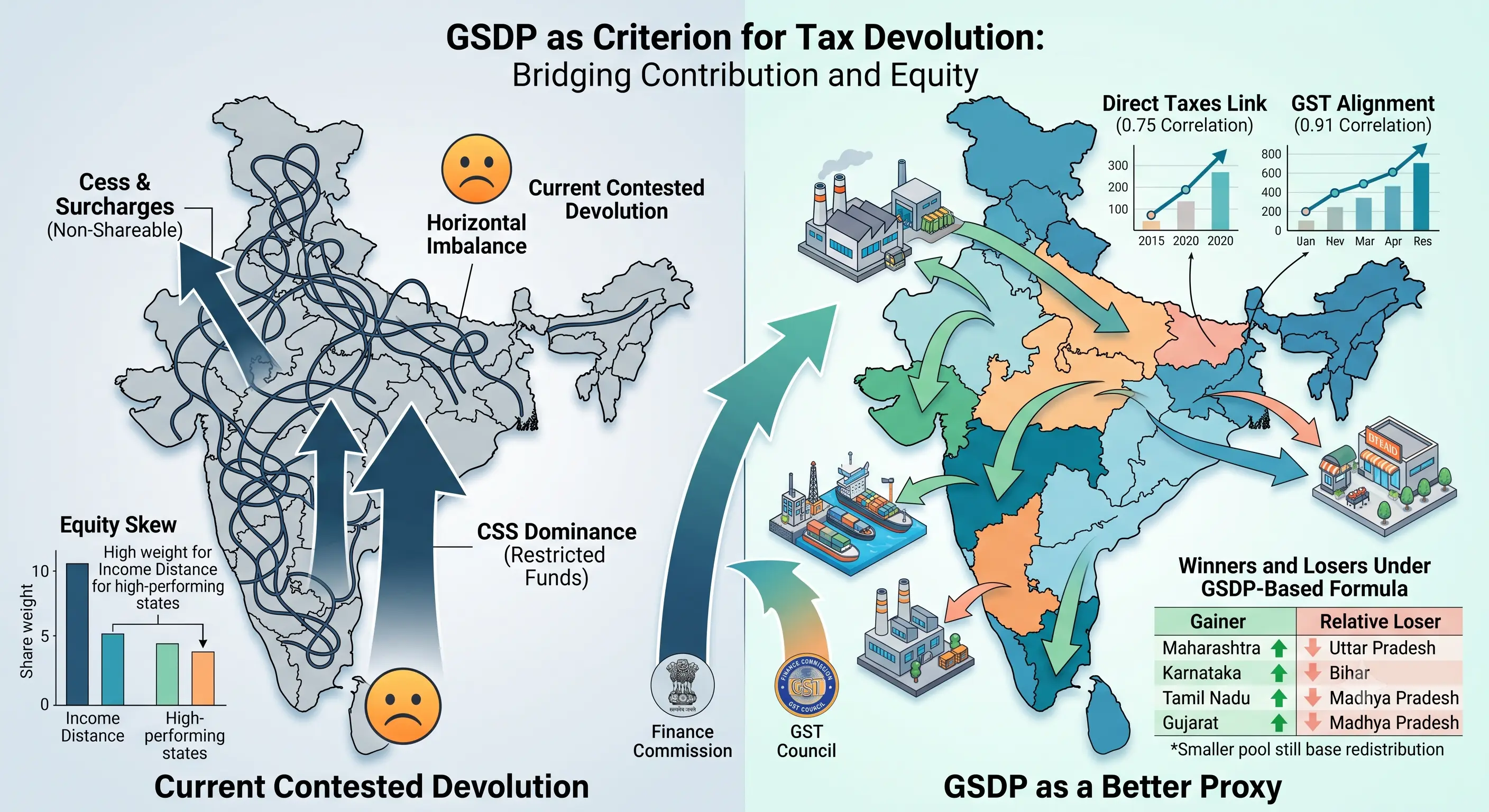
- •The Core Debate: Central tax devolution to States is guided by the Finance Commission. While 15th FC norms are in force, the 16th FC recommendations are awaited. Rising Centre–State tensions have sparked demand for using GSDP to dictate shares.
- •Declining State Autonomy: States’ own tax revenue averages just 7% of GSDP, while their expenditure responsibilities continue to rise. This widens the vertical fiscal imbalance.
- •Direct Taxes Link: GSDP correlates highly (0.75 in 2023–24) with direct tax collections, indicating that States with larger economies contribute proportionally more to direct taxes.
- •GST Alignment: GSDP has a massive 0.91 correlation with GST collections. This reflects GST’s destination-based nature and its close link with actual economic activity.
- •Lower Distortion: Unlike PAN-based tax attribution which creates a 'headquarters bias', GSDP reduces distortions and better reflects real production and value addition across States.
- •Winners and Losers under GSDP Formula: Transitioning to a GSDP proxy would make Maharashtra, Karnataka, Tamil Nadu, and Gujarat major gainers. Conversely, Uttar Pradesh, Bihar, and Madhya Pradesh would see reduced shares compared to current transfers, though baseline redistribution would continue.
Why is Tax Devolution Contested?
| Issue | Description | Impact on States | Bookmark |
|---|---|---|---|
| GST Centralisation | States surrendered key taxation powers; compensation ended in June 2022. | States report revenue shortfalls relative to pre-GST growth trends. | |
| Cess Expansion | Cesses and surcharges form 22–25% of Centre’s gross tax revenue. | Shrinks the divisible pool as these are not shareable with States. | |
| CSS Dominance | Centrally Sponsored Schemes account for 40% of Central transfers. | Limits States’ flexibility to allocate funds based on local priorities. | |
| Equity Skew | 15th FC assigned high weights for income distance (45%) and population (15%). | Reduced the relative shares of fiscally high-performing States. |
Tax Contribution vs Tax Collection Flaws
| Limitation | Cause | Distortion Effect | Bookmark |
|---|---|---|---|
| PAN Bias | Direct taxes recorded where PAN/registered offices are located. | Favors headquarters States over manufacturing States (e.g., Tamil Nadu). | |
| Multi-State Firms | Large firms operate pan-India but tax is booked centrally. | Distorts state-wise revenue estimates. | |
| Labour Mobility | Migrant labour generates income in host States. | Tax attribution remains unclear and fails to credit host States. |
Related Entities
Impact & Significance
- •Efficiency-Equity Balance: Using GSDP could bridge the gap between acknowledging economic efficiency and maintaining redistributive equity, as GSDP correlates 0.81 with tax collections and 0.58 with devolution shares.
- •Financial Autonomy: An updated devolution mechanism could restore fiscal autonomy to states, mitigating the restrictive impact of Centrally Sponsored Schemes (CSS) which currently eat up 40% of Central transfers.
- •Correcting Market Distortions: Relying on GSDP rather than tax collection data corrects the artificial 'headquarters bias' caused by the current PAN-based tracking of corporate taxes.
Challenges & Criticism
- •Redistributive Shock: Implementing a heavily GSDP-weighted formula would significantly reduce funds to states like UP, Bihar, and Madhya Pradesh, potentially stalling their developmental and poverty-alleviation programs.
- •Political Friction: Altering the formula could exacerbate the North-South political divide, pitting populous developing states against economically advanced industrial states.
- •Measurement Complexities: While GSDP is comprehensive, accurately measuring the unorganized sector and informal migrant labor contributions in real-time remains a statistical challenge.
Future Outlook
- •16th Finance Commission Considerations: The upcoming FC may need to re-evaluate the weightage given to demographic and income-distance criteria versus economic efficiency indicators like GSDP.
- •Cess Rationalisation: A potential cap on the Centre's ability to levy cesses and surcharges to ensure the divisible pool of taxes is not artificially shrunk.
- •Refining Attribution Rules: Developing mechanisms to map corporate tax collections to the states where actual manufacturing and economic activity take place, rather than just corporate headquarters.
UPSC Relevance
- • GS-2 (Polity & Governance): Centre-State relations, functions and responsibilities of the Union and the States, issues and challenges pertaining to the federal structure.
- • GS-3 (Economy): Government Budgeting, mobilization of resources, inclusive growth.
- • Essay Topics: 'Fiscal Federalism in India: Challenges and the Way Forward'.
- • Mains Focus: Analyzing the criteria of the Finance Commission and the implications of Centrally Sponsored Schemes (CSS) on state autonomy.
Sample Questions
Prelims
Consider the following statements regarding fiscal federalism and tax devolution in India: 1. Cesses and surcharges levied by the Centre do not form part of the divisible pool of taxes shared with the States. 2. The 15th Finance Commission gave the highest weightage to population for horizontal tax devolution. 3. The correlation between GSDP and GST collections is generally weak because GST is an origin-based tax. Which of the statements given above is/are correct?
1. Only 1 and 2
2. Only 2 and 3
3. Only 1 and 3
4. 1, 2, and 3
Answer: Option 1
Explanation: Statement 1 is correct (Article 270 excludes cesses/surcharges from the divisible pool). Statement 2 is incorrect; the highest weight was given to 'Income Distance' (45%), not population (15%). Statement 3 is incorrect; GST is a 'destination-based' tax and has a very strong correlation (0.91) with GSDP.
Mains
“The current formula for tax devolution creates a vertical fiscal imbalance and penalizes demographic and economic efficiency.” Analyze this statement in the context of the demand by well-performing states to use GSDP as a criterion for tax devolution.
Introduction: Introduce the role of the Finance Commission (Article 280) in tax devolution. Mention the recent context of the 16th Finance Commission and the grievances of southern and western states regarding their diminishing share in central taxes.
Body:
• Issues with Current Devolution: Cess and surcharge expansion shrinks the divisible pool. 15th FC’s heavy weightage to income distance (45%) and population (15%) reduces shares for high-performing states. Dominance of CSS (40%) restricts state autonomy.
• Flaws in Tax Collection Metrics: PAN bias leads to corporate taxes being booked in HQ states rather than manufacturing hubs; multi-state firms distort estimates; migrant labor contributions are not attributed to host states.
• Why GSDP is a Better Proxy: Strong correlation with Direct Taxes (0.75) and GST (0.91). Balances efficiency and equity (0.81 correlation with tax collections). It removes the HQ distortion and reflects true economic output.
Conclusion: Conclude by noting that while GSDP promotes efficiency and rewards economic performance (benefiting states like MH, TN, KA), the Finance Commission must balance this with the constitutional mandate of equity to ensure developing states (UP, Bihar) are not starved of developmental funds.