
HC Ruling Revives Debate on Older Definition of Rape
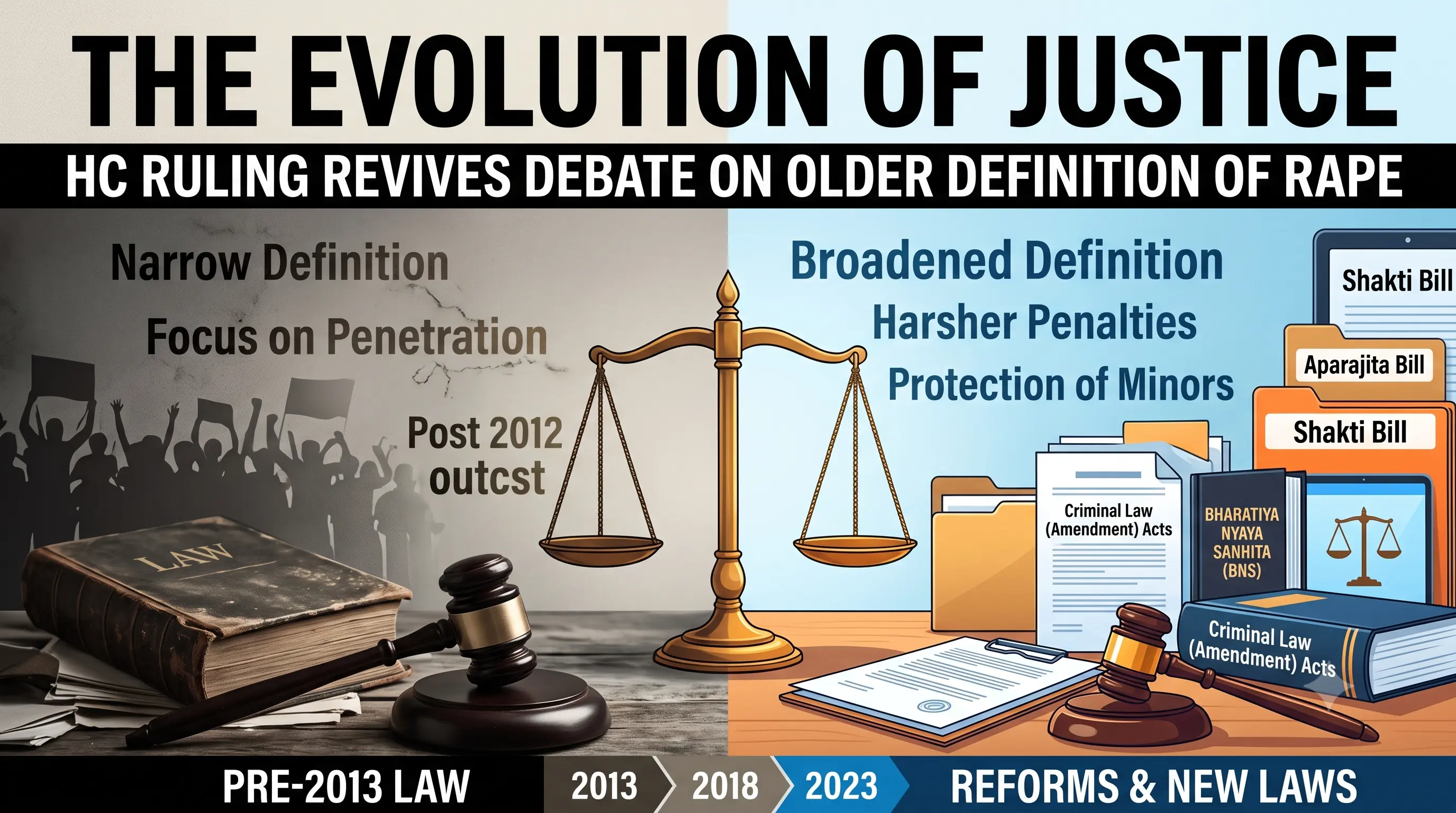
A recent High Court judgment has reignited discussions on the pre-2013 legal framework, which defined rape narrowly based on penile-vaginal penetration. The case highlights the evolution of sexual assault laws in India from the IPC to the Bharatiya Nyaya Sanhita (BNS) and various state-level initiatives.
Introduction
Context & Background
Key Points
- •The Case Background: The High Court acquitted the accused of rape but upheld the conviction for attempt to rape, citing the absence of proven penetration. The court applied the older legal standard that existed before 2013.
- •Pre-2013 Law Limitations: Under the old Section 375 of the IPC, rape was strictly defined as penile-vaginal penetration. This narrow definition excluded other forms of sexual assault, making prosecution difficult as it heavily relied on physical proof of penetration.
- •Post-2012 Shifts: Following the 2012 Delhi gang rape case, public sensitivity and demand for broader recognition of sexual violence led to the comprehensive Criminal Law (Amendment) Act, 2013.
- •Progressive State Legislation: States like West Bengal, Andhra Pradesh, and Maharashtra have pushed for more stringent local laws (like the Aparajita and Disha Bills) that mandate the death penalty and faster trial timelines.
Central Laws Addressing Sexual Assaults
| Legislation | Key Provisions | Bookmark |
|---|---|---|
| Criminal Law (Amendment) Act, 2013 | Introduced death penalty for cases leading to death or vegetative state; allowed capital punishment for repeat offenders; expanded definitions of sexual crimes. | |
| Criminal Law (Amendment) Act, 2018 | Introduced death penalty for rape and gang rape of girls below 12 years of age, reflecting harsher deterrence policies. | |
| Bharatiya Nyaya Sanhita (BNS), 2023 | Retained earlier punishments and introduced death penalty for gang rape of a woman below 18 years of age. |
State-Level Initiatives and Bills
| State & Bill/Year | Key Focus Areas | Bookmark |
|---|---|---|
| Aparajita Bill, West Bengal (2024) | Death penalty for aggravated rape and cases causing death/vegetative state; rigorous life imprisonment for repeat offenders; enhanced punishment for revealing victim identity and acid attacks. | |
| Disha Bill, Andhra Pradesh (2019) | Death penalty for rape (including minors below 16 and gang rape); strict timelines for investigation and trial. | |
| Shakti Bill, Maharashtra (2020) | Capital punishment for rape cases; reduced time for investigation and trial for quicker justice. | |
| Madhya Pradesh (2017) & Arunachal Pradesh (2018) | Introduced death penalty for rape or gang rape of girls up to 12 years of age. |
Related Entities
Impact & Significance
- •Legal Precedents: Rulings relying on the pre-2013 definition underscore the complexities of trying older cases under historical legal frameworks.
- •Deterrence Debate: The continuous introduction of the death penalty (through the 2013/2018 amendments and state bills) fuels ongoing debates about whether capital punishment effectively deters sexual crimes.
- •Victim Protection: Newer frameworks place a stronger emphasis on protecting victim identity and addressing severe circumstances like acid attacks or cases involving permanent vegetative states.
Challenges & Criticism
- •Evidentiary Challenges: Historical cases emphasize the difficulty of proving physical penetration, an issue that previously derailed many convictions.
- •Implementation Gaps: While laws (especially state bills demanding rapid trials) are stringent on paper, judicial backlog and investigative delays often hinder swift justice.
- •Debate on Capital Punishment: Legal scholars often debate the effectiveness of the death penalty, suggesting it might lead to lower conviction rates due to the higher burden of proof required by judges before sentencing.
Future Outlook
- •Standardization of State Laws: With multiple states introducing their own stringent bills (like Aparajita and Disha), there may be a push for harmonizing these provisions at the central level.
- •Judicial Interpretation under BNS: Courts will progressively interpret the provisions of the newly enacted Bharatiya Nyaya Sanhita (BNS), 2023, particularly concerning offenses against minors.
- •Focus on Procedural Speed: State initiatives emphasizing reduced investigation and trial timelines indicate a growing systemic shift toward ensuring swift justice for victims.
UPSC Relevance
- • GS-II (Polity & Governance): Structure, organization and functioning of the Judiciary; Government policies and interventions for development in various sectors and issues arising out of their design and implementation.
- • GS-I (Indian Society): Role of women and women's organization, social empowerment.
- • Essay Topics: Evolution of gender justice in India; The efficacy of capital punishment as a deterrent to crimes against women.
Sample Questions
Prelims
Consider the following statements regarding laws on sexual assault in India: 1. The pre-2013 definition of rape under the IPC was limited strictly to penile-vaginal penetration. 2. The Bharatiya Nyaya Sanhita (BNS), 2023 introduces the death penalty for the gang rape of a woman below 18 years of age. 3. The Disha Bill was passed by the state of Maharashtra to ensure quicker justice in rape cases. Which of the statements given above is/are correct?
1. 1 and 2 only
2. 2 and 3 only
3. 1 and 3 only
4. 1, 2, and 3
Answer: Option 1
Explanation: Statement 1 is correct; pre-2013 laws required physical proof of penetration. Statement 2 is correct as BNS 2023 includes this provision. Statement 3 is incorrect; the Disha Bill was introduced by Andhra Pradesh, whereas the Shakti Bill is associated with Maharashtra.
Mains
Trace the evolution of legal frameworks addressing sexual assault in India from the pre-2013 IPC provisions to the recent state-level initiatives. How do these changes reflect the changing societal attitudes towards women's safety?
Introduction: Introduce the context by mentioning the restrictive pre-2013 definition of rape (Section 375 IPC) which relied heavily on penetration, and note how recent judicial observations still reflect upon this era.
Body:
• Evolution of Central Laws: Discuss the pivotal 2013 Amendment expanding definitions and punishments, the 2018 Amendment focusing on minors, and the BNS 2023 provisions.
• State-Level Interventions: Highlight state bills like Aparajita (West Bengal), Disha (Andhra Pradesh), and Shakti (Maharashtra) that focus on the death penalty and expedited trials.
Conclusion: Conclude by noting that while the legislative shift reflects progressive societal demands for justice, the focus must also include effective enforcement, fast-track courts, and gender-sensitization of the justice system.