
Reimagining Heritage Conservation in India
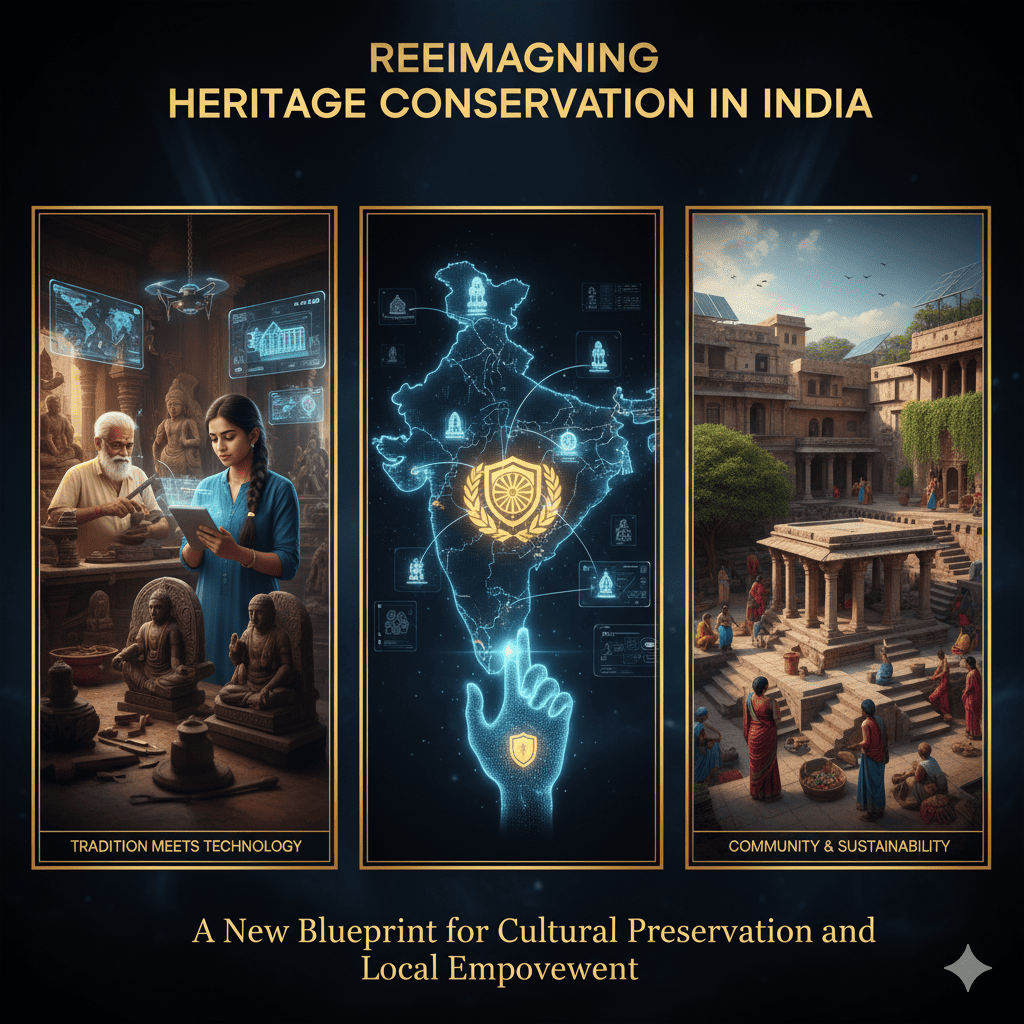
India’s heritage conservation framework, led by the ASI since 1861, is facing institutional stagnation, policy neglect and resource deficits. The government’s new Public–Private Partnership (PPP) approach is a major shift — it invites private money, professional skills and modern technology to help preserve monuments while making them accessible and self-sustaining. For a beginner: think of the ASI as the traditional caretaker of an old library; PPPs bring in new librarians, funding and digital tools so the library can be used and protected for the next generation.
Introduction
Context & Background
Key Points
- •Who is ASI? — The Archaeological Survey of India is the government agency that identifies, protects and conserves monuments. It surveys archaeological sites, runs excavations and enforces laws to stop illegal construction near protected monuments.
- •Why ASI is strained: Imagine one maintenance team responsible for thousands of old buildings — that is how stretched ASI often is. Limited funds, few specialists and centralised decision-making slow down restoration work.
- •What is PPP for heritage? — PPP stands for Public–Private Partnership. In heritage, it means private firms, NGOs or philanthropies fund and help run conservation projects while the ASI oversees scientific standards and legal compliance.
- •Simple PPP example: A company funds restoration of a fort, pays for 3D scanning and a museum space, and in return runs a visitor centre that earns revenue (tickets, bookstore). The ASI approves methods and ensures the restoration is authentic.
- •National Culture Fund (NCF): A government fund where corporate donations (including CSR money) and philanthropic gifts are pooled for conservation projects. Donors often get tax benefits.
- •Technology helps: Tools like 3D scanning reproduce the exact shape of carvings, drone surveys map inaccessible areas, and AR/VR give visitors virtual tours without touching fragile objects.
- •Why local communities matter: People living near sites often hold traditional knowledge about a monument; involving them creates jobs and reduces vandalism. For beginners: when locals feel ownership, they protect the site like a shared family heirloom.
- •Risks to watch: Without clear rules, private partners may focus only on well-known sites that make money, neglecting smaller monuments. There’s also the danger of turning sacred spaces into entertainment venues.
- •Case study — Dr Bhau Daji Lad Museum: A 21-year PPP restoration in Mumbai that combined municipal support, NGO expertise and foundation funding — the result was a restored museum with improved displays, training for craftsmen and a sustainable business model.
- •Heritage & urban planning: Integrating heritage into city plans (zoning, traffic, drainage) prevents encroachment and makes sites part of daily city life.
- •Archive digitisation: ASI holds maps, reports and photographs. Digitising these makes research easier and helps plan restorations—like having a scanned blueprint before fixing an old house.
- •Climate threats: Rising temperatures, heavy rains, pollution and salt spray cause faster decay of stone, metal and frescoes; climate science must be part of conservation plans.
- •Training & skill gaps: Conservators, stonecutters, mural restorers and heritage managers are needed. Training programmes and apprenticeships can build local capacity.
- •Transparency & accountability: Clear Memoranda of Understanding (MoUs), published conservation plans, and third-party audits ensure private partners follow conservation standards.
- •Visitor management: Simple measures — ticket caps, guided routes, clear signboards, waste disposal — protect monuments while allowing people to enjoy them.
- •Funding balance: A mix of government money, visitor fees, CSR funds and small user charges (like audio-guide rentals) helps keep sites sustainable without over-commercialising them.
- •Decentralisation: Empowering regional ASI offices and local heritage bodies speeds up decisions and makes conservation context-sensitive.
- •Heritage education: School visits, local festivals and volunteer programmes build long-term public interest in protecting monuments.
- •Heritage as soft power: Well-preserved sites attract international visitors, academic collaborations and cultural diplomacy opportunities.
Institutional Challenges of ASI (Explained Simply)
| Challenge | Plain-English Description | Why It Matters | Bookmark |
|---|---|---|---|
| Bureaucratic Structure | Too many decisions have to be approved at the top (slow process). | Slows repairs — a small crack might wait months to be fixed and get worse. | |
| Funding Limitations | Not enough money for so many sites. | No money → no maintenance → closed or unsafe monuments. | |
| Skilled Manpower Shortage | Not enough trained conservators and craftsmen available locally. | Poor-quality restoration or delays because specialists are scarce. | |
| Data Inaccessibility | Historical reports and drawings are stored in offices, not online. | Researchers and planners can’t use old records to plan better work. | |
| Urban Planning Disconnect | City plans and heritage protection are not coordinated. | New roads or buildings may damage the setting of a monument. |
How a Heritage PPP Works — Simple Steps
| Step | What Happens | Who Does It | Bookmark |
|---|---|---|---|
| Project Identification | ASI or state picks a site needing work | ASI/State Archaeology Dept | |
| Tender & Selection | Private partner is chosen through transparent process | Government + Selection Committee | |
| Conservation Plan | Detailed scientific plan with timelines and budgets | Conservation Architects + ASI Review | |
| Execution | Restoration, setting up visitor facilities, training locals | Private partner under ASI supervision | |
| Monitoring & Reporting | Regular public reports and third-party audits | ASI + Independent Auditors |
Related Entities
Impact & Significance
- •Better Conservation Outcomes: With modern tools and specialist teams, restorations are more accurate and long-lasting — like using the right glue and methods to repair an old painting rather than painting over it.
- •Improved Visitor Experience: Facilities like clear signboards, restrooms, audio guides and small museums make a visit educational and comfortable — increasing public interest and respect for heritage.
- •Economic Benefits: Well-managed sites create jobs (guides, conservators, shopkeepers), boost local businesses (hotels, transport) and provide revenues for maintenance.
- •Scientific Upgrading: PPPs can fund scientific studies (material analysis, climate impact studies) that improve how we conserve delicate materials like frescoes and old wood.
- •Community Empowerment: Locals trained in conservation and site management gain sustainable livelihoods and become stewards of their own history.
Challenges & Criticism
- •Over-Commercialisation: Turning heritage sites into event venues or theme parks risks damaging their cultural meaning. Example (hypothetical): a temple complex used for loud concerts may lose its sacred character and harm delicate sculptures.
- •Selective Attention: Corporates may prefer famous monuments where brand visibility and ticket sales are high, leaving small village sites to deteriorate further.
- •MoU Weaknesses: If agreements are vague, private partners might cut corners (use cheaper materials or quick fixes). Strong, published standards and independent audits are essential.
- •Community Exclusion: Ignoring local people’s views can create resistance, protests or loss of traditional practices tied to the site. Successful projects hire locals as guides and artisans.
- •Tourism Pressure: More visitors can mean more waste, footfall damage and noise unless visitor numbers and behaviour are managed carefully.
Future Outlook
- •Adopt a clear National Heritage Policy that explains roles, standards and funding models so everyone knows the rules of engagement.
- •Digitise ASI’s records using scanning, cloud storage and searchable databases so researchers and planners can access them easily.
- •Create Heritage Cadres — training programmes and career paths for conservators, archaeologists and heritage managers based in states and districts.
- •Plan urban heritage zones with specific land-use rules, buffer areas and traffic plans to protect monuments inside cities.
- •Use technology for everyday monitoring — drones to spot roof leaks, sensors to track humidity, and dashboards to show site health at a glance.
- •Design PPP agreements with community benefit clauses (local hires, shared revenue for village services) to make conservation inclusive.
- •Set up small-scale, sustainable revenue streams — modest visitor fees, souvenir stalls run by cooperatives, or heritage workshops — to fund maintenance without over-commercialisation.
- •Encourage schools and universities to adopt local heritage as part of the curriculum to build long-term public interest.
UPSC Relevance
- • GS-1: Cultural heritage, architecture and Indian history topics.
- • GS-2: Institutional reforms, PPPs and governance.
- • GS-3: Use of technology (AI, drones) in public administration and conservation.
- • Essay: Balancing growth with heritage; cultural identity and development.
Sample Questions
Prelims
With reference to heritage conservation in India, consider the following statements:
1. ASI was established in 1861 by Alexander Cunningham.
2. CSR funds can be used for heritage conservation via the National Culture Fund.
3. All heritage conservation work in India must legally be done only by the ASI.
4. The Bhau Daji Lad Museum restoration is a recognised PPP conservation model.
Answer: Option 1, Option 2, Option 4
Explanation: Explanation for beginners: Statement 1 is correct — ASI began in 1861. Statement 2 is correct — companies can donate CSR funds to the National Culture Fund for conservation projects. Statement 3 is incorrect — recent policy allows private participation under ASI supervision, so ASI does not have exclusive operational control. Statement 4 is correct — the Bhau Daji Lad Museum is a well-known example of a successful PPP restoration.
Mains
India’s heritage conservation framework is undergoing major reforms with the entry of PPP models. Critically evaluate how PPPs can transform conservation while addressing risks of commercialisation and community exclusion.
Introduction: Context: The ASI has protected India’s monuments since 1861 but faces capacity and funding constraints. The PPP model aims to bring private resources and expertise under ASI’s scientific oversight.
Body:
• Strengths of PPPs: Access to funds, project management skills, modern conservation techniques (3D scanning, material analysis) and better visitor management that can make heritage sites sustainable.
• Weaknesses & Risks: Possibility of over-commercialisation, neglect of less-known sites, and exclusion of local communities if safeguards are not included in agreements.
• Safeguards Required: Transparent MoUs, published conservation plans, third-party audits, mandatory community benefit clauses, and central guidelines for PPP MoUs.
• Implementation Steps: Create a National Heritage Policy, train heritage cadres, digitise archives, set up regional conservation cells, and design standard PPP templates with conservation experts and community representatives.
• Case Example: Dr Bhau Daji Lad Museum shows how long-term partnership, professional curation and community engagement can restore a site and make it financially viable.
• Conclusion: PPPs can transform India’s conservation landscape if implemented with scientific oversight, community participation, transparency and legal safeguards to protect authenticity and access.
Conclusion: With careful design, PPPs can complement ASI’s strengths — bringing resources, technology and public engagement — while ASI retains scientific control and regulatory authority to protect India’s heritage for future generations.