
Independence of the Election Commission: Constitutional Safeguards and Recent Controversies
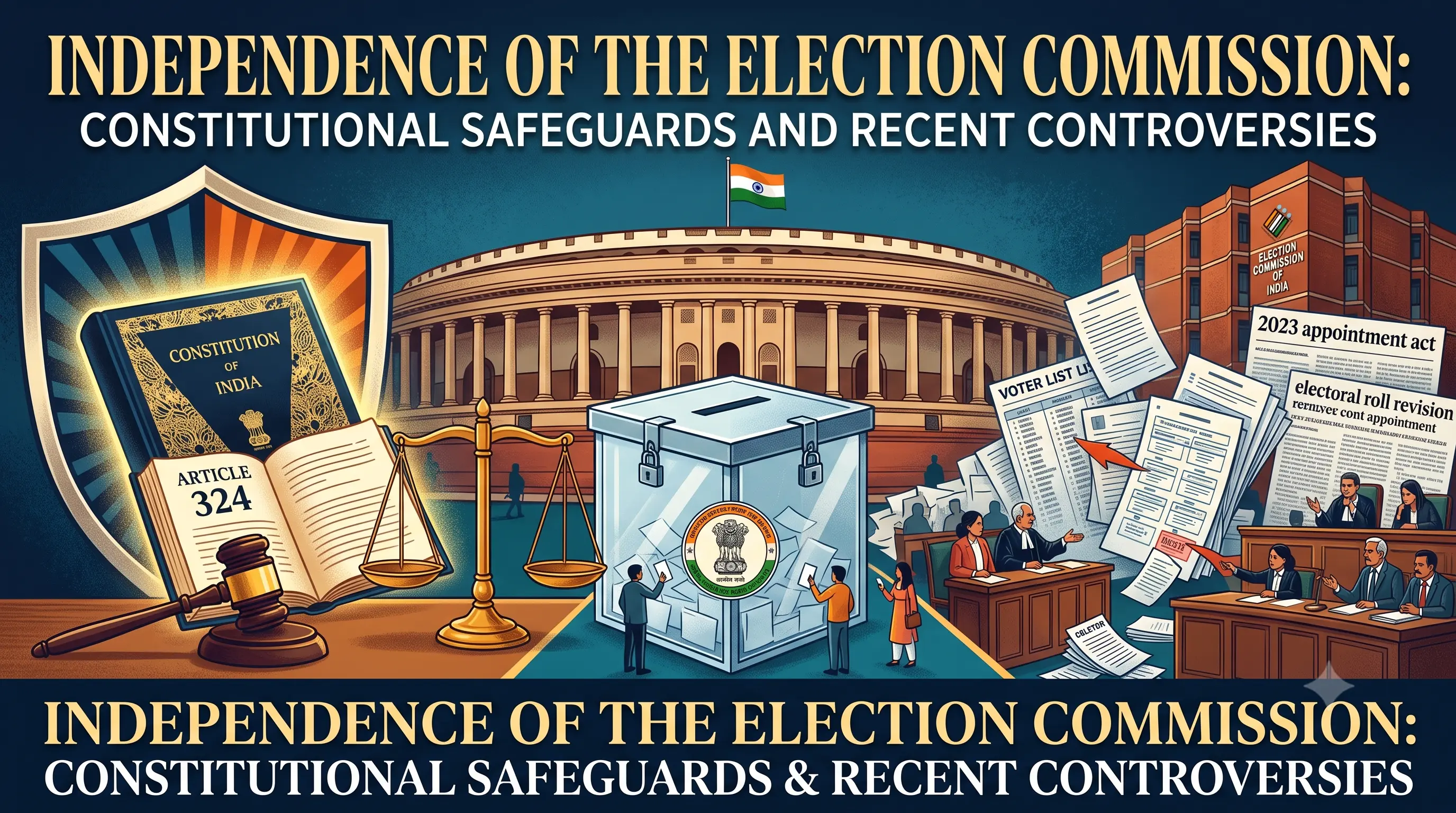
The Constitution of India provides robust institutional safeguards to preserve the autonomy of the Election Commission. However, recent controversies regarding alleged electoral roll manipulations and debates over the 2023 legislative changes for appointing Election Commissioners have brought institutional independence under intense scrutiny.
Introduction
Context & Background
Key Points
- •Constitutional Mandate (Article 324): Establishes a permanent Election Commission vested with the powers of superintendence, direction, and control of elections to Parliament, State legislatures, the President, and the Vice-President.
- •2023 Appointment Legislation: The Chief Election Commissioner and Other Election Commissioners Act, 2023 provides that the President appoints ECs based on a selection committee comprising the Prime Minister, a Union Minister, and the Leader of the Opposition.
- •Tenure Protection: Under the new law, the CEC holds office for a term of six years or until the age of 65 (whichever is earlier), and their service conditions cannot be altered to their disadvantage during their tenure.
- •Removal Safeguards: The CEC can only be removed in the same manner as a Supreme Court judge (Article 124(4)) for proven misbehaviour or incapacity. Other Election Commissioners can only be removed on the recommendation of the CEC.
- •Multi-Member Evolution: The Commission transitioned from a single-member body to a multi-member structure briefly in 1989, and permanently in 1993. The CEC functions as Chairperson, ensuring consensus-based decisions.
- •Parliamentary Thresholds: Motions for removal require special parliamentary majorities, meaning removal is highly difficult without broad, cross-party consensus.
Key Judicial Interventions regarding the Election Commission
| Case / Judgment | Significance / Ruling | Bookmark |
|---|---|---|
| Anoop Baranwal v. Union of India | Suggested the inclusion of the Chief Justice of India (CJI) in the selection panel for Election Commissioners. | |
| Jaya Thakur v. Union of India | Ongoing challenge to the 2023 Act which omitted the judicial member (CJI) from the appointment committee. | |
| T. N. Seshan v. Union of India | Upheld the permanent multi-member structure of the Election Commission restored in 1993. | |
| Vineet Narain v. Union of India | Clarified that the Chief Election Commissioner's advice for removing other ECs should not be given suo motu. |
Parliamentary Procedure for Removal of the CEC
| Stage | Requirement / Details | Bookmark |
|---|---|---|
| Initiation of Motion | Requires at least 100 Lok Sabha members or 50 Rajya Sabha members under the Judges (Inquiry) Act, 1968. | |
| Investigation Mechanism | A 3-member committee is formed (CJI or SC Judge, HC Chief Justice, and a distinguished jurist). | |
| Principles of Natural Justice | CEC receives adequate time to respond and an opportunity to present a defence against specific charges. |
Related Entities
Impact & Significance
- •Democratic Legitimacy: The independence of the Election Commission is fundamentally tied to the credibility of the democratic process. Fair voter registration and impartial elections are the bedrock of the Republic.
- •Checks and Balances: Ensuring an unbiased appointment and removal process prevents the ruling coalition from exerting undue influence over electoral administration.
- •Rule of Law: Mandating strict adherence to natural justice and formal inquiry mechanisms during removal proceedings ensures that constitutional bodies remain insulated from political vendettas.
Challenges & Criticism
- •Voter Roll Integrity: Allegations of massive voter name deletions—such as the claimed removal of 65 lakh names during Special Intensive Revision (SIR) exercises—have cast doubts on procedural transparency.
- •Executive Dominance in Appointments: The omission of the Chief Justice of India from the selection committee in the 2023 Act has drawn criticism for tilting the balance of power toward the executive.
- •Institutional Politicisation: Threats of parliamentary motions against the CEC by political parties underscore the risk that excessive politicisation can erode public faith in independent constitutional authorities.
Future Outlook
- •Judicial Resolution: The Supreme Court's upcoming hearings in Jaya Thakur v. Union of India will be pivotal in determining the constitutional validity of excluding the CJI from the appointment committee.
- •Enhancing Transparency: The Commission must ensure utmost procedural fairness and transparency during voter list revisions to restore cross-party trust and address deletion allegations.
- •Institutional Culture: Moving forward, maintaining electoral credibility will depend not just on formal legal safeguards, but on preserving a non-partisan institutional culture and strong public confidence.
UPSC Relevance
- • GS-II (Polity & Governance): Appointment to various Constitutional posts, powers, functions and responsibilities of various Constitutional Bodies.
- • GS-II (Elections): Salient features of the Representation of People's Act; structural independence of electoral machinery.
- • Mains Focus: Analyzing the balance between executive authority and institutional autonomy, and the necessity of judicial oversight in constitutional appointments.
Sample Questions
Prelims
Consider the following statements regarding the Election Commission of India: 1. The Chief Election Commissioner can be removed from office in the same manner as a Judge of the Supreme Court. 2. Any other Election Commissioner can be removed from office at the sole discretion of the President of India. 3. The Constitution originally provided for a permanent multi-member Election Commission. Which of the statements given above is/are correct?
1. Only 1 and 2
2. Only 2 and 3
3. Only 1 and 3
4. 1, 2, and 3
Answer: Option 1
Explanation: Statement 1 is correct (Article 324(5)). Statement 2 is incorrect; other ECs can only be removed on the recommendation of the CEC. Statement 3 is incorrect; the Constitution provided a framework under Article 324, but it operated as a single-member body until 1989 and was made permanently multi-member only in 1993.
Mains
“The independence of the Election Commission is central to India's democratic legitimacy, yet it remains vulnerable to executive dominance.” Analyze this statement in the context of the Chief Election Commissioner and Other Election Commissioners Act, 2023, and the constitutional safeguards provided under Article 324.
Introduction: Define the mandate of the Election Commission under Article 324 and introduce the ongoing debate regarding its autonomy following the 2023 Act.
Body:
• Constitutional Safeguards: Discuss Article 324, tenure security (6 years/65 age), and the stringent removal process for the CEC (similar to an SC judge) and other ECs (on CEC's recommendation).
• Recent Changes (2023 Act): Explain the new appointment committee (PM, Union Minister, LoP) and the exclusion of the CJI, contrasting it with the SC's suggestion in the Anoop Baranwal case.
• Issues & Allegations: Mention recent concerns like the alleged deletion of 65 lakh voters during SIR exercises, highlighting the necessity of institutional transparency.
Conclusion: Conclude that while structural protections are robust, enduring electoral integrity requires procedural fairness, minimal political interference, and sustained public confidence.