
India's Re-engagement with Afghanistan: Strategic Pragmatism and Regional Diplomacy
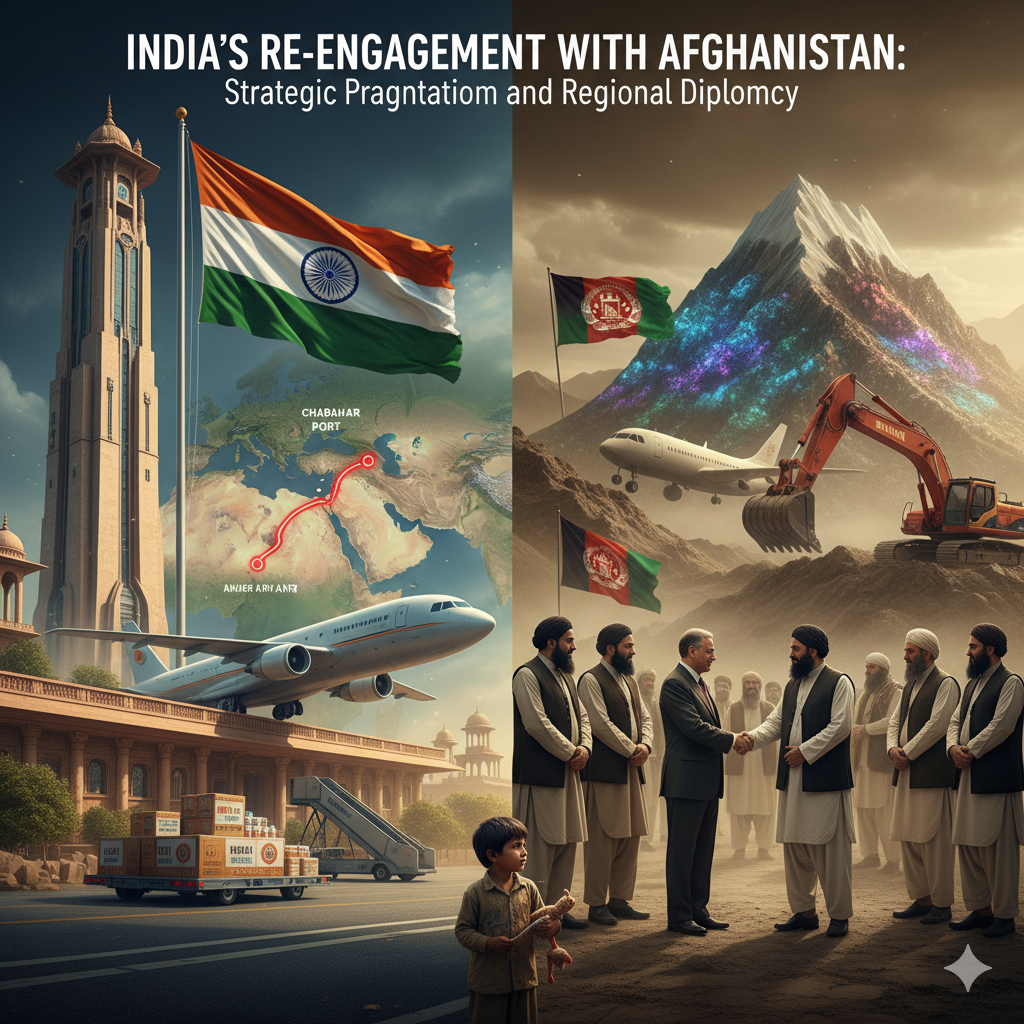
India's cautious re-engagement with Taliban-led Afghanistan marks a major policy evolution, shifting from isolation to pragmatic diplomacy. By reopening its embassy and holding direct talks, India seeks to safeguard its security imperatives, protect its $3B+ in legacy investments, and maintain a strategic foothold in the region, all while navigating the diplomatic dilemma of avoiding formal recognition of the Taliban regime.
Introduction
Context & Background
• Pre-1979 Period: India enjoyed warm ties with King Zahir Shah and later President Daoud Khan. Afghanistan valued India’s role as a non-aligned, development partner.
• 1979–1989 (Soviet Invasion): India *did not condemn* the Soviet invasion, a controversial stance that prioritized its strategic partnership with the USSR. It remained engaged with the Soviet-backed Afghan government in Kabul.
• 1996–2001 (Taliban 1.0): India refused all recognition of the Taliban's 'Islamic Emirate' due to its extreme ideology, public executions, *blatant support* from Pakistan's ISI, and the IC-814 hijacking (which ended in Kandahar). Instead, India provided support to the anti-Taliban Northern Alliance.
• 2001–2021 (The Republic): After the fall of the Taliban, India became Afghanistan’s largest *regional* donor, investing over USD 3 billion. This 'soft power' strategy focused on building critical infrastructure (Salma Dam, Zaranj-Delaram Highway, the Afghan Parliament) and human capital (thousands of scholarships).
• Post-2021 (Taliban 2.0): India evacuated its diplomatic staff but immediately began sending humanitarian aid (wheat, vaccines, medicines) to the Afghan people. A small 'Technical Mission' was reopened in Kabul in 2022 to coordinate this aid.
• 2025 Breakthrough: A *calibrated* step forward occurred when Taliban Foreign Minister Amir Khan Muttaqi visited New Delhi for multilateral talks. Following this, India decided to formally *upgrade* its Technical Mission and reopen its embassy, appointing a Chargé d’Affaires.
Key Points
- •Upgraded Diplomatic Presence: By appointing a Chargé d’Affaires (a mission head) instead of a full Ambassador, India signals de facto working relations without granting de jure (legal) recognition. This allows India to protect its interests on the ground without endorsing the regime.
- •Humanitarian Assistance as Soft Power: India has consistently supported Afghan civilians by sending over 50,000 metric tonnes of wheat, COVID vaccines, and medical supplies. This bypasses the Taliban regime where possible and strengthens India’s *historical goodwill* and 'people-to-people' ties.
- •Taliban's Assurances (Rhetoric vs. Action): Taliban leaders have repeatedly stated that Afghan soil will not be used by terror groups against other countries. India remains *cautiously skeptical*, watching for a gap between Taliban rhetoric and action, especially regarding groups like LeT and JeM.
- •Regional Consensus Building: India actively uses multilateral platforms like the SCO, Moscow Format, and UN-led processes. The goal is to build a regional consensus to press the Taliban on two key issues: 1) forming an inclusive government (with ethnic minorities and women) and 2) verifiably severing ties with all international terror groups.
- •The 'Critical Minerals' Factor: Afghanistan’s estimated $1 trillion+ in mineral wealth—especially critical minerals like lithium, copper, and rare earth elements—is extremely important for India's clean energy transition (EV batteries, solar grids) and diversifying its supply chains.
- •Countering the China Factor: China's *aggressive outreach* (e.g., mining contracts like Mes Aynak, BRI expansion) is a major driver. India’s re-engagement is a *strategic necessity* to prevent Afghanistan from becoming an *exclusive Chinese sphere of influence* and to avoid India's strategic encirclement.
- •Connectivity Diplomacy: India aims to re-energize connectivity through Chabahar Port (bypassing Pakistan), and link it to the International North-South Transport Corridor (INSTC) via Central Asia, for which a stable Afghanistan is crucial.
India–Afghanistan Relations: A Historical Snapshot
| Period | Nature of Relations | Key Highlights & Policy | Bookmark |
|---|---|---|---|
| Pre-1979 | Warm & Non-Aligned | Strong cultural ties; India seen as a key development partner. | |
| 1979–1989 | Pro-Soviet Engagement | India did not condemn Soviet invasion; maintained ties with Kabul govt. | |
| 1996–2001 | Hostile (No Recognition) | India supported the anti-Taliban Northern Alliance; IC-814 hijacking. | |
| 2001–2021 | Deep Development Partnership | Soft Power Strategy: $3B+ in infrastructure (Salma Dam, Parliament) & human capital. | |
| Post-2021 | Pragmatic & Calibrated | 'Engagement without Endorsement'; humanitarian aid prioritized; embassy reopened. |
Major Powers in Afghanistan (Post-2021): A Comparative Overview
| Country | Main Goal / Imperative | Key Actions on the Ground | Bookmark |
|---|---|---|---|
| India | Security (no terror havens), Strategic Autonomy (counter China/Pak), Connectivity | Humanitarian aid (wheat, meds), Embassy reopening, Chabahar Port focus. | |
| China | Mineral access (Lithium), BRI expansion, & Border security (preventing Uyghur militancy) | Restarted Mes Aynak copper mine; appointed full Ambassador; high-level talks. | |
| Iran | Border security (drugs/refugees), Water rights (Helmand River), Chabahar trade | Maintains open embassy; economic cooperation; engages on anti-ISIS-K efforts. | |
| Russia | Regional stabilizer, Counter-narcotics, & countering ISIS-K (a shared threat) | Hosts 'Moscow Format' talks; maintains full embassy; intelligence sharing. | |
| US/EU | 'Over-the-horizon' counter-terrorism, Human rights leverage, Humanitarian aid | Largest humanitarian donors; use of frozen assets & sanctions as leverage. |
Related Entities
Impact & Significance
- •Strategic Security: A direct, on-the-ground presence allows India to monitor and message on terror threats, ensuring groups like LeT, JeM, and ISIS-Khorasan (ISIS-K) do not get a safe haven to plot attacks against India.
- •Gateway to Central Asia: A stable (or at least functional) Afghanistan is a 'land bridge' to the energy-rich Central Asian Republics (CARs). India’s INSTC and Chabahar projects are unviable without Afghan stability.
- •Countering Sino-Pak Influence: An active Indian presence prevents Beijing and Islamabad from gaining an *exclusive strategic space* and *geopolitical monopoly* in Kabul.
- •Humanitarian Diplomacy: By providing unconditional aid, India retains its 'first responder' image and deep *public goodwill* among Afghans, a long-term strategic asset that outlives any regime.
- •Critical Mineral Security: Engagement opens the door for future access to Afghanistan’s vast lithium reserves, vital for India’s green energy transition (EVs) and *diversifying critical mineral supply chains*.
Challenges & Criticism
- •Taliban’s Ideology & Human Rights: The Taliban’s draconian restrictions on women's education and employment, and *persecution of ethnic/religious minorities* (like Hazaras), clashes directly with India's democratic and constitutional values.
- •The Haqqani-Terrorism Nexus: The continued presence and power of the Haqqani Network (a US-designated terror group with deep ISI links) within the Taliban government is a primary security concern for New Delhi.
- •Pakistan's 'Dual Game': Pakistan blocks India’s land access (denying transit for aid) and its sheltering of the TTP (Tehrik-e-Taliban Pakistan) by the Afghan Taliban creates regional instability that spills over and complicates India's security calculations.
- •The Diplomatic Tightrope: The classic balancing act: How to engage for *security* without *legitimizing* an oppressive, non-inclusive regime, especially when Western partners are pushing for isolation.
- •Lack of Inclusivity: The Taliban government remains an *exclusive*, non-representative Pashtun-dominated entity, failing to meet the international community's key demand for an 'inclusive government'.
Future Outlook
- •India will maintain a 'calibrated engagement', with future upgrades (like a full Ambassador) being conditional on the Taliban's actions against terror groups and its stance on human rights.
- •Humanitarian aid will continue, likely bypassing the Taliban and working directly with NGOs and UN agencies like the World Food Programme (WFP) to ensure it reaches the people.
- •India will cautiously pursue 'economic diplomacy' (minerals, trade) to build leverage, contingent on security and stability.
- •Counterterror partnerships will be *non-public*, relying on quiet intelligence-sharing channels with the Taliban and other regional powers (Russia, Iran).
- •India's ultimate aim is to convert its vast soft power (goodwill from $3B in aid) into *tangible strategic influence* and secure its non-negotiable position as a key regional stakeholder.
UPSC Relevance
- • GS-1: Geographical location (Afghanistan's strategic importance), Post-Independence history (India's foreign policy evolution).
- • GS-2: India and its Neighbourhood, Bilateral & Regional Groupings (SCO, Moscow Format), Effect of policies of other countries on India's interests.
- • GS-3: Internal Security (Terrorism, link with organized crime), Role of external state & non-state actors.
- • Essay: India’s balancing of values and interests, Pragmatism in foreign policy.
Sample Questions
Prelims
With reference to India's policy towards Afghanistan after 2021, consider the following statements:
- (a)India has refused to provide any humanitarian aid to Afghanistan after the Taliban takeover.
- (b)India's re-engagement aims to counter the influence of the Sino-Pak axis in the region.
- (c)The Chabahar Port in Iran is India's strategic gateway to Afghanistan, bypassing Pakistan.
- (d)By appointing a full Ambassador in 2025, India granted formal 'de jure' recognition to the Taliban regime.
Mains
India’s re-engagement with the Taliban-led government in Afghanistan signals a shift from idealistic foreign policy to 'strategic realism'. Discuss the drivers, challenges, and long-term objectives of this pragmatic policy.
Introduction: India’s Afghanistan policy post-2025 reflects a major *policy evolution*, prioritizing 'strategic realism' and core national interests over ideological isolation. It is a calibrated move, described as 'engagement without endorsement', to secure India's stake in a volatile region.
Body:
• Drivers of Pragmatic Realism:
1. Security Imperatives: To prevent Afghan soil from becoming a *safe haven* for anti-India terror groups (LeT, JeM, ISIS-K) and to monitor the influence of the Haqqani Network.
2. Geopolitical Balancing: To actively counter the *Sino-Pak axis* and avoid India's *strategic encirclement* as China expands its BRI and mineral-seeking activities.
3. Protecting Investments & Connectivity: To safeguard $3B+ in legacy infrastructure investments (dams, roads, parliament) and revive connectivity to Central Asia via Chabahar Port.
• Key Challenges in this Policy:
1. Moral & Ideological Dilemma: Engaging a regime that systematically violates women's and human rights, clashing with India's democratic values.
2. Trust Deficit with Taliban: The gap between Taliban's *rhetoric* on terror and the *action* on the ground, given their links with anti-India groups.
3. Pakistan's Interference: Pakistan's continued 'dual game' and attempts to block India's land access remain significant hurdles.
• Long-Term Strategic Objectives:
1. Secure a Stakeholder Role: To ensure India is a key player in all regional consultations on Afghanistan's future, not a mute spectator.
2. Economic & Mineral Security: To position India for future access to Afghanistan's vast critical mineral reserves (especially lithium).
3. Leverage Soft Power: To convert decades of *public goodwill* (soft power) into *tangible strategic influence* (hard power) that outlasts the current regime.
Conclusion: India’s approach is a classic example of *realpolitik*, demonstrating a mature foreign policy that, while not abandoning its *values* (human rights, inclusivity), is not *paralyzed* by them. It is a calculated strategy to blend principles with national interest, ensuring India remains an indispensable partner for the Afghan people and a key stakeholder in regional security.