
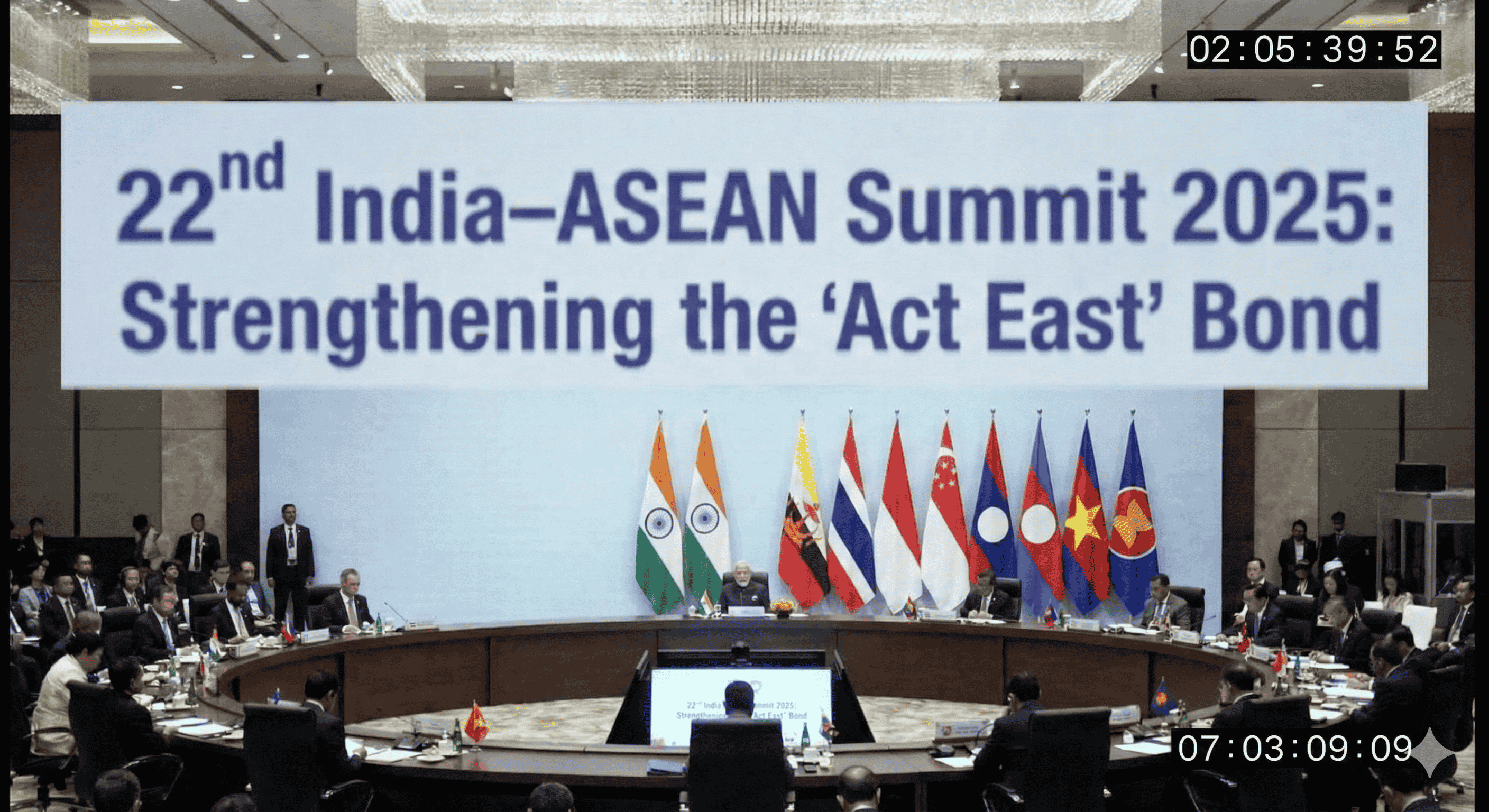
22nd India–ASEAN Summit 2025: Strengthening the 'Act East' Bond
Prime Minister Modi participated in the 22nd India-ASEAN Summit in Kuala Lumpur, Malaysia. With the theme 'Inclusivity and Sustainability', the summit focused on reviewing the trade agreement (AITIGA), enhancing maritime security (Year of Maritime Cooperation 2026), and digitally connecting India with Southeast Asia.
Introduction
This summit acted as a platform to assess ongoing cooperation, especially in trade, maritime security, digital public infrastructure, and connectivity.
Beginner’s Note: ASEAN (Association of Southeast Asian Nations) consists of 10 countries—Indonesia, Thailand, Vietnam, Singapore, Malaysia, Philippines, Brunei, Cambodia, Laos, Myanmar. It is India’s 4th largest trading partner and a critical pillar in India's neighbourhood-first engagement.
Context & Background
1. Look East Policy (1991): Launched to deepen economic integration with Southeast Asia in the post–Cold War era.
2. Sectoral Dialogue Partner (1992) → Summit-level Partner (2002) → Strategic Partner (2012).
3. Act East Policy (2014): Shift from trade-centric engagement to a multi-dimensional partnership encompassing security, culture, connectivity, and people-to-people ties.
4. Comprehensive Strategic Partnership (2023): India and ASEAN elevated ties to reflect the growing alignment on Indo-Pacific issues.
Why this Summit Matters in 2025:
• India wants to rebalance the $43 bn trade deficit with ASEAN.
• ASEAN is central to India’s Indo-Pacific Oceans Initiative (IPOI) and its vision of a free, open, and inclusive Indo-Pacific.
• ASEAN countries are seeking diversification from overdependence on China—creating a strategic opportunity for India.
• India aims to position itself as a supply-chain alternative and a reliable partner through digital cooperation and maritime security.
Key Points
- •1. AITIGA Review – Towards AITIGA 2.0:
The ASEAN-India Trade in Goods Agreement is undergoing its first major revision since 2009.
Key goals of the review:- Reduce India's trade deficit by addressing non-tariff barriers.
- Simplify rules of origin and customs procedures.
- Correct structural asymmetry that disadvantages Indian manufacturers.
- Improve market access for Indian IT, pharma, textiles, engineering goods.
- •2. Maritime Cooperation & Indo-Pacific Vision:
India declared 2026 as the ASEAN–India Year of Maritime Cooperation.
Focus areas include:- Joint naval exercises under IORA and ADMM-Plus frameworks.
- Cooperation on maritime domain awareness (MDA) using India’s Information Fusion Centre (IFC-IOR).
- Protection of Sea Lanes of Communication (SLOCs) in South China Sea.
- Collaboration on blue economy and disaster management.
- •3. Connectivity Push – Physical, Digital, Cultural:
Physical: Fast-tracking:- India–Myanmar–Thailand Trilateral Highway and its planned extension to Cambodia, Laos, Vietnam.
- India offered its Digital Public Infrastructure (DPI) ecosystem—UPI, DigiLocker, CoWIN-style platforms.
- Proposal to interlink UPI with ASEAN fintech networks.
- Revival of Nalanda University as a hub for Buddhist and Southeast Asian studies.
- Organising a Maritime Heritage Festival at Lothal to celebrate ancient Indo–ASEAN trade.
- •4. Strategic & Security Cooperation:
• Enhancing collaboration under frameworks like ADMM-Plus (ASEAN Defence Ministers Meeting Plus).
• India reaffirmed its role as a First Responder in HADR missions (earthquakes, cyclones, tsunamis).
• Cooperation on counterterrorism, cybersecurity, and combating transnational crime such as drug trafficking from the Golden Triangle. - •5. ASEAN Expansion & India’s Role:
India welcomed Timor-Leste's progress towards becoming the 11th ASEAN member.
• India committed support via Quick Impact Projects (QIPs) in agriculture, education, water management.
• This enhances India’s diplomatic footprint in Southeast Asia.
Look East vs. Act East Policy
| Feature | Look East Policy (1991) | Act East Policy (2014) | Bookmark |
|---|---|---|---|
| Focus | Primarily Economic. | Broader Strategic, including security & geopolitics. | |
| Region | Southeast Asia. | Indo-Pacific (ASEAN + Japan, Korea, Australia). | |
| Key Driver | Globalization & trade. | China's assertiveness + regional connectivity. | |
| Instruments | Trade agreements, diplomacy. | Maritime security, HADR, digital cooperation, supply chains. |
Major Challenges in Relations
| Challenge | Explanation | Bookmark |
|---|---|---|
| Trade Deficit | India's deficit with ASEAN is ~$43 bn; market access barriers persist. | |
| Connectivity Issues | Myanmar instability delays highway and Kaladan project. | |
| China Factor | ASEAN's economic dependence on China limits strategic convergence with India. | |
| Institutional Delays | Slow implementation of Indian projects vs. China's faster execution. |
Related Entities
Impact & Significance
- •1. Indo-Pacific Stability: Strengthened ASEAN–India ties balance China's influence and promote rules-based order in maritime spaces.
- •2. Supply Chain Resilience: India aims to integrate itself into ASEAN-centric value chains and reduce global reliance on China.
- •3. Boost to Northeast India: Connectivity projects act as economic corridors, benefiting border states culturally and commercially.
- •4. Strengthening Digital Cooperation: India's DPI is emerging as a diplomatic tool, enhancing trust and technological interdependence.
Challenges & Criticism
- •1. RCEP Withdrawal (2019): India’s exit created perception gaps and limited India’s participation in the region’s biggest trade bloc.
- •2. Implementation Lag: India’s infrastructure projects face delays due to bureaucratic processes and security issues in Myanmar.
- •3. Limited Defence Engagement: Not all ASEAN states are comfortable with deeper military cooperation due to their balancing strategy with China.
Future Outlook
- •1. AITIGA 2.0: Expected by 2025–26, it could reset the economic relationship.
- •2. Digital Interoperability: Linking UPI with ASEAN digital payment systems may transform tourism and remittances.
- •3. Indo-Pacific Synergy: Cooperation through IPOI and ASEAN’s AOIP will define the next decade of strategic engagement.
- •4. Northeast Connectivity: Completion of the Trilateral Highway will be a game changer for cross-border mobility.
UPSC Relevance
- • GS-2: Regional groupings, India’s Act East Policy, Indo-Pacific geopolitics.
- • GS-3: Supply chain resilience, trade agreements, infrastructure corridors.
- • Essay: Themes on Indo-Pacific, regionalism, maritime cooperation.
- • Map Work: ASEAN, Strait of Malacca, Mekong region, Lothal.
Sample Questions
Prelims
Consider the following statements about the ASEAN–India relationship:
- (a)India is a founding member of ASEAN.
- (b)AITIGA was signed to facilitate trade in goods between India and ASEAN.
- (c)The Act East Policy was launched in 1991.
- (d)ADMM-Plus includes India as a member.
Mains
Critically examine how the Act East Policy has evolved into a broader Indo-Pacific strategy. Discuss with reference to recent India–ASEAN developments.
Introduction: India’s Act East Policy represents a strategic shift from economic outreach to a comprehensive engagement shaped by geopolitical realignments in the Indo-Pacific.
Body:
• Evolution: From trade-focused engagement (1991) to strategic cooperation via ADMM-Plus, IPOI, and AITIGA review.
• Current Pillars: Maritime security, Digital Public Infrastructure, connectivity projects, cultural diplomacy.
• Impediments: China factor, Myanmar instability, India’s slow project execution.
Conclusion: India’s commitment to ASEAN centrality and the Indo-Pacific architecture will determine the success of Act East in the coming decade.