
India–Australia Defence Cooperation: Evolution, Strategic Convergence, Emerging Challenges & Indo-Pacific Significance
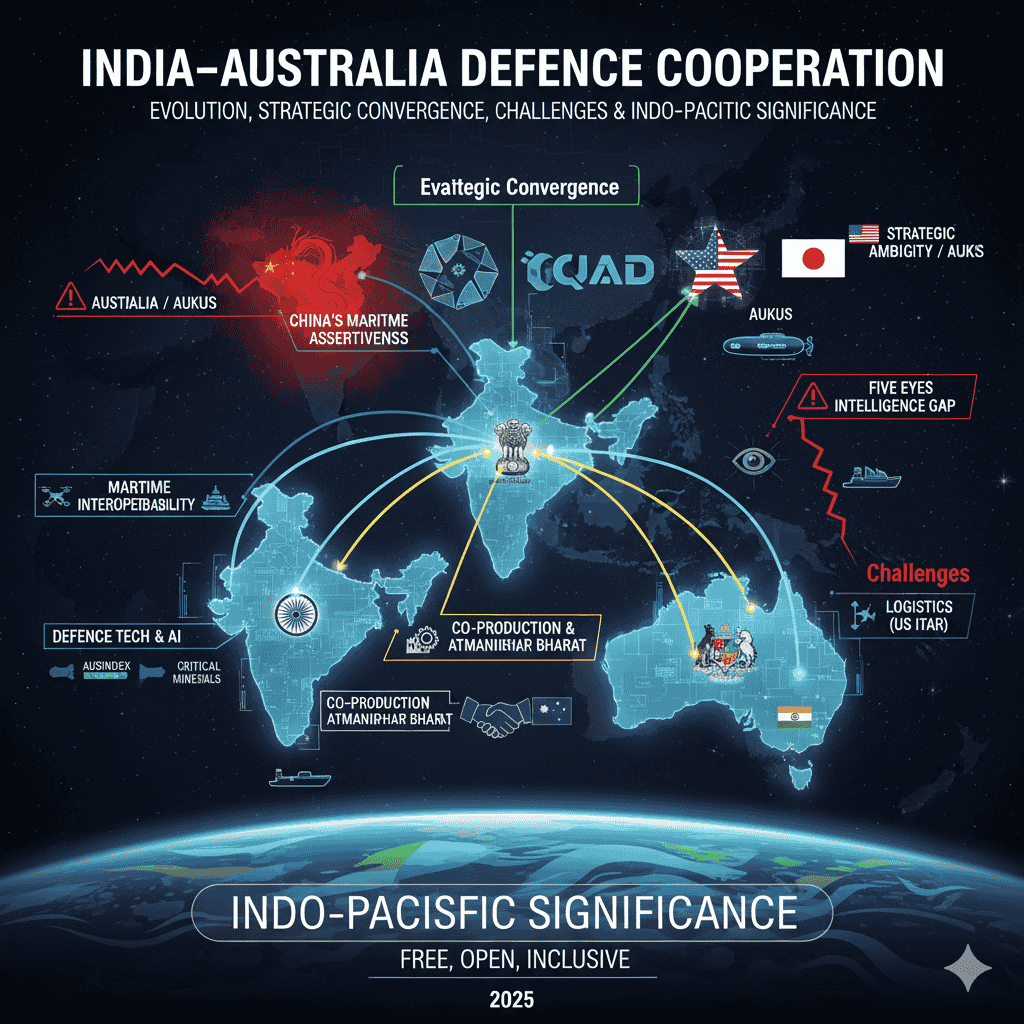
The inaugural India–Australia Defence Ministers’ Dialogue in Canberra marked a historic shift in defence cooperation, expanding military interoperability, information sharing, logistics access, defence manufacturing, and Indo-Pacific security coordination amid China’s assertiveness.
Introduction
Context & Background
Key Points
- •Deeper Strategic Convergence: Both nations now acknowledge China’s maritime assertiveness as a primary security concern, leading to increased defence alignment.
- •Evolution of Ties: From episodic interactions in the 2000s to robust military exercises (2015–23), and now towards defence industrial co-development (2024 onwards).
- •Key Agreements of 2025: Information Sharing Agreement, MoU on Submarine Rescue, Terms of Reference for Joint Staff Talks, operationalising MLSA.
- •Military Interoperability: Air-to-air refuelling (KC-30A tanker), joint naval operations, maritime surveillance, and logistics access through each other’s ports and bases.
- •Industrial Partnership: Australia’s advanced defence technology + India’s cost-effective manufacturing = long-term co-production potential.
- •Shared Indo-Pacific Vision: Ensuring freedom of navigation, rule of law, countering coercive maritime behaviour, and maintaining regional stability.
- •Operational Examples: Regular participation in Malabar, Austrahind, Pitch Black, and Talisman Sabre exercises.
- •Emerging Areas: Cybersecurity, Artificial Intelligence, autonomous underwater vehicles, maritime domain awareness, and unmanned systems.
Key Defence Agreements Between India and Australia (2025)
| Agreement | Purpose | Significance | Bookmark |
|---|---|---|---|
| Information Sharing Agreement | Secure exchange of maritime and air domain intelligence | Enhances maritime surveillance and situational awareness | |
| MoU on Submarine Rescue | Joint rescue missions & emergency responses | Boosts underwater safety and trust between navies | |
| Joint Staff Talks (ToR) | Permanent mechanism for tri-service consultations | Improves coordination in exercises and operations | |
| MLSA | Mutual logistics access and military base usage | Extends operational reach and reduces deployment costs |
Major Defence Exercises Between India and Australia
| Exercise | Type | Purpose | Bookmark |
|---|---|---|---|
| Austrahind | Army Exercise | Strengthens land warfare coordination | |
| Malabar | Quad Naval Exercise | Enhances multi-nation maritime operations | |
| Pitch Black | Air Force Exercise | Improves air combat and interoperability | |
| Talisman Sabre | Large-scale Joint Exercise | Tests multi-domain readiness |
Related Entities
Impact & Significance
- •Enhanced Maritime Security: The Indian Ocean and South Pacific face rising geopolitical tensions. Joint surveillance and intelligence-sharing improve early-warning capabilities.
- •Strengthening QUAD's Strategic Posture: India–Australia cooperation adds practical military depth to the QUAD’s Indo-Pacific strategy.
- •Boost to Atmanirbhar Bharat: Co-production of equipment like drones, radars, and sensors helps India reduce import dependency.
- •Support for Smaller Indo-Pacific Nations: Joint training and humanitarian missions improve regional stability and India’s soft power.
- •Energy & Sea Lane Security: Australia relies on sea routes through the Indian Ocean; India benefits from Australia’s Pacific presence—creating a two-ocean strategic partnership.
Challenges & Criticism
- •Strategic Ambiguity: India avoids treaty alliances, while Australia is deeply integrated with US-led frameworks such as AUKUS and Five Eyes.
- •Asymmetric Theatre Priorities: India’s main threats lie in the Indian Ocean and its land borders with China & Pakistan. Australia’s focus remains on the Pacific.
- •Technology Transfer Barriers: Australia’s tech exports are constrained by NATO/US export controls, slowing co-development.
- •Uneven Tri-Service Cooperation: Navy ties are strong, but Army and Air Force collaboration remains far behind.
- •MRO and Industrial Gaps: Lack of collaboration in Maintenance, Repair & Overhaul (MRO) restricts long-term sustainability.
- •Intelligence Limitations: Australia participates in Five Eyes; India does not—creating gaps in real-time intelligence-sharing.
Future Outlook
- •Expand cyber and space cooperation, including satellite-based maritime surveillance.
- •Joint development of autonomous systems (underwater drones, AI-enabled patrol systems).
- •Integrate India more closely into Australia’s Pacific security framework.
- •Create an India–Australia Defence Innovation Corridor linking MSMEs and start-ups.
- •Increase joint patrols in the Eastern Indian Ocean and strengthen presence in the Andaman–Northern Australia arc.
- •Build shared supply-chain resilience for critical minerals, batteries, and defence electronics.
UPSC Relevance
- • GS-2: India–Australia relations, international groupings, Indo-Pacific geopolitics.
- • GS-3: Internal security, cyber security, defence technology, supply chain resilience.
- • Essay: Multipolar Asia, Indo-Pacific order, maritime governance.
Sample Questions
Prelims
Which of the following bilateral arrangements improve India–Australia military interoperability?
- (a)Mutual Logistics Support Arrangement (MLSA)
- (b)AUKUS Treaty
- (c)India–Australia Submarine Rescue MoU
- (d)Five Eyes Intelligence Pact
Mains
Explain how India–Australia defence cooperation contributes to Indo-Pacific stability. Discuss structural challenges that need resolution for deeper strategic convergence.
Introduction: India–Australia defence ties have expanded significantly amid China’s assertiveness and the need for a stable Indo-Pacific.
Body:
• Strategic Relevance: Maritime security, QUAD synergy, sea lane safety, countering coercive behaviour.
• Institutional Framework: MLSA, information-sharing agreements, submarine rescue MoU, joint exercises.
• Challenges: Strategic ambiguity, tech-transfer issues, asymmetric priorities, lack of Army–Air Force cooperation.
• Way Forward: Joint innovation ecosystem, MRO collaboration, expanded cyber and space cooperation.
Conclusion: A stronger India–Australia defence partnership is essential for Indo-Pacific stability, but requires deeper institutional alignment and technological trust.