
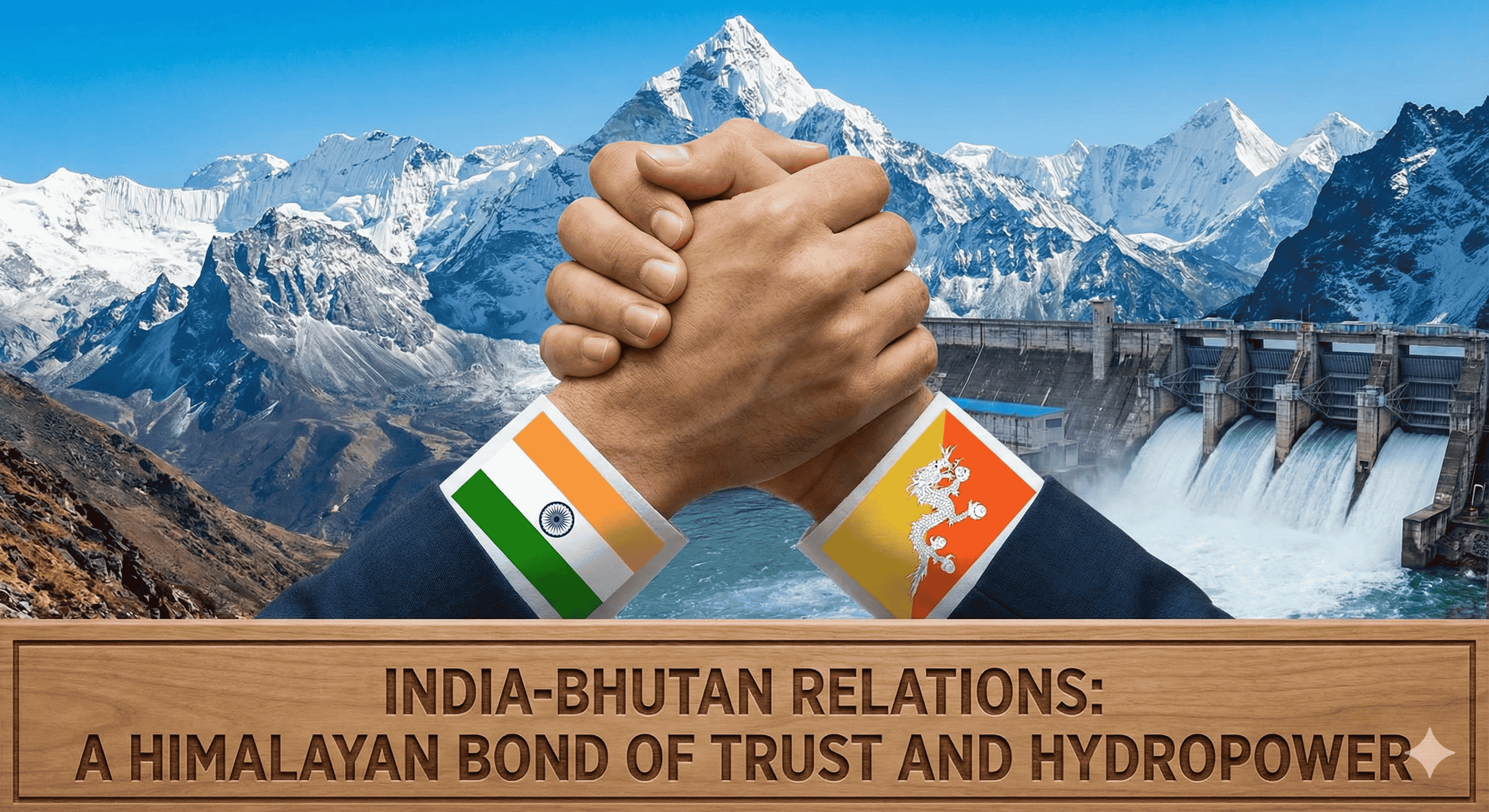
India-Bhutan Relations: A Himalayan Bond of Trust and Hydropower
PM Modi's visit to Bhutan for the King's 70th birthday reaffirmed the unique India-Bhutan friendship. The visit saw major strides in hydropower (Punatsangchhu-II), connectivity (rail links), and new areas like Space and Mental Health, solidifying Bhutan's role as India's most trusted neighbor.
Introduction
The visit reaffirmed Bhutan’s position as India's closest and most reliable partner amidst shifting Indo-China dynamics in the Himalayas.
Context & Background
• India was the first country to recognize Bhutan after its independence.
• The 1949 Treaty of Friendship established India as Bhutan’s key diplomatic guide. The treaty was modernized in 2007 to respect Bhutan’s full sovereignty, signifying political maturity in bilateral ties.
Strategic Geography:
Bhutan lies at the heart of the Himalayas between India and China. Its location is critical for India's national security because:
- The country shields India’s Siliguri Corridor — the vulnerable 22 km ‘Chicken’s Neck’ that connects mainland India to the Northeast.
- The Doklam Plateau, claimed by China, is a tri-junction area that directly impacts India’s military viewlines.
Any Chinese presence in Bhutanese territory would significantly compromise India’s strategic posture.
Shared Values: Buddhism, cultural kinship, open borders, and people-to-people contact have shaped a relationship rooted in trust rather than transactional diplomacy.
Key Points
- •1. Hydropower Cooperation – The Economic Bedrock:
Hydropower accounts for nearly 30–35% of Bhutan’s GDP and is central to India–Bhutan economic ties.
• The inauguration of the 1,020 MW Punatsangchhu-II project marks a milestone in cross-border clean energy cooperation.
• Electricity export to India guarantees long-term revenue for Bhutan.
• India benefits through renewable energy that helps stabilize Eastern India’s power grid.
UPSC Insight: India funds, builds, and purchases — a ‘win-win’ development model. - •2. Connectivity Leap – Rail, Roads and Border trade:
For the first time in history, rail connectivityKey Projects:- Gelephu–Kokrajhar (Assam) rail link
- Samtse–Banarhat (West Bengal) rail corridor
- Boosts bilateral trade
- Enables tourist inflow
- Critical for supply chain and emergency logistics
- •3. Gelephu Mindfulness City (GMC): A Futuristic Bhutan:
Bhutan aims to transform Gelephu into a ‘Mindfulness and Carbon-Negative Economic Hub’.
India’s role:- Building cross-border infrastructure to ensure accessibility.
- Supporting aviation connectivity.
- Encouraging Indian investors to explore hospitality, wellness, IT, and green energy.
- •4. Economic Assistance & Five-Year Plan Support:
India doubled assistance to Bhutan’s 13th Five-Year Plan to ₹10,000 crore.
Sectoral focus:- Road and border infrastructure
- Health & Education
- Digital capacity-building
- Hydropower and green energy
- •5. New-Age Cooperation – Space, Mental Health & Fintech:
• Space: Satellite data sharing for agriculture, weather modelling, and disaster warning.
• Health: Bhutan-NIMHANS collaboration on mental health, aligning with Bhutan’s policy on Gross National Happiness (GNH).
• Fintech: Bhutan already uses India’s RUPAY. The next step is UPI interlinking, allowing Bhutanese travellers to make seamless payments in India.
• Digital Governance: Future cooperation may include India’s Digital Public Infrastructure (DPI) framework. - •6. Assured Supply Chains & Essential Goods:
During global crises (e.g., COVID, fertilizer shortages), India ensured uninterrupted supplies of fuel, food, and key commodities.
In 2025, India reaffirmed that even if export bans are imposed globally, Bhutan will have full access — reinforcing that Bhutan’s stability is central to India’s security. - •7. Defence & Border Management:
Though Bhutan does not maintain a large military, India's training support is crucial.
• India assists through IMTRAT (Indian Military Training Team).
• Cooperation on surveillance and border roads helps Bhutan withstand Chinese pressure.
• Joint efforts ensure that Bhutan’s territory cannot be used against India.
Evolution of India–Bhutan Treaty Framework
| Feature | 1949 Treaty | 2007 Treaty (Revised) | Bookmark |
|---|---|---|---|
| Foreign Policy | Bhutan would be guided by India. | Full autonomy; partnership based on mutual respect. | |
| Sovereignty | More India-centric. | Complete equality between nations. | |
| Security Clause | India responsible for external affairs. | Mutual commitment to prevent harm from each other's territory. | |
| Era | Post-independence diplomatic structure. | Modern framework suited for democracy (Bhutan adopted democracy in 2008). |
Major Hydropower Projects
| Project Name | Capacity | Status | Bookmark |
|---|---|---|---|
| Chukha | 336 MW | Operational since 1987. | |
| Tala | 1020 MW | Fully operational; major contributor to Bhutan's GDP. | |
| Punatsangchhu-II | 1020 MW | Commissioned in 2025 – a landmark achievement. | |
| Punatsangchhu-I | 1200 MW | Delayed due to geological instability; under review. |
Related Entities
Impact & Significance
- •1. Strategic Stability in the Himalayas: Bhutan strengthens India’s northern frontier. The Doklam crisis (2017) demonstrated Bhutan’s alignment with India against Chinese attempts to alter boundary lines.
- •2. Energy Interdependence: Bhutan gains assured revenue; India gains clean hydro-power. This interdependence reduces the chances of geopolitical drift.
- •3. A Model for ‘Neighborhood First’: India-Bhutan ties serve as a successful example of asymmetry of size but equality of respect — an important theme for GS-2.
- •4. Environmental Diplomacy: Bhutan is the world’s only carbon-negative country. India supports Bhutan's global leadership on climate-friendly development.
- •5. Regional Connectivity Corridors: Railway and road links will integrate Bhutan with BBIN and potentially BIMSTEC corridors — strengthening India’s Act East policy.
Challenges & Criticism
- •1. China’s Rising Influence: Bhutan’s boundary negotiations with China pose risks. China seeks to settle the deal by offering northern territories in exchange for Doklam access. This is a red line for India.
- •2. Economic Overdependence on India: Bhutan's exports are heavily concentrated in hydropower. Lack of diversification makes its economy vulnerable.
- •3. Youth Migration Crisis: Over 10% of Bhutan’s youth workforce has moved abroad (Australia, Canada). Domestic job creation remains a challenge.
- •4. Project Delays: Hydropower constructions often face cost overruns and geological issues, creating financial stress for Bhutan.
- •5. Bhutan’s Environmental Concerns: Bhutan withdrew from the BBIN Motor Vehicles Agreement fearing environmental degradation — a policy divergence with India.
Future Outlook
- •1. Digital Integration: Linking Bhutan's governance systems with India's DPI ecosystem will boost e-governance, financial inclusion and transparency.
- •2. Gelephu City & Green Economy: If successful, GMC can become South Asia’s first carbon-neutral smart hub, reducing Bhutan's dependence on hydropower.
- •3. Border Settlement with China: How Bhutan negotiates with China will shape India’s Himalayan security landscape over the next decade.
- •4. Hydropower Diversification: India and Bhutan may move from large dams to small hydro, solar-wind hybrids, and green hydrogen.
- •5. Enhanced Connectivity: Future rail links may open Bhutan to BIMSTEC tourism and trade if managed sustainably.
UPSC Relevance
- • GS-2: India and its neighborhood relations; Strategic partnerships; Role of treaties.
- • GS-3: Hydropower as renewable energy; Border security in the Himalayas.
- • Essay: Themes of ‘Good Neighbourliness’, ‘Sustainable Development’, ‘Himalayan Geopolitics’.
- • Map Work: Doklam Plateau, Gelephu, Punatsangchhu river system.
Sample Questions
Prelims
Consider the following statements regarding India–Bhutan relations:
- (a)Bhutan shares an open and completely unrestricted border with India.
- (b)Punatsangchhu-II hydropower project uses a run-of-the-river design.
- (c)Bhutan has a formal security treaty with China.
- (d)India trains Bhutanese military personnel through IMTRAT.
Mains
India–Bhutan relations are often cited as a model of 'trust-based diplomacy' in South Asia. Examine this statement in the context of recent strategic developments including hydropower cooperation, Gelephu City, and China factor.
Introduction: India–Bhutan ties represent an exceptional blend of trust, shared values and strategic convergence amidst a volatile Himalayan neighbourhood.
Body:
• Strategic Strength: Doklam issue, security of Siliguri Corridor, IMTRAT training support, buffer against Chinese expansion.
• Economic Interdependence: Hydropower as core revenue, new connectivity corridors, Five-Year Plan assistance.
• Emerging Areas: Gelephu Special Economic Zone, digital cooperation (UPI), space and mental health partnerships.
Conclusion: Going ahead, balancing Bhutan's sovereignty, addressing its economic diversification, and managing China’s expanding influence will be key to sustaining this unique partnership.