
India Attends “Board of Peace” Meeting as Observer
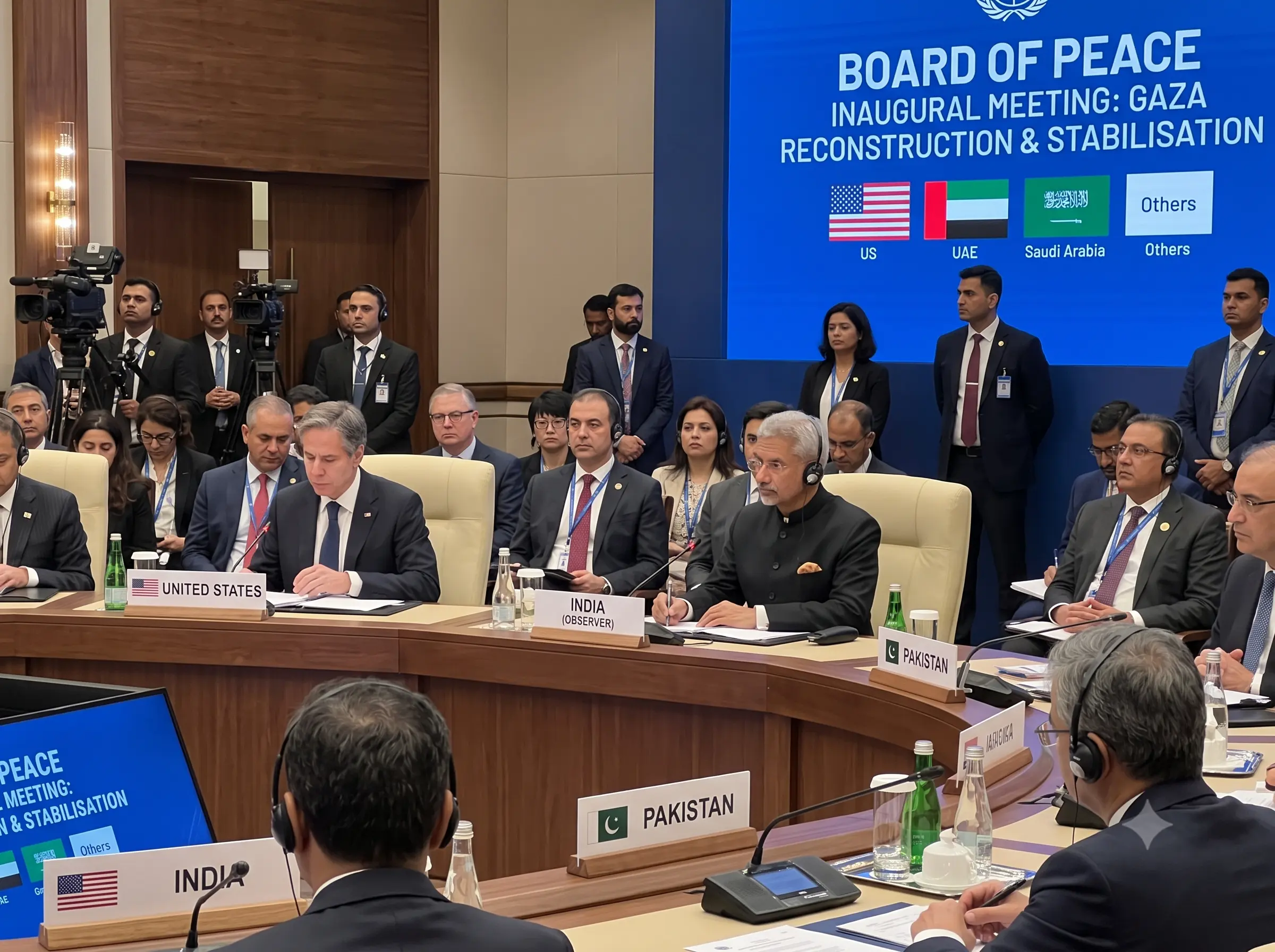
India participated as an observer nation in the inaugural meeting of U.S. President Donald Trump's newly created 'Board of Peace' for Gaza reconstruction. This decision reflects India's careful diplomatic strategy of balancing its relationship with the U.S. and its commitment to UN-led multilateralism, while safeguarding its strategic interests and keeping a check on regional dynamics.
Introduction
Context & Background
Key Points
- •Rivalry with the UN: President Trump indicated the Board might replace the United Nations in peace-building roles, creating a politically sensitive environment that challenges existing multilateral institutions.
- •Absence of Global Powers: The initiative lacks the presence of major UN Security Council members like Russia and China, which diminishes its institutional weight but underscores deep global geopolitical divides.
- •The Pakistan Challenge: Pakistan's membership makes India's complete absence risky. Being an observer allows India to protect its interests if South Asian affairs or mediation claims are raised.
- •Balancing West Asia: The reconstruction of Gaza is intrinsically tied to the stability of the Middle East, directly impacting India's energy security and strategic projects like the India-Middle East-Europe Economic Corridor (IMEC).
- •Massive Financial Package: The initiative is backed by a $10 billion pledge from the U.S. and an additional $5–7 billion from other member nations, aiming for structured regional rebuilding.
Overview of the 'Board of Peace'
| Feature | Details | Bookmark |
|---|---|---|
| Initiator | United States (President Donald Trump) | |
| Core Objective | Post-war Gaza reconstruction, humanitarian relief, and political stabilization | |
| Funding | U.S. pledged $10 billion; Members collectively pledged $5–7 billion | |
| Key Members | Argentina, Armenia, Azerbaijan, Hungary, Pakistan, Saudi Arabia, UAE | |
| India's Status | Observer (Represented by Deputy Chief of Mission in Washington) |
Rationale Behind India's Observer Status
| Strategic Factor | India's Calculus | Bookmark |
|---|---|---|
| U.S. Engagement | Signals goodwill to Washington and keeps channels open during ongoing trade negotiations without a full political commitment. | |
| Multilateralism | Avoids full endorsement of a parallel structure that challenges the UN, adhering to India's traditional support for UN-led solutions. | |
| Strategic Autonomy | Maintains flexible alignment, minimizes diplomatic exposure, and keeps an exit option open. | |
| Pakistan Factor | Prevents Pakistan (a full member) from pushing adverse narratives against India or internationalizing bilateral issues. |
Related Entities
Impact & Significance
- •Israel–Palestine Balance: India manages to sustain its strong strategic ties with Israel while continuing its ideological support for Palestinian statehood by not formally aligning with the Board.
- •Economic Stakes: Remaining engaged as an observer ensures India doesn't isolate the U.S. at a time when crucial bilateral trade and technology partnerships are being negotiated.
- •Geoeconomic Corridors: Restoring peace in Gaza is vital for broader Middle Eastern stability, which acts as a prerequisite for India's strategic infrastructure projects like the IMEC.
Challenges & Criticism
- •Dilution of UN Authority: If the Board expands into a dominant global forum, it threatens to bypass established international laws and fragment global governance.
- •Geopolitical Divides: The intentional exclusion of powers like Russia and China severely limits the Board's universal legitimacy.
- •Unpredictable Leadership: The initiative is closely tied to President Trump's often unpredictable diplomatic style, leading to fears that the U.S. could abruptly shift course, leaving participating nations politically exposed.
Future Outlook
- •Continued Middle-Path Diplomacy: India will likely maintain its strategy of controlled engagement—participating selectively without formal alignment to preserve its strategic flexibility.
- •Monitoring the Initiative's Longevity: Because the Board is heavily tied to President Trump's personal political agenda, its sustainability beyond his tenure remains highly uncertain.
- •Defending Multilateral Norms: India will carefully avoid setting a normative precedent that weakens global UN-led mechanisms, continuing to advocate for traditional international law and a two-state solution.
UPSC Relevance
- • GS-2 (International Relations): Bilateral, regional and global groupings and agreements involving India and/or affecting India's interests.
- • GS-2 (Extended Neighbourhood): Effect of policies and politics of developed and developing countries on India's interests (West Asia focus).
- • Mains Focus: Analyzing India's doctrine of strategic autonomy, its stance on parallel U.S.-led platforms vs. the UN, and the diplomatic handling of the 'Pakistan factor' in multilateral forums.
Sample Questions
Prelims
Consider the following statements regarding the 'Board of Peace' initiative recently seen in the news: 1. It is a United Nations-backed multilateral platform aimed at rebuilding Gaza. 2. India is one of the founding full members of this initiative. Which of the statements given above is/are correct?
1. 1 only
2. 2 only
3. Both 1 and 2
4. Neither 1 nor 2
Answer: Option 4
Explanation: Statement 1 is incorrect: The Board of Peace is a U.S.-led initiative by President Donald Trump and is perceived as a rival to the UN framework. Statement 2 is incorrect: India participated only as an observer nation, not as a full member.
Mains
“India’s decision to join the U.S.-led 'Board of Peace' as an observer is a textbook example of its strategic autonomy.” Analyze this statement in the context of India's changing geopolitical priorities in West Asia and its commitment to multilateralism.
Introduction: Briefly introduce the 'Board of Peace' proposed by President Trump and state India's rationale for opting for observer status rather than full membership.
Body:
• Strategic Autonomy and the U.S.: Explain how observer status prevents antagonizing the U.S. during crucial trade pact negotiations, while keeping an exit option open.
• Commitment to Multilateralism: Discuss India's reluctance to endorse a parallel platform that undermines the UN and its consistent stance on a two-state solution.
• Regional Dynamics: Address the necessity of monitoring Pakistan’s involvement to prevent the internationalization of bilateral issues, and highlight the importance of Gaza's stability for IMEC and energy security.
Conclusion: Conclude that the 'middle-path' strategy allows India to safeguard its independent foreign policy, ensuring it shapes the discourse without bearing the risks of unpredictable geopolitical initiatives.