
India’s Cooperatives: Scale to Strength
India's cooperative movement has grown into one of the largest structured economic systems globally, representing 27% of the world's cooperatives. This article explores their vast landscape, regulatory frameworks, pivotal role in achieving an Atmanirbhar Bharat, internal challenges, and the structural reforms needed to drive inclusive economic growth.
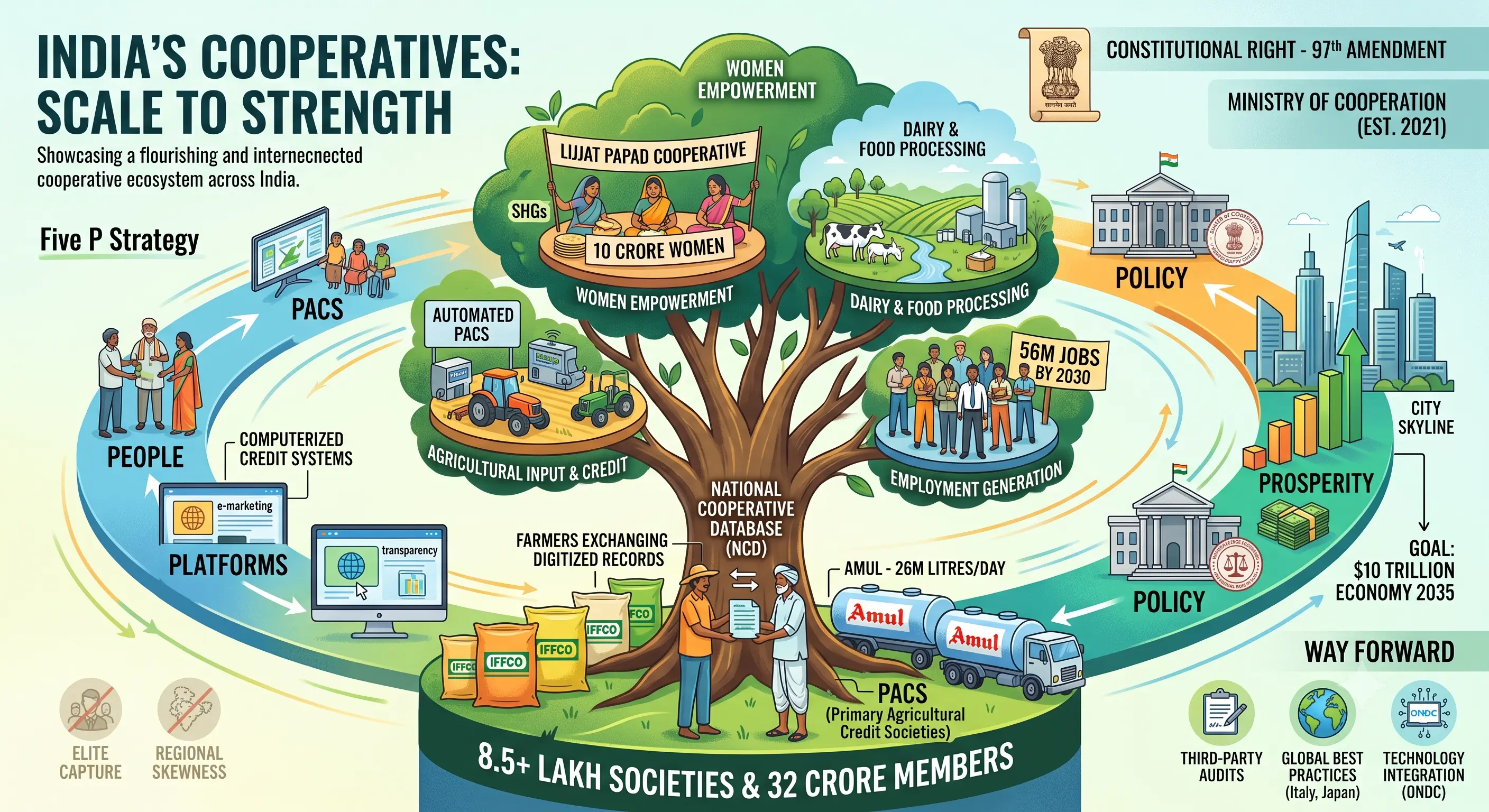
Introduction
Context & Background
Key Points
- •Expanding Financial Access: Primary Agricultural Credit Societies (PACS) are vital for grassroots lending, contributing nearly 15% of India's total agricultural credit.
- •Input and Production dominance: Cooperatives like IFFCO and KRIBHCO supply about one-third of the country's fertilizers. The sector also handles over 30% of sugar production and a substantial portion of milk distribution.
- •Role in Atmanirbhar Bharat: Cooperatives fuel local production (e.g., Amul handles 26M litres/day) and empower vulnerable groups (e.g., Lijjat Papad for women, VDVKs for tribals).
- •Employment Engine: The sector supports extensive non-farm employment, driving over 13% of direct job creation. Estimates suggest it could generate 56 million self-employment opportunities by 2030.
- •Digital & Market Upgrades: Tools like the National Cooperative Database and e-marketing platforms (Sahakar Se Samriddhi, CRCS-Sahara Refund Portal) are bringing unprecedented transparency and digital service delivery.
- •Better Producer Returns: By cutting out middlemen, the cooperative structure allows grassroots producers to capture a significantly larger share of the final market price.
Current Landscape of Cooperative Societies in India
| Metric | Details | Bookmark |
|---|---|---|
| Total Registered Societies | More than 8.5 lakh (nearly 27% of the world's cooperatives) | |
| Functioning Entities | Approx. 6.6 lakh (about three-fourths of the total) | |
| Membership Reach | Nearly 32 crore members across 30 sectors; 98% rural presence | |
| Women's Participation | Close to 10 crore women, primarily through SHGs | |
| Leading State | Maharashtra (over 2.21 lakh societies, ~5.8 crore members) |
Regulatory and Legal Framework for Cooperatives
| Law/Framework | Purpose | Oversight/Limitation | Bookmark |
|---|---|---|---|
| 97th Constitutional Amendment (2011) | Recognised forming cooperatives as a Fundamental Right under Article 19(1)(c); introduced Part IXB. | SC limited Part IXB applicability mostly to Multi-State cooperatives (2021). | |
| State Cooperative Societies Acts | Regulates state-level cooperatives (Entry 32 of the State List). | Overseen by respective State Registrars. | |
| Multi-State Cooperative Societies Act, 2002 | Governs cooperatives operating in multiple states (Entry 44 of the Union List). | Overseen by the Central Registrar. | |
| Banking Regulation Act, 1949 | Empowers RBI to regulate cooperative banks. | NABARD handles rural cooperative banking supervision. |
Related Entities
Impact & Significance
- •GDP and Livelihoods: Cooperatives account for nearly 3% of India's GDP, embedding themselves as a critical pillar for rural livelihoods and sustainable community wealth building.
- •Socio-Economic Equalizers: By pooling resources and redistributing surpluses locally, cooperatives curb distress out-migration, as visibly seen in the fisheries cooperatives of Kerala and Meghalaya.
- •Market Democratization: They dismantle monopolistic supply chains, ensuring that margins typically lost to middlemen are redirected to the grassroots producers.
- •Financial Inclusion: By integrating 10 crore women through SHGs and supporting 32 crore members overall, they are one of the most effective tools for banking the unbanked.
Challenges & Criticism
- •Politicization and Elite Capture: A major critique is the lack of internal democracy. Many cooperatives suffer from nepotism; a 2022 IRMA study noted over 40% of elected PACS directors have political affiliations.
- •Regional Skewness: Growth is highly uneven. States like Maharashtra (25% of all cooperatives) and Gujarat dominate, while penetration in North-Eastern and Eastern states remains critically weak.
- •Managerial Deficit: The sector suffers from a severe lack of professional management. Roughly 8% of cooperatives employ trained CEOs or use modern financial, marketing, and digital tools.
- •Capital and Branding Constraints: Many state-level societies rely heavily on informal lenders due to delayed institutional refinancing. Furthermore, poor branding keeps their share of national agricultural exports to less than 1%.
Future Outlook
- •Technology and ONDC Integration: Cooperatives must integrate with digital commerce platforms like the Open Network for Digital Commerce (ONDC) and specialized platforms like 'Janani' to solve logistics and market access hurdles.
- •The 'Five P' Strategy: A governance strategy focusing on People, PACS, Platforms, Policy, and Prosperity to modernize cooperatives into digitally driven, professionally managed institutions.
- •Capacity Building: Establishing Centres of Excellence (CoEs) alongside Krishi Vigyan Kendras (KVKs) to train members in digital literacy, modern farming, and entrepreneurship.
- •Professionalization & Branding: Mandating professional CEOs, leveraging 'One District One Cooperative' (ODOC) for scalability, and widening access to finance via CSR and Priority Sector Lending (PSL).
UPSC Relevance
- • GS-2 (Polity & Governance): Statutory, regulatory, and quasi-judicial bodies; Government policies; Development processes (role of NGOs, SHGs, and cooperatives).
- • GS-3 (Economy): Inclusive growth, agricultural credit, and supply chain management.
- • Constitutional Law: Understanding the 97th Constitutional Amendment (Article 19(1)(c) and Part IXB) and federalism debates (State vs. Union List).
- • Mains Focus: Analyzing the regional disparities and governance deficits in cooperatives, and evaluating their potential as engines of rural empowerment.
Sample Questions
Prelims
Consider the following statements regarding Cooperative Societies in India: 1. The right to form cooperative societies is a fundamental right guaranteed under Article 19. 2. All cooperative societies are regulated uniformly by the Multi-State Cooperative Societies Act, 2002. 3. Cooperative banks are regulated by the Reserve Bank of India under the Banking Regulation Act, 1949. Which of the statements given above is/are correct?
1. 1 and 3 only
2. 2 only
3. 2 and 3 only
4. 1, 2, and 3
Answer: Option 1
Explanation: Statement 1 is correct (added by the 97th Constitutional Amendment Act, 2011). Statement 2 is incorrect; state-level cooperatives are governed by State Acts (Entry 32, State List), whereas only those operating in multiple states fall under the 2002 Act. Statement 3 is correct.
Mains
Despite being a massive institutional framework, the cooperative movement in India suffers from severe regional imbalances and governance deficits. Analyze the challenges faced by cooperatives and discuss the recent state initiatives aimed at making them a reliable partner in Atmanirbhar Bharat.
Introduction: Highlight the scale of India's cooperative sector (8.5 lakh societies, 32 crore members). Mention its constitutional backing (97th Amendment) and its fundamental objective of inclusive socio-economic growth.
Body:
• Challenges/Limitations: Elite capture and politicization (40% PACS directors politically affiliated); Severe regional skewness (Maharashtra/Gujarat vs. North-East); Lack of professional management (only 8% have trained CEOs); Poor digital integration and financial credit linkages.
• Role in Atmanirbhar Bharat: Grassroots credit via PACS; Strengthening local supply chains (Amul model, IFFCO); Women/Tribal empowerment (Lijjat Papad, VDVKs); Large-scale self-employment generation.
• Recent Initiatives & Way Forward: Formation of the Ministry of Cooperation (2021); MSCS (Amendment) Act 2023; Computerization of 63,000+ PACS; Integration with ONDC; Implementation of the 'Five P' strategy.
Conclusion: Conclude that transitioning cooperatives from politically entangled entities to professionally managed, digitally-integrated business models is essential for bridging the rural-urban divide and achieving a $10 trillion economy by 2035.