
India’s Rising Dependence on Imported Crude Oil
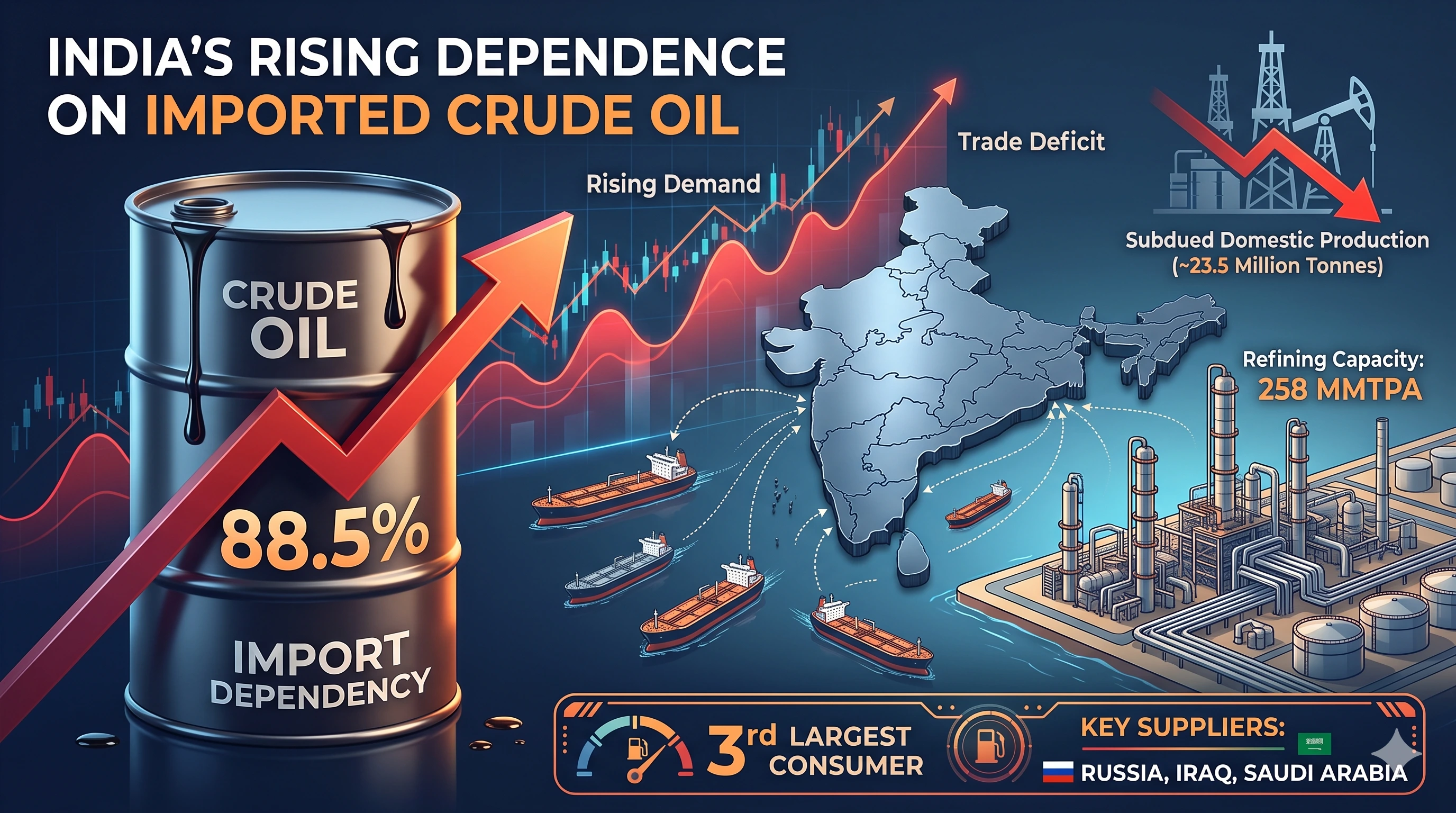
India's crude oil import dependency crossed 88.5% in FY26 (April–January), driven by a widening gap between robust domestic demand and stagnant domestic production. This article examines the drivers behind this trend, the economic implications for India's trade deficit and inflation, and the strategic path forward.
Introduction
Context & Background
Key Points
- •Demand Expansion: India remains a major growth centre of global oil demand. This is primarily fueled by rising consumption in the transport, industrial, aviation, and petrochemical sectors.
- •Stagnant Domestic Production: Despite policy pushes, local crude oil output continues to remain subdued, declining marginally to about 23.5 million tonnes in FY26 (April–January).
- •Refinery Capacity Dynamics: India possesses a massive 258 MMTPA refining capacity. Refineries often operate at over 100% utilization, reflecting strong downstream demand and highly complex refining capabilities that allow India to remain a net exporter of petroleum products (like petrol and diesel).
- •Trade Deficit Pressures: Crude oil consistently constitutes nearly 25–30% of India’s total merchandise import bill, exerting persistent pressure on the current account deficit (CAD).
India's Crude Oil Sector Profile (FY26)
| Metric | Data / Details | Implications / Notes | Bookmark |
|---|---|---|---|
| Import Dependency | ~85-89% (>88.5% in Apr-Jan FY26) | High vulnerability to global supply shocks. | |
| Global Consumption Ranking | 3rd Largest Globally | Major driver of global oil demand. | |
| Domestic Production | ~23.5 Million Tonnes (Apr-Jan FY26) | Marginal decline; output remains subdued. | |
| Refining Capacity | 258 MMTPA | Utilization often >100%; India is a net exporter of refined products. |
Top Crude Oil Suppliers to India
| Supplier | Status / Trend | Bookmark |
|---|---|---|
| Russia | Emerged as the largest supplier in recent years. | |
| Iraq | Traditional heavyweight supplier in the Middle East. | |
| Saudi Arabia & UAE | Consistent strategic energy partners. | |
| USA | Growing share in India's import basket for diversification. |
Related Entities
Impact & Significance
- •External Sector Vulnerability: Elevated crude import dependency exceeding 88% significantly amplifies India’s exposure to global oil price volatility, supply chain disruptions, and exchange-rate fluctuations.
- •Trade Deficit Intensification: Crude oil imports are a massive drain on foreign exchange, consistently constituting nearly 25–30% of India’s total merchandise import bill, which stresses the Current Account Deficit.
- •Inflationary Transmission Risks: Fuel and energy components carry a notable weight in domestic indices (roughly 6.8% in CPI & over 13% in WPI). Consequently, any shock in global crude prices propagates rapidly across the broader price system, affecting everything from logistics to daily groceries.
Challenges & Criticism
- •Geopolitical Sensitivity: Heavy reliance on a few concentrated regions (like the Middle East and Russia) leaves India's energy security at the mercy of global geopolitical conflicts and sanction regimes.
- •Sluggish Domestic Upstream Growth: Despite structural reforms and open licensing policies, foreign direct investment and technological breakthroughs in domestic oil exploration have not yielded the massive discoveries required to offset import dependence.
- •Fiscal Burden: The continuous outflow of foreign currency limits the fiscal space available for the government to spend on other critical developmental infrastructure.
Future Outlook
- •Domestic Exploration Push: Accelerating upstream investments to enhance domestic production resilience. A key strategy is the continuous expansion of the Open Acreage Licensing Policy (OALP) rounds to attract exploration.
- •Energy Diversification Strategy: Scaling alternative fuels and integrating renewables to reduce long-term hydrocarbon dependency. Major initiatives include the National Green Hydrogen Mission and incentives for the Electric Vehicle (EV) ecosystem.
- •Demand-Side Efficiency: Strengthening fuel efficiency norms and encouraging modal shifts in transport to lower structural petroleum intensity. This includes enforcing Corporate Average Fuel Efficiency (CAFÉ) standards and accelerating railway electrification.
UPSC Relevance
- • GS-3 (Indian Economy): Infrastructure, Energy, Changes in industrial policy and their effects on industrial growth.
- • GS-2 (International Relations): Bilateral, regional and global groupings and agreements involving India and/or affecting India’s interests (e.g., oil imports from Russia vs Middle East).
- • Mains Focus: Analyzing the macroeconomic impacts of high import dependence (Current Account Deficit, Imported Inflation) and structural reforms needed for energy security.
Sample Questions
Prelims
With reference to India's crude oil sector, consider the following statements: 1. India is currently a net importer of refined petroleum products. 2. Domestic crude oil production in India has been steadily increasing over the last five years. 3. Russia has emerged as the largest supplier of crude oil to India in recent years. How many of the above statements are correct?
Only one
Only two
All three
None
Answer: Option 0
Explanation: Statement 1 is incorrect: India is a net exporter of petroleum products (like diesel and petrol) due to its massive refining capacity (258 MMTPA). Statement 2 is incorrect: Domestic crude oil production continues to remain subdued/stagnant and has seen a marginal decline. Statement 3 is correct: Russia has become the top supplier of crude oil to India recently.
Mains
India's rising crude oil import dependency poses significant structural risks to its macroeconomic stability. Discuss the economic implications of this trend and evaluate the measures taken by the government to ensure long-term energy security.
Introduction: Briefly state the context: India's crude oil import dependency crossing 88.5% in FY26. Mention India's dual status as the 3rd largest consumer of crude oil and a net exporter of refined petroleum products.
Body:
• Economic Implications: 1. External Sector Vulnerability: Exposure to global oil price volatility and exchange-rate fluctuations. 2. Trade Deficit: Oil accounts for 25-30% of the import bill, widening the Current Account Deficit (CAD). 3. Imported Inflation: High weightage of fuel in CPI (6.8%) and WPI (>13%) means crude price shocks quickly translate into broader inflation.
• Drivers: Rapid demand expansion in transport/industry vs. stagnant domestic production (~23.5 MMT in FY26 Apr-Jan).
• Government Measures/Way Forward: 1. Upstream exploration: Promoting OALP and HELP. 2. Diversification: Transitioning to EVs, National Green Hydrogen Mission, and ethanol blending. 3. Demand Efficiency: Implementation of CAFÉ standards and railway electrification.
Conclusion: Conclude that while short-term reliance on imported crude is unavoidable, a fast-tracked transition towards renewable energy and domestic exploration is imperative to safeguard India's macroeconomic stability and achieve 'Atmanirbhar Bharat' in the energy sector.