
India’s First Ricin “Bioterrorism” Case
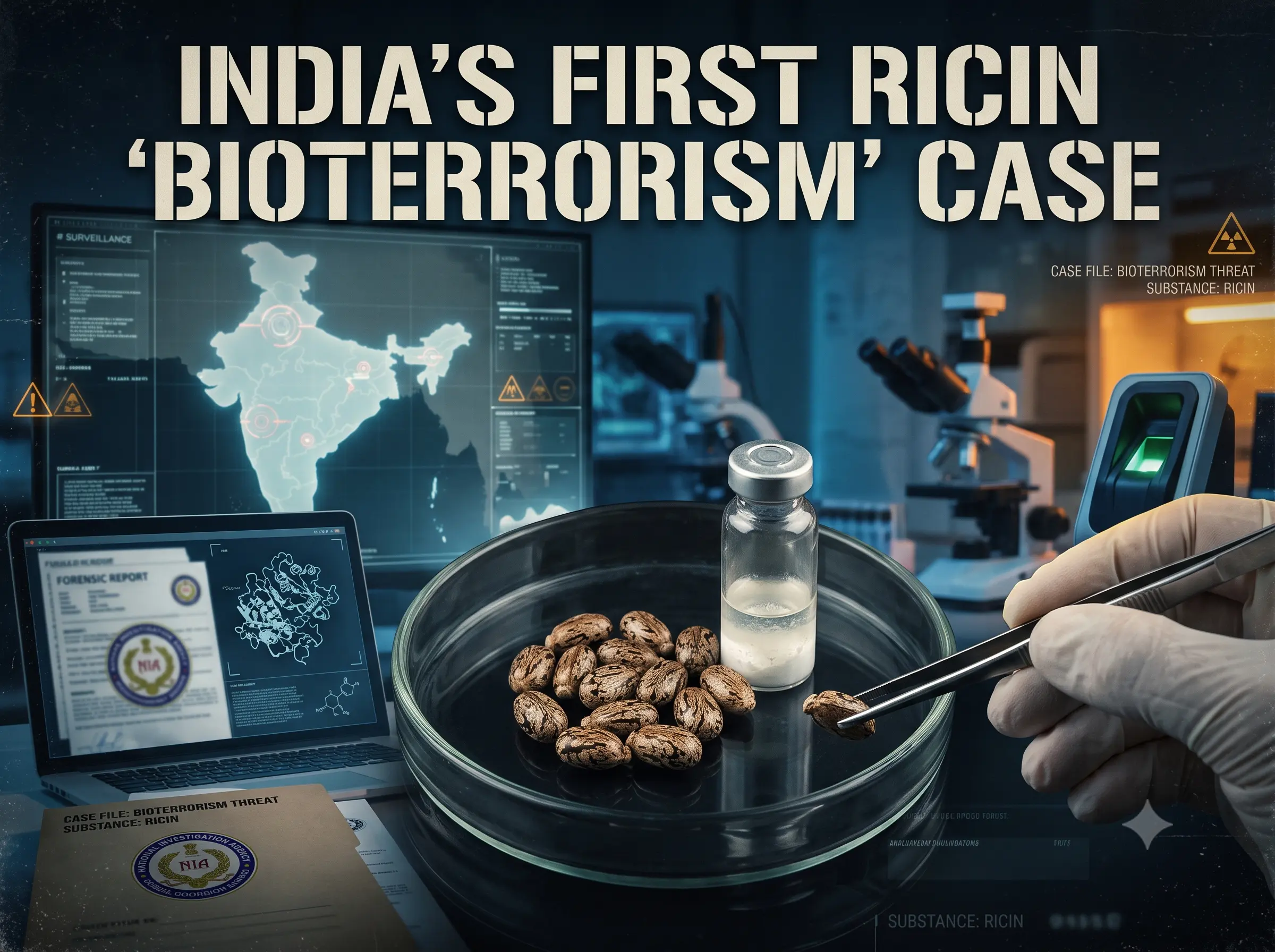
The NIA has uncovered India's first bioterrorism plot involving an attempt to isolate the deadly ricin toxin from castor beans. This incident highlights the emerging security threats posed by lone-actor radicalization, easy access to raw materials, and the challenges of detecting colorless, odorless toxins.
Introduction
Context & Background
Key Points
- •Targeted Assassinations: The most famous case is the 1978 assassination of Bulgarian dissident Georgi Markov in London using a ricin-filled umbrella tip.
- •Ricin Letters in the U.S.: In 2013, 2018, and 2020, ricin-laced letters were sent to U.S. officials, including Presidents Obama and Trump, but were intercepted before causing harm.
- •Limited Terrorist Attempts: There is no recorded mass-casualty attack using ricin. Attempts have usually involved small-scale plots due to technical challenges.
- •German 2018 Case: In Cologne, Germany, suspects managed to isolate ricin but were arrested before executing an attack. This remains one of the rare confirmed isolation cases.
Properties and Profile of Ricin
| Feature | Description | Bookmark |
|---|---|---|
| Classification | Listed under Schedule 1 of the Chemical Weapons Convention (CWC). No known antidote. | |
| Source | Extracted from castor beans; remains in the waste mash after castor oil extraction in countries like India, Brazil, and China. | |
| Toxicity Level | Extremely poisonous; causes organ failure and death. More toxic than cyanide in certain exposure conditions. | |
| Forms | Powder, liquid, or pellet. Often discussed as a possible aerosol or ingestion-based poison in terror contexts. | |
| Weaponisation | Highly toxic but difficult to produce in large quantities and disperse effectively, limiting mass-casualty attacks. |
Related Entities
Impact & Significance
- •Security Paradigm Shift: The incident marks India’s first bioterrorism case, signaling a shift toward unconventional threats and highlighting vulnerabilities in monitoring widely available agricultural by-products.
- •International Obligations: As a signatory to the Chemical Weapons Convention, India is obligated to prevent the misuse of substances like ricin, underscoring the need for strict domestic compliance.
- •Evolving Radicalisation Tactics: The possible involvement of lone-wolf actors using open-source internet and AI tools to isolate toxins indicates a dangerous evolution away from structured terror modules.
Challenges & Criticism
- •Ease of Access to Raw Material: Since castor beans are widely available in India for agricultural and industrial use, tracking misuse without harming legitimate business is extremely difficult.
- •Knowledge Proliferation: Open-source information and AI tools make it easier for individuals to learn toxin extraction methods, elevating lone-wolf risks.
- •Detection Difficulties: Ricin is colorless and odorless, which makes early detection almost impossible without highly specialized laboratory equipment.
- •Cross-Border Complexity: Allegations of drone-based arms drops indicate that bioterrorism might be combining with evolving cross-border smuggling tactics, complicating the security response.
Future Outlook
- •Tighter Monitoring of Hazardous Substances: Authorities should strengthen monitoring of bulk purchases and suspicious transactions without affecting genuine agricultural and commercial businesses.
- •Strengthening Chemical Weapons Compliance: India, as a signatory to the Chemical Weapons Convention (CWC), must ensure strict domestic enforcement and periodic audits of toxic substance handling.
- •Licensing and Reporting Mechanisms: Establish mandatory reporting mechanisms for unusual procurement of lab equipment or toxic chemicals.
- •Monitoring Online Radicalisation: Security agencies should strengthen monitoring of online platforms where extremist ideologies or toxin-making information may circulate.
- •AI-Based Threat Detection: Develop AI-driven systems to detect suspicious digital searches or procurement patterns linked to chemical agents.
UPSC Relevance
- • GS-3 (Internal Security): Emerging Security Threats, Bioterrorism, Lone-wolf attacks, and cross-border security concerns.
- • GS-2 (International Relations): International treaties and India's obligations regarding the Chemical Weapons Convention (CWC).
- • Mains Focus: Analyzing the challenges of lone-actor radicalization and formulating strategies to monitor hazardous dual-use substances without disrupting legitimate industries.
Sample Questions
Prelims
Consider the following statements regarding 'Ricin':
1. It is a highly toxic protein extracted from castor beans.
2. There is a widely available antidote for ricin poisoning.
3. It is listed under Schedule 1 of the Chemical Weapons Convention (CWC).
Answer: Option 1, Option 3
Explanation: Statement 2 is incorrect; there is no known antidote for ricin poisoning. Statements 1 and 3 are correct. Ricin is extremely toxic and listed under Schedule 1 of the CWC.
Mains
What is bioterrorism? In light of the recent uncovering of a ricin-based plot in India, discuss the scientific and security challenges associated with such threats and suggest measures to mitigate them.
Introduction: Define bioterrorism (use of biological toxins/agents like ricin to spread fear or cause harm). Mention the recent NIA discovery of India's first ricin plot as context.
Body:
• Scientific & Security Challenges: Easy access to raw materials (castor beans); knowledge proliferation through the internet and AI; difficulty in detection (colorless/odorless); lone-actor radicalization; and cross-border smuggling tactics (drones).
• Way Forward / Measures: Tighter monitoring of bulk purchases without hurting genuine businesses; strengthening Chemical Weapons Convention (CWC) compliance; mandatory reporting for lab equipment procurement; and AI-driven threat detection systems.
Conclusion: Conclude by emphasizing the need for a proactive approach combining technological surveillance, strict regulatory frameworks, and international cooperation to combat evolving lone-wolf and bioterrorism threats.