
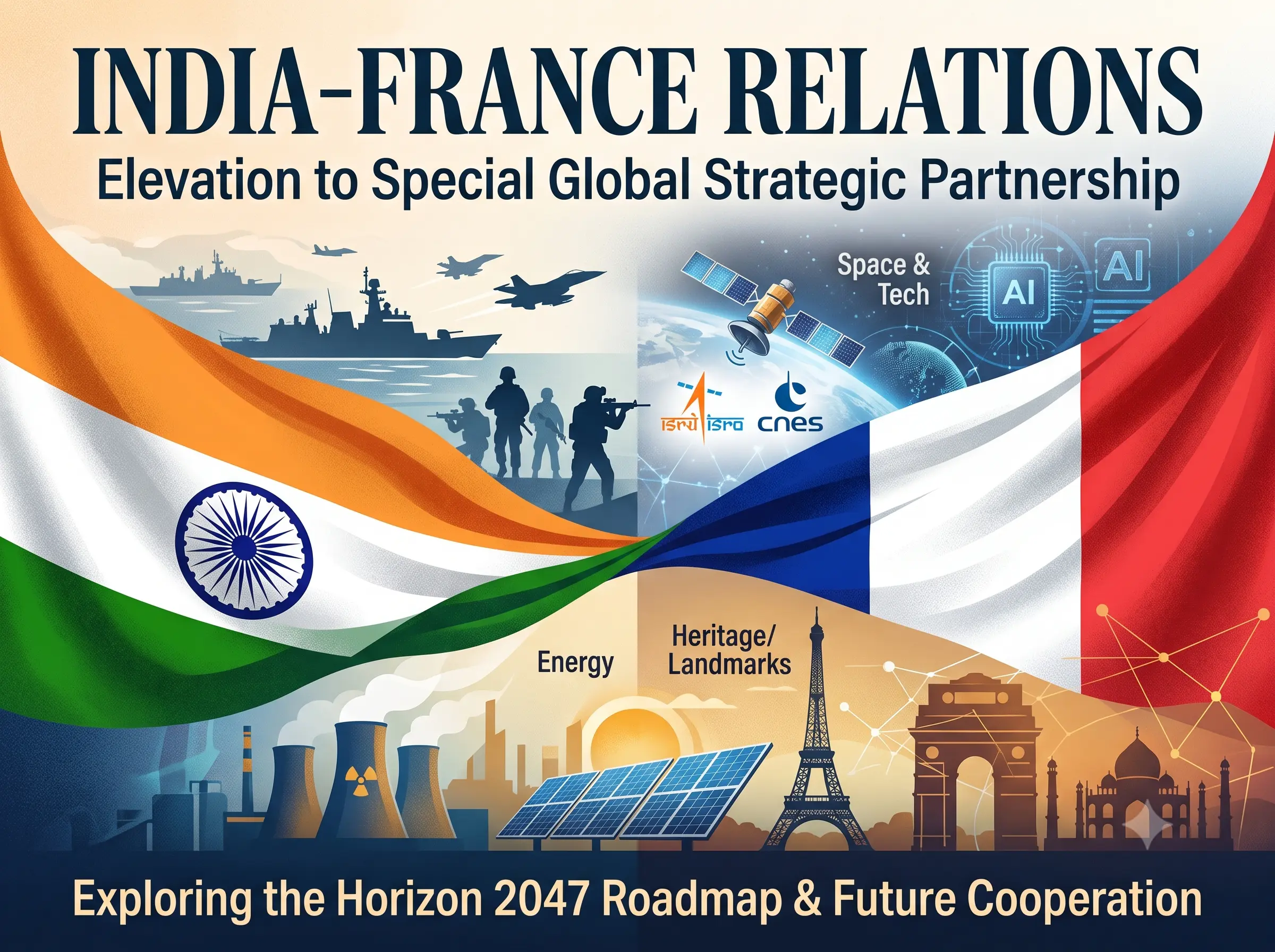
India-France Relations: Elevation to Special Global Strategic Partnership
During President Emmanuel Macron's recent visit, India and France elevated their bilateral ties to a "Special Global Strategic Partnership." Key outcomes include an agreement on the reciprocal deployment of armed forces, the amendment of the Double Taxation Avoidance Agreement (DTAA), and the launch of the India-France Year of Innovation 2026 focusing on advanced technologies like AI, space, and clean energy.
Introduction
Context & Background
Key Points
- •Special Global Strategic Partnership: The bilateral relationship, which has been strategic since 1998, was formally upgraded to a 'Special Global Strategic Partnership' during the visit, reflecting deepening mutual trust.
- •Defense and Strategic Alignment: A landmark agreement allows the reciprocal deployment of military officers in each other’s armed forces, enhancing interoperability and strategic coordination.
- •Horizon 2047 Review Mechanism: Both nations instituted an Annual Foreign Ministers’ Dialogue to systematically review and drive progress under the Horizon 2047 Roadmap.
- •Economic Facilitation: The amendment to the Double Taxation Avoidance Agreement (DTAA) is a significant step for businesses, ensuring companies operating in both nations are not taxed twice on the same income, thereby reducing financial and legal friction.
- •Year of Innovation 2026: A major focus of the visit was the inauguration of the India-France Year of Innovation 2026, aiming to spur cooperation in AI, space research, advanced manufacturing, and clean energy through dedicated centers of excellence.
- •Nuclear and Space Synergies: Continued strong collaboration in high-end technologies, including the civil nuclear domain (Jaitapur project, ITER participation, SMRs) and space (TRISHNA mission, space situational awareness).
Key Initiatives under the India-France Year of Innovation 2026
| Initiative | Focus Area | Objective | Bookmark |
|---|---|---|---|
| Indo-French Centre for AI in Health | Healthcare | Develop AI-based tools for early disease detection, medical diagnostics, and health data analysis. | |
| Indo-French Centre for Digital Science and Technology | Future Technologies | Work on quantum computing, cybersecurity, semiconductor research, and high-performance computing. | |
| National Centre of Excellence for Skilling in Aeronautics | Aerospace | Train engineers and technicians in aircraft manufacturing, maintenance, and advanced aeronautical systems. | |
| India-France Innovation Network | Research & Industry | Connect research institutions, universities, start-ups, and industries from both countries. |
Pillars of Bilateral Cooperation
| Sector | Key Engagements & Projects | Bookmark |
|---|---|---|
| Space Cooperation | ISRO and CNES (French Space Agency) collaboration; Joint missions like TRISHNA (Earth observation); maritime domain awareness; commercial collaboration between Arianespace and NSIL. | |
| Civil Nuclear Energy | Cooperation on Jaitapur Nuclear Power Project; Indian participation in the ITER fusion energy project in France; Letters of Intent on Small Modular Reactors (SMRs) and Advanced Modular Reactors (AMRs). | |
| Economic & Trade | France is India’s 5th largest trading partner in the EU (~€12.92 billion bilateral trade); 11th largest FDI investor; Amended DTAA to prevent double taxation. | |
| Defense & Security | Reciprocal deployment of military officers in each other's armed forces. |
Related Entities
Impact & Significance
- •Bolstering Strategic Autonomy: By deepening ties with a major European power, India diversifies its strategic partnerships, reducing over-reliance on any single global superpower.
- •Catalyzing Technological Leadership: Initiatives under the Year of Innovation 2026 will accelerate India's capabilities in critical emerging technologies like AI, quantum computing, and advanced aeronautics.
- •Advancing Energy Transition: Cooperation in civil nuclear energy and clean tech is vital for India to meet its growing energy demands while adhering to climate commitments.
- •Enhancing Ease of Doing Business: The amendment to the DTAA directly impacts the economic landscape by providing clarity and reducing the tax burden for multinational enterprises operating in both jurisdictions.
Challenges & Criticism
- •Project Gestation and Delays: Despite strong political will, mega-projects like the Jaitapur Nuclear Power Project have experienced prolonged negotiations and delays over technical and pricing issues.
- •Translating MoUs into Action: While comprehensive roadmaps like Horizon 2047 set ambitious targets, execution on the ground across bureaucratic frameworks in both countries remains a challenge.
- •Trade Potential Gap: Despite strong strategic ties, bilateral trade volume (~€12.92 billion) remains relatively modest compared to India's trade with other major global partners, indicating untapped economic potential.
Future Outlook
- •Digital Infrastructure Integration: Exploring cooperation in undersea internet cables leveraging Marseille as a critical communication hub linking Europe with Asia and Africa.
- •Advanced Nuclear Technologies: Following the recent Letters of Intent, joint development and training in Small Modular Reactors (SMRs) and Advanced Modular Reactors (AMRs) are expected to accelerate.
- •Deepening Multilateral Cooperation: Continued joint leadership in global climate and infrastructure initiatives like the International Solar Alliance (ISA) and the Coalition for Disaster Resilient Infrastructure (CDRI).
- •Expanding Diaspora and Academic Links: Strengthening diplomatic presence with the new Indian Consulate in Marseille and enhancing student exchange programs and higher education research.
UPSC Relevance
- • GS-2 (International Relations): Bilateral, regional and global groupings and agreements involving India and/or affecting India’s interests.
- • GS-3 (Science and Technology): Indigenization of technology and developing new technology, awareness in the fields of IT, Space, Computers, robotics, nano-technology, bio-technology.
- • Mains Focus: Analyzing the 'Special Global Strategic Partnership' and the significance of the Horizon 2047 roadmap in balancing India's strategic autonomy.
Sample Questions
Prelims
Consider the following statements regarding India-France bilateral relations: 1. France is India's largest trading partner in the European Union. 2. The TRISHNA mission is a joint Earth observation satellite project between ISRO and the French space agency. 3. India is a participating member in the International Thermonuclear Experimental Reactor (ITER) project located in France. How many of the statements given above are correct?
Only one
Only two
All three
None
Answer: Option 1
Explanation: Statement 1 is incorrect: France is India's 5th largest trading partner in the EU, not the largest. Statement 2 is correct: TRISHNA is a joint ISRO-CNES mission. Statement 3 is correct: India actively participates in the ITER project in France.
Mains
The elevation of India-France ties to a 'Special Global Strategic Partnership' reflects a shared vision for strategic autonomy in a multipolar world. Discuss this statement in the context of the recent bilateral engagements and the 'Horizon 2047' roadmap.
Introduction: Briefly introduce the historical context of the India-France strategic partnership (since 1998) and mention the recent visit elevating it to a 'Special Global Strategic Partnership'. Define the Horizon 2047 roadmap as the guiding framework.
Body:
• Strategic Autonomy & Defense: Discuss the reciprocal deployment of armed forces, cooperation in the Indo-Pacific, and joint military exercises which help both nations reduce dependence on other dominant powers.
• Technological & Economic Collaboration: Highlight the 'Year of Innovation 2026', collaboration in space (TRISHNA), civil nuclear energy (ITER, SMRs), and economic ease provided by the DTAA amendment.
• Global Multilateralism: Mention their joint efforts in ISA and CDRI, advocating for a multipolar world and rules-based international order.
Conclusion: Conclude by stating that the partnership is no longer just transactional but a comprehensive alliance addressing future global challenges, cementing France as one of India's most trusted Western allies.