
India’s Bid for Full IEA Membership Faces Charter Barrier
At the 2026 Ministerial Meeting in Paris, the International Energy Agency (IEA) acknowledged progress on India’s request for full membership. This article examines India's strategic push for voting rights, the structural hurdles such as the OECD membership mandate, and the necessity of reforming global energy governance.
Introduction
Context & Background
Key Points
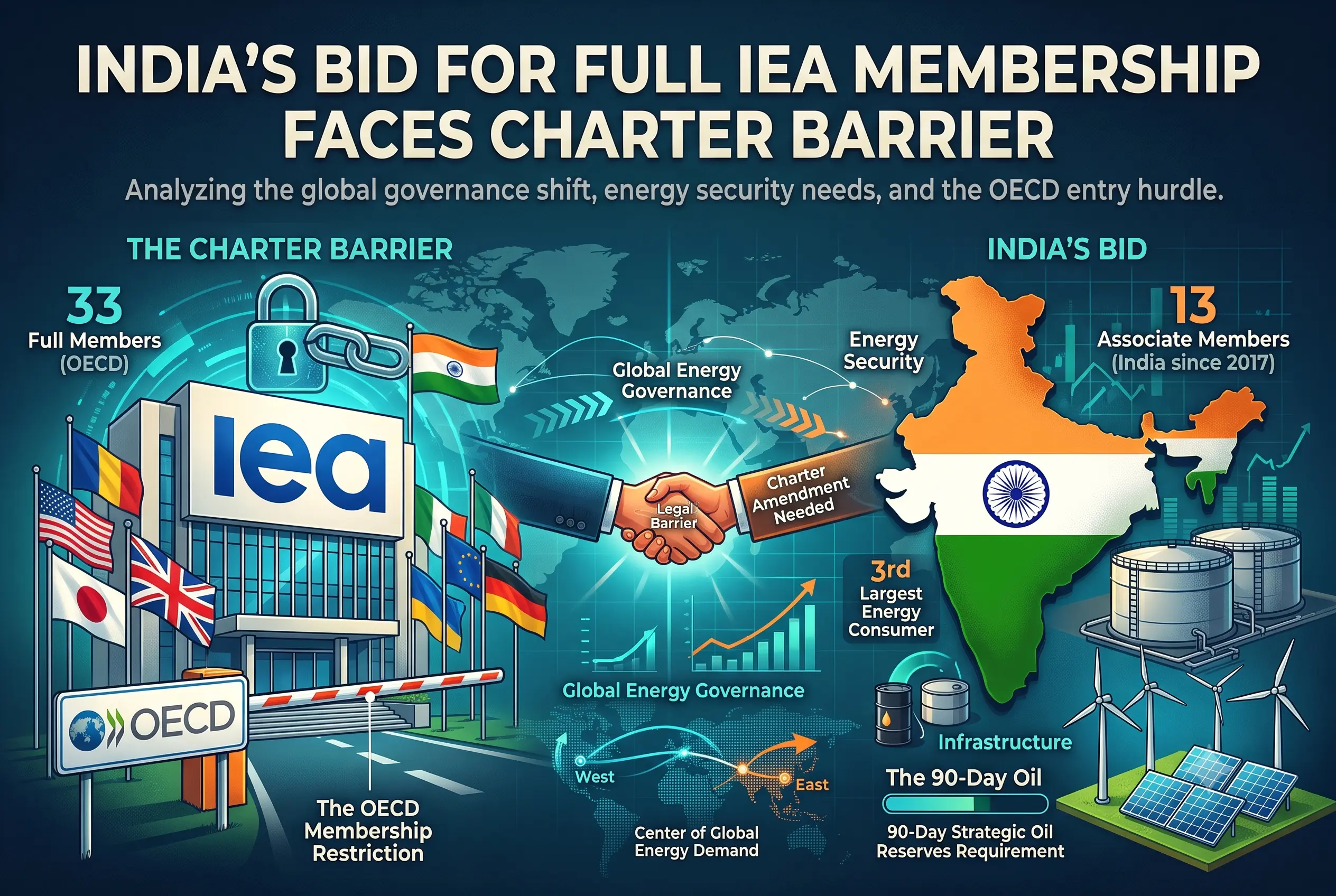
- •Global Energy Decision-Making: As the world’s third-largest energy consumer and fastest-growing market, India is seeking voting rights to actively shape global energy governance rather than just participating as an associate.
- •Energy Security Coordination: With nearly 85% dependence on oil imports, joining the IEA would grant India formal access to coordinated emergency oil release mechanisms and global energy planning.
- •Changing Global Dynamics: The center of energy demand has shifted decisively toward emerging economies. Without nations like India and China, the IEA risks losing its legitimacy, as its framework (including associates) accounts for 80% of global demand.
- •Climate & Transition Leadership: India wants to influence global climate-energy modeling and clean energy roadmaps, ensuring that the transition narratives balance climate ambitions with the developmental priorities of the Global South.
- •The OECD Barrier: The most significant technical roadblock is the IEA charter, which restricts full membership exclusively to OECD countries. India has no immediate intention to join the OECD, necessitating a complex charter amendment.
- •Strategic Reserve Obligations: Full members are mandated to maintain emergency petroleum reserves equivalent to 90 days of net imports, which requires India to significantly expand its strategic storage infrastructure.
IEA Membership Structure
| Category | Current Strength | Rights & Obligations | Bookmark |
|---|---|---|---|
| Full Members | 33 (All OECD countries) | Voting rights, decision-making power, and mandatory 90-day strategic oil reserves. | |
| Associate Members | 13 (Includes India, China, Brazil) | Participation in policy discussions and data sharing; lacks voting and decision-making powers. |
Timeline of India-IEA Engagement
| Milestone | Year | Significance | Bookmark |
|---|---|---|---|
| Associate Membership | 2017 | Allowed India to participate in policy discussions, data sharing, and energy transition programs. | |
| Strategic Partnership | 2021 | Deepened cooperation on energy security and clean energy, laying the groundwork for full membership talks. |
Related Entities
Impact & Significance
- •Voting & Policy Influence: Moving from an associate to a full member grants India voting rights, allowing it to dictate terms on global clean energy transitions rather than merely adopting Western-centric models.
- •Emergency Preparedness: Integration into the IEA's collective oil release system acts as a massive strategic buffer against geopolitical shocks (e.g., the Middle East or Russia-Ukraine crises).
- •Global Credibility: Full membership cements India's status as a decisive economic and energy superpower, anchoring its leadership role in initiatives like the Global Biofuels Alliance and the International Solar Alliance.
- •Access to Capital and Tech: Closer alignment with IEA data models and policy frameworks can improve investor confidence and accelerate technology transfers in green energy sectors.
Challenges & Criticism
- •The OECD Precondition: The legal text of the IEA limits membership exclusively to OECD countries. Since India prioritizes policy flexibility and has not sought OECD entry, a complex charter amendment is mandatory.
- •Unanimous Consensus Required: Amending the charter requires the unanimous agreement of all 33 existing members, some of whom fear diluting the bloc's traditionally Western, industrialized character.
- •Infrastructure Deficit: The requirement to stockpile 90 days of strategic petroleum reserves demands massive capital expenditure. While India is building underground rock caverns (ISPRL), it is yet to meet the full 90-day threshold.
- •Precedent Setting: Existing members are cautious that altering the rules for India might open the floodgates for other non-OECD giants like China, dramatically shifting the internal balance of power.
Future Outlook
- •Institutional Reform: Amending the 1974 founding charter to decouple IEA membership from OECD membership is the most practical solution to modernize the agency.
- •Hybrid Membership Model: Creating a new, specialized category between 'Associate' and 'Full' membership to accommodate major non-OECD energy economies.
- •Domestic Preparedness: India must aggressively expand its strategic petroleum reserves and align its domestic energy data systems with international standards.
- •Gradual Integration: A phased increase in India’s institutional role and decision-making capacity could help build consensus among existing members cautious about shifting power dynamics.
UPSC Relevance
- • GS-1 (Geography): Global distribution of critical energy resources, minerals, and the shifting center of global energy demand.
- • GS-2 (International Relations): Important International institutions, agencies and fora - their structure and mandate (IEA vs OECD).
- • Mains Focus: Analyzing the transition of the IEA from an oil security bloc to a climate and clean energy authority, and India's strategic imperatives.
Sample Questions
Prelims
Consider the following statements regarding the International Energy Agency (IEA):
1. It was established under the OECD framework to coordinate responses to major oil supply disruptions.
2. India is currently a full member of the IEA.
3. Full member countries must maintain emergency oil reserves equivalent to at least 90 days of net imports.
Which of the statements given above is/are correct?
1. 1 and 2 only
2. 2 and 3 only
3. 1 and 3 only
4. 1, 2, and 3
Answer: Option 3
Explanation: Statement 1 is correct; the IEA was formed in 1974 by 17 OECD nations. Statement 2 is incorrect; India is currently an 'Associate Member' (since 2017) and is bidding for full membership. Statement 3 is correct; the 90-day reserve is a core mandate for emergency collective action.
Mains
“India’s bid for full membership in the International Energy Agency (IEA) reflects both the shifting center of gravity in global energy demand and the structural rigidities of Western-led institutions.” Discuss the significance of IEA membership for India and the challenges it faces in attaining it.
Introduction: Introduce the IEA's origins (1973 oil crisis) and mention the recent 2026 Ministerial Meeting acknowledging India's progress. Highlight India's current status as an Associate Member (since 2017).
Body:
• Significance of Membership: Access to emergency oil sharing mechanisms (crucial given 85% import dependence); acquisition of voting rights to shape global energy governance; leverage in global climate modeling; access to advanced data and critical mineral supply chain strategies.
• Structural Challenges: The 'OECD Clause' restricting full membership; requirement for a unanimous charter amendment by existing members; hesitation over institutional power shifts; and the logistical burden of maintaining 90-day strategic oil reserves.
• Way Forward: Proposing a hybrid membership model; phased institutional reform within the IEA; accelerating domestic strategic reserve capacity.
Conclusion: Conclude by stating that incorporating India is not just beneficial for New Delhi's energy security, but an existential necessity for the IEA to remain relevant as a true global energy guardian in the 21st century.