
India's Industrial Transition: From Molecules to Electrons
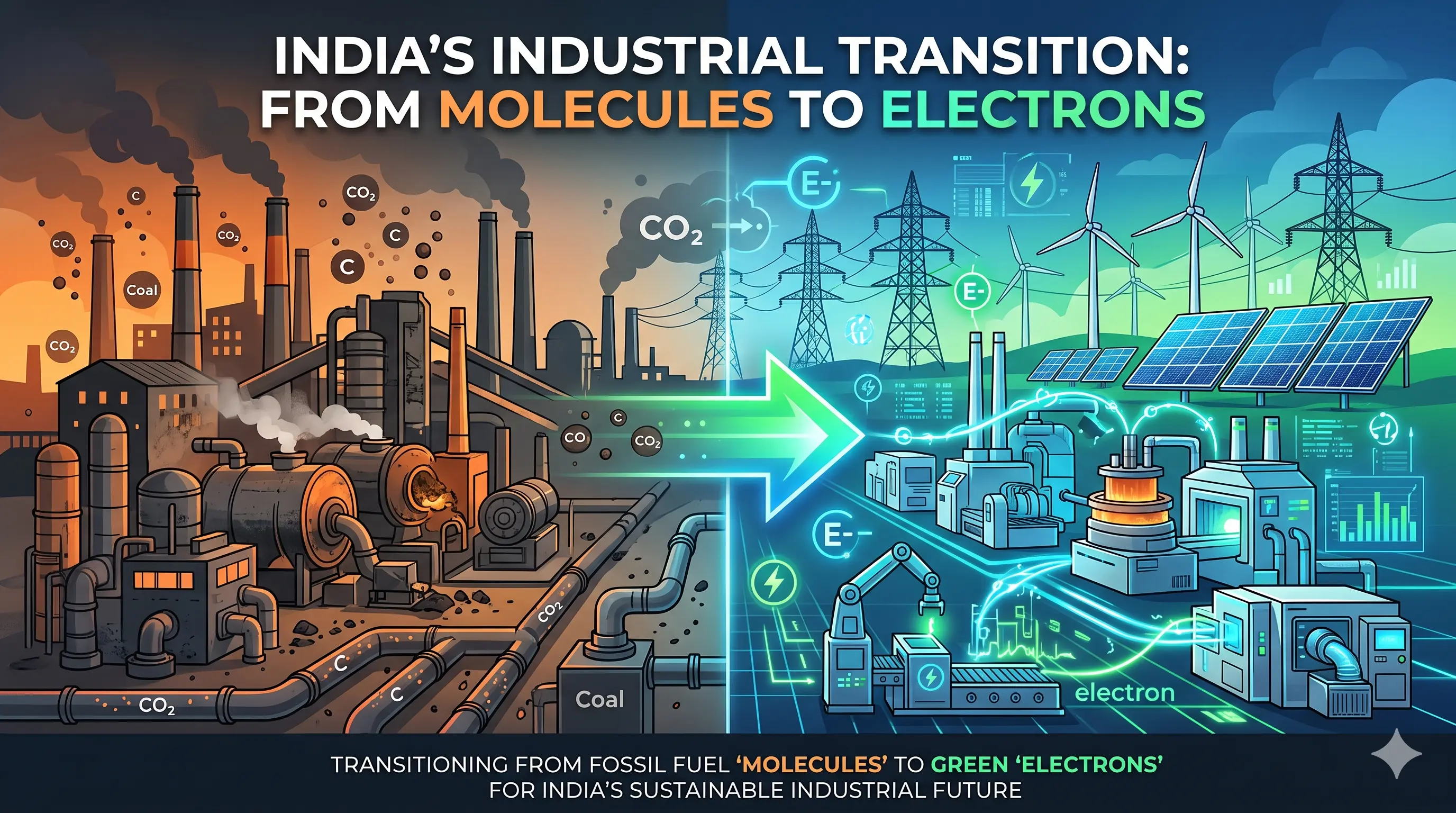
While India's industrial sector remains heavily dependent on fossil fuel 'molecules', global competitors like China have shifted nearly half of their industrial energy use to 'electrons'. This transition towards electrified and digitalised manufacturing is crucial for India's energy security, export competitiveness, and decarbonisation.
Introduction
Context & Background
Key Points
- •Shift in Energy Source: The transition involves replacing the direct combustion of fossil fuels in factories with grid-based electricity for heat, motion, and production processes.
- •Efficiency and Cost: Electric motors operate at over 90% efficiency, compared to sub-35% for combustion engines, which sharply lowers the energy cost per unit of output.
- •China's Grid First Strategy: China has invested massively in ultra-high-voltage transmission, storage, and flexible substations, enabling its industries to reliably transition to electricity.
- •Energy Security: India imports nearly 85% of its crude oil and over 45% of its natural gas. Electrification is vital to insulate the economy from global fuel price shocks.
- •The Decarbonisation Lever: With industry contributing about 25% of India's total greenhouse gas emissions, adopting 'green electrons' is essential to meet climate goals and satisfy emerging global climate standards.
Industrial Electrification: India vs. China
| Parameter | India | China | Bookmark |
|---|---|---|---|
| Industrial Energy from Electricity | ~25% | Nearly 50% | |
| Green Electron Share | ~7–8% of final industrial energy | High renewable integration | |
| Strategic Focus | Generation-centric policy (capacity addition) | Grid-first strategy (ultra-high-voltage transmission) | |
| Steel Production Strategy | Legacy combustion lock-in | Policy-driven Electric-Arc Furnace (EAF) adoption (106M tonnes by 2024) |
Molecules vs. Electrons in Manufacturing
| Feature | Molecules (Fossil Fuels) | Electrons (Electricity) | Bookmark |
|---|---|---|---|
| Energy Sources | Coal boilers, diesel generators, fossil furnaces | Electric motors, induction furnaces, electric boilers | |
| Operational Efficiency | Below 35% efficiency for combustion engines | Over 90% efficiency for electric motors | |
| Automation & Control | Limited precision | Supports advanced manufacturing, smart factories, and digital controls |
Related Entities
Impact & Significance
- •Supply Chain Competitiveness: As global buyers demand low-carbon supply chains, heavily electrified industries will secure better contracts and avoid penalties like carbon border taxes.
- •Macroeconomic Stability: Shifting from imported crude oil and natural gas to domestically produced electricity reduces the import bill and shields the economy from geopolitical fuel shocks.
- •Technological Leapfrogging: Electrification goes hand-in-hand with digitalization, enabling precise monitoring, reduced wastage, and auditable carbon data required by international markets.
Challenges & Criticism
- •Capital Intensive Redesign: Transitioning from legacy coal boilers and fossil furnaces to induction furnaces and electric boilers requires massive upfront capital, which is particularly difficult for MSMEs.
- •Technological Dead Ends: Certain industries, such as cement, require high-temperature calcination processes that produce inherent chemical emissions, making complete electrification technologically elusive currently.
- •Grid Reliability: A major deterrent to all-electric factory design is power quality and reliability; frequent outages force industries to rely on backup diesel generators.
Future Outlook
- •National Electrification Mission: Shifting the policy focus from merely adding renewable generation capacity to mandating industrial electricity usage, such as enforcing electron-first processes in new industrial parks.
- •Grid Investment Surge: Expanding transmission corridors, grid storage, and reliability infrastructure to guarantee continuous and stable power for heavy industries.
- •Steel Transition Support: Scaling up incentives for renewable-linked Electric-Arc Furnaces (EAF) and formalizing scrap markets to meet standards like the EU CBAM.
- •MSME Green Finance: Establishing concessional loan frameworks and pooled renewable Power Purchase Agreements (PPAs) through institutions like SIDBI to help smaller industries upgrade their equipment.
UPSC Relevance
- • GS-3 (Economy & Environment): Directly relevant to industrial policy, manufacturing competitiveness, energy security, and decarbonisation strategies.
- • Mains Focus: Analyzing the structural bottlenecks in India's energy transition (legacy lock-in, generation-centric policy) and framing a policy roadmap for industrial electrification.
- • Essay Topics: The intersection of economic sovereignty and climate change; 'Green Electrons vs. Grey Electrons' as the new currency of global trade.
Sample Questions
Prelims
With reference to the industrial energy transition, consider the following statements: 1. Electric motors operate at significantly lower energy efficiency compared to traditional internal combustion engines. 2. In India, the share of green electrons in final industrial energy consumption currently exceeds 25%. 3. The transition towards Electric-Arc Furnaces (EAF) is a key strategy for the decarbonisation of the steel sector. Which of the statements given above is/are correct?
1 and 2 only
3 only
2 and 3 only
1, 2 and 3
Answer: Option 2
Explanation: Statement 1 is incorrect because electric motors operate at over 90% efficiency, far superior to the <35% efficiency of combustion engines. Statement 2 is incorrect because India's total industrial electrification is around 25%, but the green electron share is only 7-8%. Statement 3 is correct as EAFs replace coal-heavy processes with electricity, enabling decarbonisation.
Mains
The transition from 'molecules' to 'electrons' in the industrial sector is not just a climate imperative but an economic necessity for India. Analyze the challenges in this transition and suggest a comprehensive policy roadmap.
Introduction: Define the paradigm shift from fossil fuel 'molecules' to grid-based 'electrons'. Highlight the stark contrast: China meets nearly 50% of its industrial energy needs via electricity, whereas India remains around 25%.
Body:
• Economic & Strategic Necessity: Discuss energy security (reducing 85% crude oil dependency), efficiency gains (90% electric motor efficiency vs 35% combustion), and export competitiveness (shielding sectors like steel from EU CBAM).
• Key Challenges: Highlight the 'legacy lock-in' of coal boilers/diesel generators, the low share of 'green electrons' (only 7-8%), technological barriers in process emissions (e.g., cement calcination), and policies skewed towards generation rather than end-use electrification.
• Policy Roadmap: Propose a National Electrification Mission, massive grid infrastructure investments (ultra-high-voltage transmission), targeted incentives for EAF steel, and MSME green finance via SIDBI.
Conclusion: Conclude that an 'electron-first' industrial strategy is the cornerstone of building a resilient, globally competitive, and decarbonised 'Viksit Bharat'.