
India & the Multipolar West: Strategic Rebalancing in a Changing Global Order
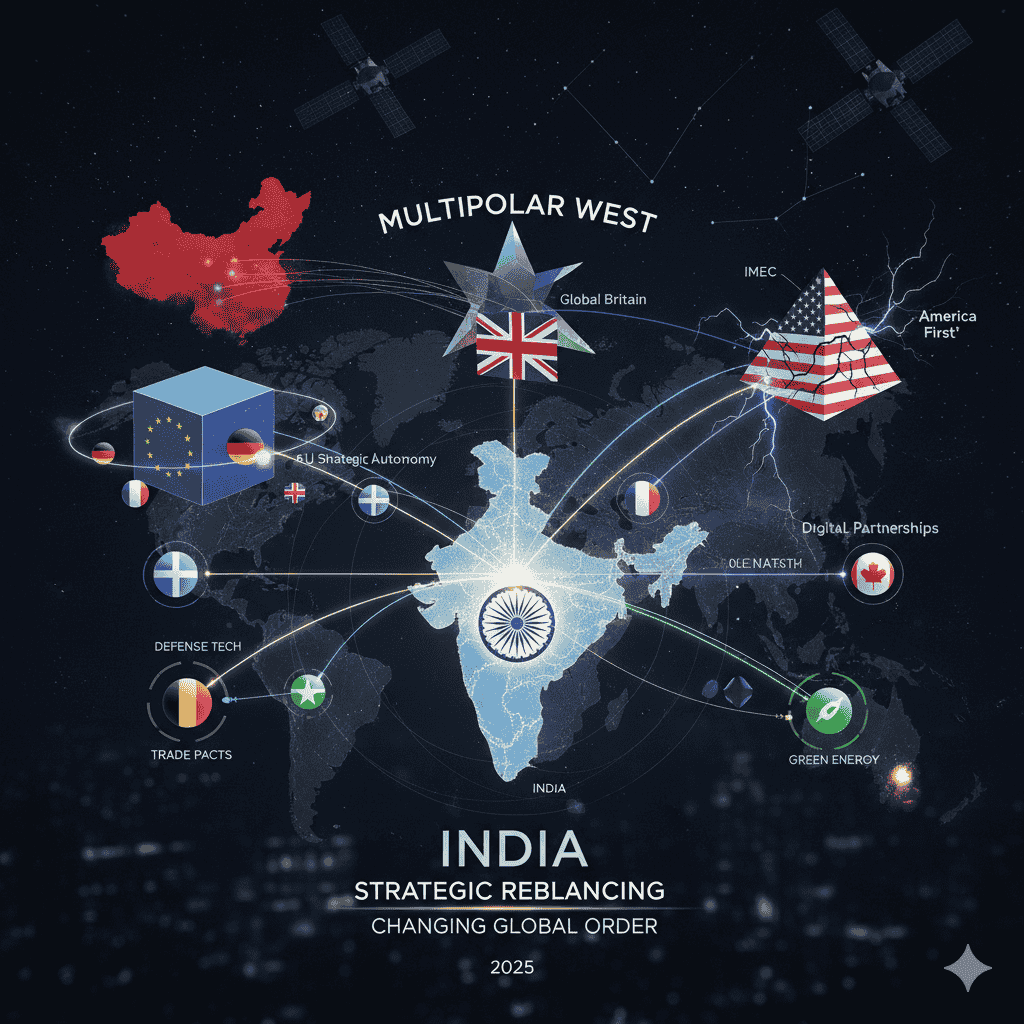
India’s renewed engagement with Europe—driven by trade pacts, technology partnerships, and shifting global geopolitics—comes at a time when the Western world is becoming ‘multipolar’. This means power is no longer concentrated in the United States alone. A more autonomous Europe, a reshaped UK, and a divided Western approach to China and Russia give India multiple strategic opportunities.
Introduction
Context & Background
1. After World War II (1945–1991): Europe was devastated and relied heavily on the United States for military and economic support. NATO became the backbone of Western security. The West functioned as a tightly united group against the USSR. For beginners: Think of the US as the ‘captain’ and Europe as the ‘team members’.
2. After the Cold War (1991–2008): With the collapse of the Soviet Union, the US emerged as the world’s only superpower. Europe focused more on internal stability—expanding the EU and building a common currency (Euro). Europe was prosperous but not militarily independent.
3. The 21st Century disruptions (2008–2025): Large events challenged Western unity: the 2008 crisis, China’s rise, Russia’s resurgence, migration waves, and internal political divisions. The US also became unpredictable—especially with the America First shift under Donald Trump. Europe realised it must build its own capabilities in defence, energy, and technology instead of depending entirely on Washington.
4. Post-Ukraine War era: Europe experienced a ‘Zeitenwende’ (meaning ‘turning point’). It increased defence budgets, moved away from Russian gas, and started building autonomous technological systems. Leaders like Emmanuel Macron pushed for Europe to take “control of its destiny”.
Together, these developments transformed the West from a single US-led pole into a web of multiple Western powers—creating space for India to engage more flexibly and negotiate better terms.
Key Points
- •Meaning of Multipolar West: It does NOT mean the West is weak. Instead, it means the West now has more than one centre of decision-making. For example, the EU may disagree with the US on China policy or climate action.
- •Shift from US-led order: Earlier, the US set most rules for the Western world. Today, Europe insists on equal decision-making in defence, tech regulation, energy and global trade.
- •US Domestic Politics: Changes inside the US—polarisation, protectionism, and reduced commitment to multilateral institutions—create uncertainty. Europe is therefore preparing for a future where the US may not always lead.
- •Europe’s Strategic Awakening: Europe wants autonomy in defence (through defence industries), technology (AI, data rules), and energy (renewables, reducing Russian dependency).
- •Differences on China: The US treats China primarily as a strategic threat, while Europe sees China as a competitor AND a necessary economic partner—showing internal Western divergence.
- •Role of the Global South: The rise of India, Brazil, ASEAN, and Africa means Western powers now actively seek partnerships with multiple countries, further reducing Western centralisation.
Evolution of Western Unity: A Beginner-Friendly Timeline
| Period | Western Structure | Key Characteristics | Bookmark |
|---|---|---|---|
| 1945–1991 | Single cohesive Western bloc | US-led NATO, united against USSR | |
| 1991–2008 | Unipolar West | US dominance; Europe economically focused | |
| 2008–2020 | Fissures emerge | Financial crisis, China’s rise, US unilateralism | |
| 2020–2025 | Multipolar West | Europe, UK, US, Canada act independently on global issues |
Why the West Became Multipolar: Key Drivers
| Factor | Explanation | Impact on Western Unity | Bookmark |
|---|---|---|---|
| Rise of China | China’s economic dominance & tech leadership challenge traditional Western power | US and EU disagree on how to handle China | |
| US Politics | ‘America First’ foreign policy reduces US global commitments | Europe searches for independence | |
| Ukraine Conflict | Energy crisis & sanctions reshape Europe’s strategic position | Europe strengthens military & energy autonomy | |
| Climate/Tech Policies | Green subsidies, AI regulations differ between US & EU | Fragmented Western technology landscape |
Related Entities
Impact & Significance
- •More Options for India: Instead of one Western power centre, India can now partner with many Western actors—France for defence, UK for education and fintech, EU for trade, Nordics for green technology.
- •Strategic Autonomy Alignment: India and Europe both prefer making independent choices rather than aligning with one superpower. This increases India’s diplomatic comfort.
- •Better Trade Terms: Europe diversifying away from China increases India’s importance as a stable and democratic market.
- •Technology Advantages: India gains opportunities in AI, cybersecurity, semiconductors, quantum tech, green hydrogen through joint collaborations.
- •Balancing Russia: A multipolar West allows India to maintain defence relations with Russia without facing intense Western pressure.
- •Global South Leadership: Europe’s outreach to India to engage the Global South strengthens India’s leadership position in multilateral diplomacy.
Challenges & Criticism
- •Fragmented Europe: EU decision-making is slow and often divided, affecting FTAs, defence deals, and investment flows.
- •US-EU Differences: India must balance two Western systems with different regulatory models (e.g., data protection standards).
- •Dependency Risks: Overreliance on Europe for critical minerals or advanced green technologies could create new vulnerabilities.
- •Persistent Transatlantic Tensions: If US–Europe relations worsen, India must avoid appearing to favour one side.
- •Unpredictable US Politics: Frequent policy reversals in the US create uncertainty in long-term strategic planning for India.
Future Outlook
- •Create a Comprehensive India–Europe Strategic Council to coordinate cooperation across trade, defence, tech, and climate.
- •Scale up India–Europe defence manufacturing under Make in India with co-development of submarines, jet engines, UAVs.
- •Enhance maritime cooperation with EU navies to secure Indo-Pacific sea lanes.
- •Invest jointly in AI, green hydrogen, battery tech, critical minerals, and quantum computing.
- •Maintain multi-alignment by balancing relations with the US, Russia, UK, and the EU.
- •Leverage India’s leadership in G20 and the Voice of Global South to work with Europe on reforming IMF, WTO, and UNSC.
- •Improve domestic regulatory systems to attract European investment in high-tech sectors.
UPSC Relevance
- • GS-2: Global power transitions, India–Europe relations, multipolarity, international institutions.
- • GS-3: Technology partnerships, climate finance, supply chain resilience.
- • Essay: Multipolar world, India’s foreign policy evolution, rise of the Global South.
Sample Questions
Prelims
With reference to the rise of a ‘Multipolar West’, consider the following statements:
1. It refers to the decline of the United States as a major world power.
2. Europe’s strategic autonomy efforts have contributed to the West becoming multipolar.
3. India’s engagement with Europe has increased due to the diversification of Western power centres.
4. The Multipolar West reduces India’s strategic options in foreign policy.
Answer: Option 2, Option 3
Explanation: Statement 1 is incorrect because multipolar West does not mean U.S. decline. Statement 4 is incorrect since multipolarity increases India's options. Statements 2 and 3 are correct.
Mains
Discuss how the emergence of a ‘Multipolar West’ has reshaped India’s diplomatic, economic, and technological engagements with Europe and other Western actors.
Introduction: The Western world is undergoing a historic transformation from US-led unipolarity to a multipolar structure where Europe, the UK, and other Western countries act as autonomous power centres. This emerging configuration creates fresh opportunities for India’s strategic autonomy.
Body:
• Changing Nature of the West: Divergences over China, Russia, climate, and trade have eroded transatlantic unity. Europe’s push for strategic autonomy further decentralises Western power.
• India’s Expanded Engagement: India now interacts separately with multiple Western actors—EU (FTA), UK (tech & education), France (defence), Nordics (green tech).
• Benefits for India: Increased bargaining power, supply chain diversification, opportunities in AI & climate tech, and greater strategic flexibility.
• Challenges: Fragmented European decision-making, regulatory differences, and unpredictable US politics complicate India’s long-term strategy.
Conclusion: India’s multi-alignment gains new momentum in a multipolar West. By engaging each Western pole independently, India strengthens its global leadership while preserving strategic autonomy.