
India’s Russia Challenge: Balancing Energy Security and Strategic Ties
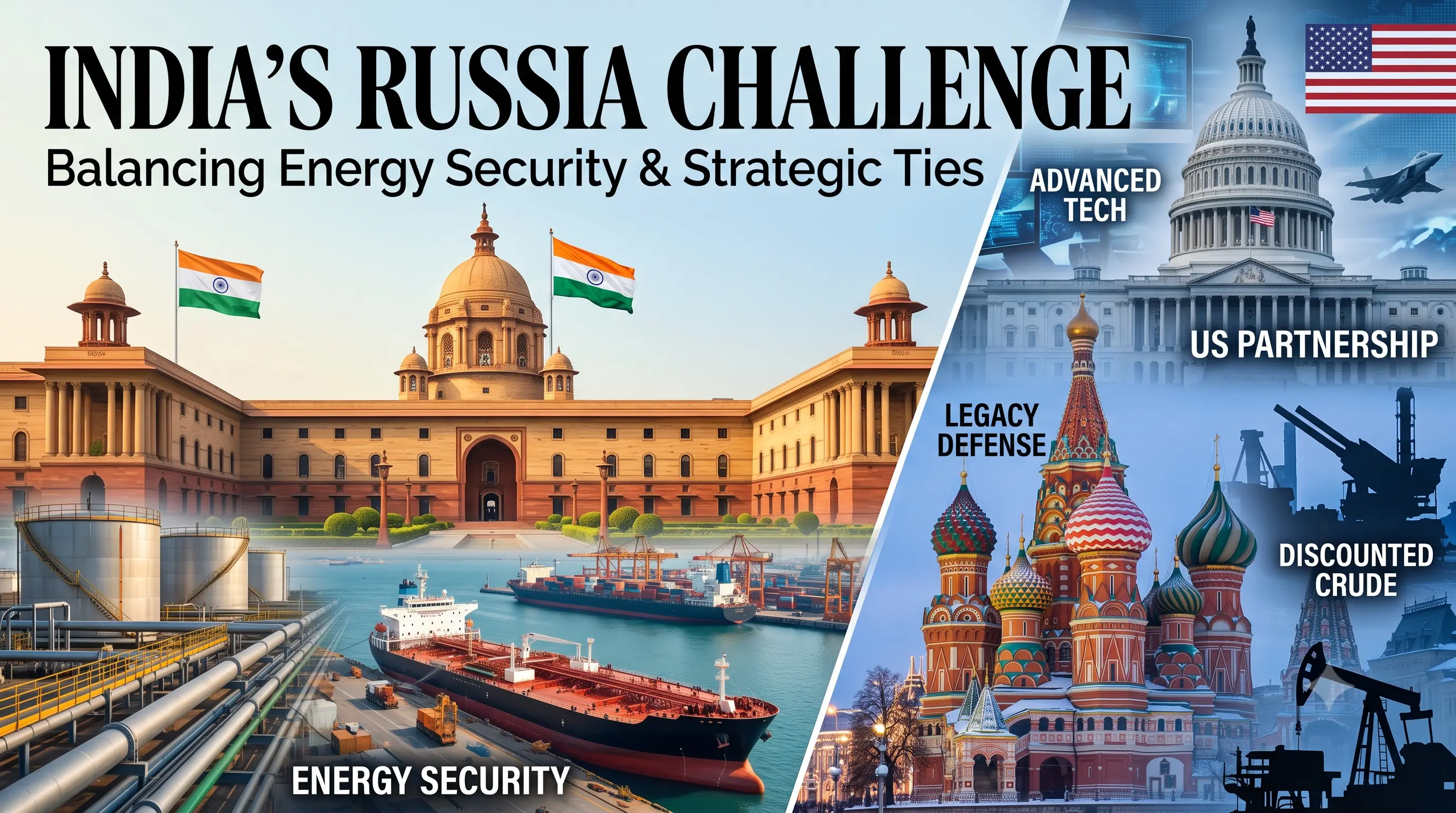
Following claims that India would stop buying Russian oil, New Delhi has reiterated that its energy imports remain strictly guided by national interest and affordability. This article analyzes India's strategic balancing act: managing its critical dependence on discounted Russian crude and legacy defence ties, while deepening its indispensable partnership with the United States to counter China and secure advanced technologies.
Introduction
Context & Background
Key Points
- •The Rise and Dip of Russian Imports: Before 2022, Russia supplied less than 2% of India's crude. Post-sanctions, it surged to 35–40%, making India the largest importer of Russian crude in mid-2024. However, volumes dipped from a peak of ~2.09 million bpd in mid-2025 to ~1.16 million bpd by Jan 2026 due to tighter U.S. sanctions.
- •Economic Rationale: Importing Russian crude at deep discounts has helped India contain inflationary pressures, protect consumers from fuel price shocks, and facilitate post-pandemic economic recovery. Non-dollar payment mechanisms also reduced currency volatility risks.
- •Strategic Autonomy: India maintains that energy decisions cannot be outsourced to geopolitical pressures. It recognizes only UN-backed sanctions and prioritizes the energy security of a nation that imports nearly 85% of its crude oil requirements.
- •Refinery Constraints: Halting Russian imports abruptly is unfeasible. Entities like Nayara Energy rely almost entirely on Russian crude due to restricted alternatives. Furthermore, Indian refineries are optimized for medium-sour crudes (Russia/Middle East) rather than lighter U.S. variants.
- •The Venezuela Question: While Venezuelan oil is technically suitable (heavy and sour), production is severely constrained at ~1 million bpd due to years of sanctions and damaged infrastructure, making it a long-term prospect rather than an immediate replacement.
Strategic Importance: Russia vs. United States
| Area of Cooperation | Why Russia Remains Important | Why the U.S. is Equally Crucial | Bookmark |
|---|---|---|---|
| Defence & Technology | Supplies 60–70% of legacy military hardware; provides critical tech with fewer restrictions. | Key source of advanced defence platforms, semiconductors, AI, and space/cyber collaboration. | |
| Geopolitics & World Order | Supports a multipolar world; opposes Western dominance; provides Eurasian/Arctic access. | Crucial partner in managing China's rise and assertiveness; anchors maritime security via QUAD. | |
| Economic & Trade | Major supplier of deeply discounted crude oil, coal, LNG, and fertilisers. | Largest trading partner and investor; significant bilateral goodwill driven by the Indian diaspora. |
Viability of Alternative Oil Sources
| Source | Technical Compatibility / Advantages | Limitations & Constraints | Bookmark |
|---|---|---|---|
| Russian Crude | Deep discounts; non-dollar payment mechanisms; matches complex refinery requirements. | Vulnerable to tightening U.S. sanctions; creates friction with Western strategic partners. | |
| Venezuelan Crude | Heavy and sour crude, making it technically ideal for Indian refineries. | Output limited to ~1 million bpd; damaged infrastructure; competes with U.S. demand. | |
| U.S. Crude | Enhances supply diversification; politically favorable with Washington. | Lighter and sweeter (less ideal for Indian refineries); freight costs more than double compared to Russia. |
Related Entities
Impact & Significance
- •Inflation Control: The influx of affordable Russian crude acted as a vital shock absorber, shielding the Indian economy from massive global price surges and protecting the domestic consumer.
- •Foreign Policy Precedent: By successfully continuing trade despite Western discontent, India firmly established its 'Strategic Autonomy' doctrine, asserting that domestic economic survival supersedes extraterritorial geopolitical mandates.
- •Shifts in Payment Infrastructure: The necessity to bypass dollar-dominated systems has accelerated India's experimentation with non-dollar payment mechanisms and Rupee-denominated trade accounts.
- •Defence Modernisation Constraints: War-related constraints in Russia have caused delays in defence deliveries, forcing India to urgently accelerate indigenous defence manufacturing and diversify procurement.
Challenges & Criticism
- •Sanctions and Supply Chain Friction: Tighter U.S. sanctions on Russian entities (e.g., Rosneft, Lukoil) complicate shipping logistics and payment settlements, recently causing a drop in import volumes.
- •The China Factor: Moscow's increasing economic and strategic dependence on Beijing causes severe anxiety in New Delhi, potentially diluting India's historic leverage over Russia.
- •Geopolitical Misinterpretation: India’s neutral and transactional approach is frequently criticized by Western media as tacit support for Russian actions, while Moscow simultaneously views India's deepening ties with Washington with suspicion.
- •Lack of Immediate Substitutes: While alternatives like Venezuela offer technically compatible crude, severe production caps (~1 million bpd) and ruined infrastructure mean they cannot immediately step in to replace massive Russian volumes.
Future Outlook
- •Diversify Energy Sources: Gradually reduce over-reliance on any single supplier by expanding sourcing networks across the Middle East, Africa, the U.S., and Latin America.
- •Accelerate Energy Transition: Ramp up investments in renewables, green hydrogen, and nuclear energy to structurally lower the economy's vulnerability to fossil fuel shocks.
- •Rebalance Defence Partnerships: Continue maintaining Russian ties for legacy military systems, while accelerating domestic indigenisation and expanding Western defence collaborations.
- •Strengthen Multipolar Platforms: Leverage groupings like the G20, BRICS, SCO, and the Quad to forcefully institutionalize India’s independent, multi-aligned role in global governance.
UPSC Relevance
- • GS-2 (International Relations): Bilateral, regional and global groupings; Effect of policies and politics of developed and developing countries on India’s interests (Strategic Autonomy).
- • GS-3 (Economy & Energy): Infrastructure (Energy), Energy Security, and the impact of global supply chain disruptions on domestic inflation.
- • Essay Topics: 'Navigating a Multipolar World: India's Strategic Autonomy', 'Energy Security as the bedrock of Foreign Policy'.
Sample Questions
Prelims
Consider the following statements regarding India's energy imports and refinery capabilities: 1. Before 2022, Russia accounted for more than 20% of India's total crude oil imports. 2. Indian refineries are primarily optimized for lighter, sweeter crudes sourced exclusively from the United States. 3. Venezuelan crude is technically compatible with Indian refineries as it is heavy and sour.
1. 1 and 2 only
2. 3 only
3. 2 and 3 only
4. 1, 2 and 3
Answer: Option 2
Explanation: Statement 1 is incorrect: Before 2022, Russia accounted for less than 2% of India's crude imports. Statement 2 is incorrect: Indian refineries are optimized for medium-sour crudes (from Russia/West Asia), whereas U.S. crude is lighter and sweeter. Statement 3 is correct: Venezuelan crude is heavy and sour, making it technically suitable for complex Indian refineries.
Mains
“India’s continued import of Russian oil underscores the prioritization of domestic economic stability over external geopolitical pressure.” Critically analyze the challenges India faces in balancing its strategic partnerships with Russia and the United States.
Introduction: Define the context: India imports 85% of its crude requirements. The surge in Russian oil imports post-2022 reflects New Delhi's commitment to 'Strategic Autonomy' amidst Western pressure.
Body:
• Economic and Energy Imperatives: Discounted Russian oil protects against inflation and fuel price shocks. Sudden halts are unfeasible due to contractual lock-ins and refinery specificities (e.g., Nayara Energy).
• The Balancing Act (Challenges): 1. Navigating US/EU pressure and potential CAATSA-related sanctions. 2. Addressing Russia's growing dependence on China, which threatens India's leverage. 3. Managing the optics of neutrality in Western media.
• Why both partners are vital: Russia provides 60-70% of legacy defence hardware and multipolar support. The U.S. provides advanced tech, space/AI collaboration, and acts as a strategic counterweight to China via the QUAD.
Conclusion: Conclude that India must mitigate external sector risks by accelerating its green energy transition and diversifying its supply chains, while utilizing platforms like the G20 and BRICS to institutionalize its multi-aligned foreign policy.